
that's disappointing. i always thought the share was percentage of total audience. how would you compute the rating for an eastlan market of 1,458,700? the station has a share of 0.5 up from 0.4 and 0.3.No, share is a percentage of radio listeners. People with the radio on. That 14.9 share is a rating of about 0.6 or around 15,700 people.
With a population of 2.62 million and a PUMM of 5, there are just 131,000 people on average listening to ALL radio stations throughout the day. WKQC got roughly 15% of that.

-
Get involved.
We want your input!
Apply for Membership and join the conversations about everything related to broadcasting.
After we receive your registration, a moderator will review it. After your registration is approved, you will be permitted to post.
If you use a disposable or false email address, your registration will be rejected.
After your membership is approved, please take a minute to tell us a little bit about yourself.
https://www.radiodiscussions.com/forums/introduce-yourself.1088/
Thanks in advance and have fun!
RadioDiscussions Administrators
You are using an out of date browser. It may not display this or other websites correctly.
You should upgrade or use an alternative browser.
You should upgrade or use an alternative browser.
January 2026 Bay Area Radio PPM Ratings
- Thread starter HenryOchs
- Start date

"Share" is an industry term, going back to the 1930's. It always means "percentage of radio listeners".that's disappointing. i always thought the share was percentage of total audience. how would you compute the rating for an eastlan market of 1,458,700? the station has a share of 0.5 up from 0.4 and 0.3.
To further confuse things, in TV we have "shares" that are "households" and "shares" that are "persons". That comes from the time when most TV viewing was done as a family or residence group, not on individual screens and devices.
thank you for explaining it. makes total sense. can you tell me how you would compute the rating for an eastlan market of 1,458,700? the station has a share of 0.5 up from 0.4 and 0.3."Share" is an industry term, going back to the 1930's. It always means "percentage of radio listeners".
To further confuse things, in TV we have "shares" that are "households" and "shares" that are "persons". That comes from the time when most TV viewing was done as a family or residence group, not on individual screens and devices.
We don’t need the book to know what KZAC’s number is.🤪Oh, no. We won’t get to see how low KSFO’s ratings have bottomed out. 🙃
Almost all markets today have Persons Using Mass Media of around 5% to 6% on a 6A to 12MN average. So if the share is a 0.5, the rating is about 0.025.thank you for explaining it. makes total sense. can you tell me how you would compute the rating for an eastlan market of 1,458,700? the station has a share of 0.5 up from 0.4 and 0.3.
You can multiply the population by that and get the audience.
wow, i had three TIMES the audience (IP connections, not estimates) on my internet station.Almost all markets today have Persons Using Mass Media of around 5% to 6% on a 6A to 12MN average. So if the share is a 0.5, the rating is about 0.025.
You can multiply the population by that and get the audience.

You are comparing apples to bananas here. Nielsen and Eastlan measurements are taken from a representative sample within a standardize geographic area extrapolated to give not only only overall listening estimates, but also demographic data. And AQH persons is a metric indicating number of people listening at any given moment. Cume persons is the number of different people sampling a radio station over time, and would be more analogous, but not identical, to the number of connections made to a stream.wow, i had three TIMES the audience (IP connections, not estimates) on my internet station.
makes sense. thank you.Cume persons is the number of different people sampling a radio station over time, and would be more analogous, but not identical, to the number of connections made to a stream.
Nerd question for @Huff or @davideduardo:
No matter how many (or how few) PUMM exist in a market, adding the AQH Share for all listening in the market will add to 100 no matter how much listening took place. Looking at the Radioinsight public numbers, adding those for a particular month adds up to the high 80s/low 90s for most markets. Am I correct that the remaining shares that would get the number to 100 belong to unsubscribers/out of market?
Additionally, I know the unsubscribers/out of market would need to meet the Minimum Reporting Standard of a 0.1 rating (not share) to even show up for a subscriber. But for the rest, can they even be seen in one of the Tapscan or other custom reports? The times I was able to see data when I was still in radio I remember there were reports that could be run where we could see all the other stations that a panelist that listened to us had listened to, as well as reports that show where someone goes when they tune out of our station / where they came from. Is that just "invisible" data or do those stations still show up even though they didn't meet MRS to be included in any rating/share breakdown.
No matter how many (or how few) PUMM exist in a market, adding the AQH Share for all listening in the market will add to 100 no matter how much listening took place. Looking at the Radioinsight public numbers, adding those for a particular month adds up to the high 80s/low 90s for most markets. Am I correct that the remaining shares that would get the number to 100 belong to unsubscribers/out of market?
Additionally, I know the unsubscribers/out of market would need to meet the Minimum Reporting Standard of a 0.1 rating (not share) to even show up for a subscriber. But for the rest, can they even be seen in one of the Tapscan or other custom reports? The times I was able to see data when I was still in radio I remember there were reports that could be run where we could see all the other stations that a panelist that listened to us had listened to, as well as reports that show where someone goes when they tune out of our station / where they came from. Is that just "invisible" data or do those stations still show up even though they didn't meet MRS to be included in any rating/share breakdown.
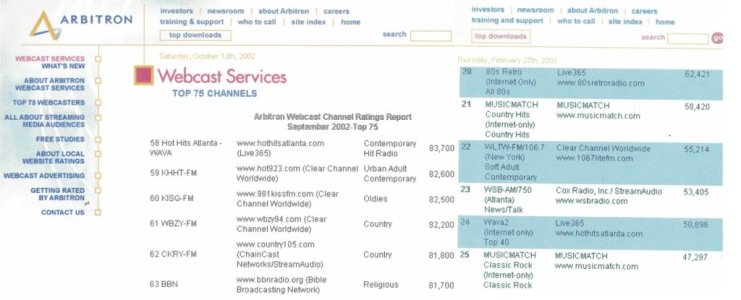
this picture compares apples to apples -- streaming audience only. i was fortunate to place as high as i did. i do realize it's streaming numbers only but i beat a bunch of great stations. (my stream "hot hits atlanta")You are comparing apples to bananas here. Nielsen and Eastlan measurements are taken from a representative sample within a standardize geographic area extrapolated to give not only only overall listening estimates, but also demographic data. And AQH persons is a metric indicating number of people listening at any given moment. Cume persons is the number of different people sampling a radio station over time, and would be more analogous, but not identical, to the number of connections made to a stream.
Attachments

They could now be @El Zilcho 😁Oh, no. We won’t get to see how low KSFO’s ratings have bottomed out. 🙃
Good Old KQED-FM, they did well in the ratings
When I was there, in TV, I'd walk over to FM, the people that worked in radio there always had a strong desire to do good.
At my time . . . the FM had two Harris FM-20K's in parallel, up on San Bruno Mt., with a great 110,000 watt signal out of the antenna.
They also had a translator in Martinez, CA (NW of SF) and a station in Sacramento (North Highlands, CA, KQEI 89.3) that aired KQED programming. It looks like they added more translators since.
Congrats to all at 88.5
When I was there, in TV, I'd walk over to FM, the people that worked in radio there always had a strong desire to do good.
At my time . . . the FM had two Harris FM-20K's in parallel, up on San Bruno Mt., with a great 110,000 watt signal out of the antenna.
They also had a translator in Martinez, CA (NW of SF) and a station in Sacramento (North Highlands, CA, KQEI 89.3) that aired KQED programming. It looks like they added more translators since.
Congrats to all at 88.5
Last edited: