• Get involved.
    We want your input!
    Apply for Membership and join the conversations about everything related to broadcasting.

    After we receive your registration, a moderator will review it. After your registration is approved, you will be permitted to post.
    If you use a disposable or false email address, your registration will be rejected.

    After your membership is approved, please take a minute to tell us a little bit about yourself.
    https://www.radiodiscussions.com/forums/introduce-yourself.1088/

    Thanks in advance and have fun!
    RadioDiscussions Administrators

Kevin & Sluggo Cut At KLOS

I have not followed the company closely over the years, but they have a long history of losses and/or market under performance and were de-listed from NASDAQ in 2020. I am unaware of any significant positive developments since that time. They are a shell of a company they once were.
Format decisions have nothing to do with stock performance; essentially every radio based company has lost stock value since the 2008 recession.

Emmis was never afraid to do format variations and take chances; they were also very research driven and based all their moves on audience feedback. My reminder to you (and one that I seem to have to mention often) is that the best marketing company ever, Proctor & Gamble, spends huge amounts on new product research yet half of their products don't make it into their third year. Being a leader does require taking more chances, but when you win you win large.
While there may have been good parts to the company (you radio insiders would know much more than I in this area), overall, they simply were not well run and belong in the same category as Cumulus. Sorry.
Absolutely wrong. Jeff Smulyan decided at some point after the recession that he wanted to wrap things up and move Emmis out of radio. He is now working on a plan to privatize the company and pay off the remaining shareholders.
 
The morning show last week said that Kevin was basically doing the show for free because he liked to do it. Considering that, how bad is it you have to fire someone who's basically working for free - with such a huge name in the market? I guess the answer is that big salary of 70K - ya' know, that you can make working at Five Guys.

Radio is even more over than I have preached - and that's saying a lot.
 
The morning show last week said that Kevin was basically doing the show for free because he liked to do it. Considering that, how bad is it you have to fire someone who's basically working for free - with such a huge name in the market? I guess the answer is that big salary of 70K - ya' know, that you can make working at Five Guys.

You're over focusing on the money aspect, which apparently is union scale.

Your assumption is they were fired because of money. Perhaps the new PD felt they were underperforming their daypart. It's not unusual for a new PD to clean house and bring in some of his own people.
 
There is a provision called "safe harbor" wherein such language is allowed to be broadcast during hours where it can be safely assumed that no significant underage listening is taking place.
I wasn't aware this existed in 1995. And according to your link, "kiss my a--" and "wiping his a--" are acceptable language whereas "smooth as owl s---" is deadly obscene. I'm so thankful the feds are spending copious cash that could be feeding homeless people or keeping emergency rooms open retaining attorneys to draw such clearly rational legal lines in the naughty sands of human expression.

Wouldn't it be nice if we could finally ditch these absurd restrictions for broadcast media, considering (a) they only cleanse mediums (terrestrial radio/TV) that now represent an extreme minority of all media consumption by the public, and, (b) all they ever truly amounted to were delusions for parents who wanted to pretend their kids would be protected from everything they pretend they themselves didn't constantly hear/think/see as kids.

Emmis was never afraid to do format variations and take chances; they were also very research driven and based all their moves on audience feedback.
Was this responsible for their mould-breaking in creating the crossover format KPWR switched to in '86 -- the one nobody knew how to categorize at the time, but that shot to the top of the ratings anyway?

During that crossover period (1986-1991), I also recall a regular on-air segment/feature called "Make It or Break It," in which audience members were invited to listen to a new and up-and-coming single and then phone in votes for whether KPWR should add it to their playlist.
 
I wasn't aware this existed in 1995. And according to your link, "kiss my a--" and "wiping his a--" are acceptable language whereas "smooth as owl s---" is deadly obscene. I'm so thankful the feds are spending copious cash that could be feeding homeless people or keeping emergency rooms open retaining attorneys to draw such clearly rational legal lines in the naughty sands of human expression.
There is no list of prohibited words. It is up to the licensee of each station to set a policy they think complies with the "spirit" of the regulations on indecency and profanity.
Wouldn't it be nice if we could finally ditch these absurd restrictions for broadcast media, considering (a) they only cleanse mediums (terrestrial radio/TV) that now represent an extreme minority of all media consumption by the public, and, (b) all they ever truly amounted to were delusions for parents who wanted to pretend their kids would be kept clear of all the things they pretend they didn't themselves constantly hear/think/see as kids.
With over 85% or adults using radio weekly, and the amount of hours being in the same range as streams and curated web music, that is hardly an "extreme minority".
Was this responsible for their mould-breaking in creating the crossover format KPWR switched to in '86 -- the one nobody knew how to categorize at the time, but that shot to the top of the ratings anyway?
It was easily categorized as it was rhythmic and urban music primarily targeting second and later generation Hispanics. LA's 18-49 and 25-54 Hispanic population is about 8 times that of African Americans and about double that of non-Hispanic whites.
During that crossover period (1986-1991), I also recall a regular on-air segment/feature called "Make It or Break It," in which audience members were invited to listen to a new and up-and-coming single and then phone in votes for whether KPWR should add it to their playlist.
That device is as old as music radio. It goes back to the 1950's at least.
 
Wouldn't it be nice if we could finally ditch these absurd restrictions for broadcast media, considering (a) they only cleanse mediums (terrestrial radio/TV) that now represent an extreme minority of all media consumption by the public
With over 85% or adults using radio weekly, and the amount of hours being in the same range as streams and curated web music, that is hardly an "extreme minority".
I should have said: "that now represent an extreme minority of all media choices available to the public."

In other words, it is unfair that a small minority -- terrestrial broadcasters (versus the endless streaming and cable and satellite networks and stations) -- has to be burdened with delays, radio edits, and other censorship efforts when everyone else is free to operate without those additional complexities (not to mention without constant threats of fines for failing to guard against obscenities perfectly). The only way I can see this arrangement as being desirable to terrestrial broadcasters in the modern age is if -- in search of something, anything to give them a theoretical advantage in the marketplace -- terrestrial radio and TV want to position themselves as family friendly.
It was easily categorized as it was rhythmic and urban music primarily targeting second and later generation Hispanics. LA's 18-49 and 25-54 Hispanic population is about 8 times that of African Americans and about double that of non-Hispanic whites.
Do you know what all of KPWR's demographic targets were during its 1986-1991 period? Or was it exclusively targeted to second generation Hispanics? Was it aimed more at males than females or vice versa? In those days, KPWR and KIIS were similar in many ways, and for that general sphere of music, myself and most of my friends preferred KPWR and seemed to be repelled by KIIS, while my little sister and all of her friends were in a solid, unbreakable orbit around KIIS.
 
Do you know what all of KPWR's demographic targets were during its 1986-1991 period? Or was it exclusively targeted to second generation Hispanics? Was it aimed more at males than females or vice versa?
Rhythmic CHRs were targeted at the largest groups that would enjoy that music. In LA, that would be mostly the majority of 18-49's who are and were Hispanic... over half the market. That would be followed by non-Hispanic whites who were part of that cultural group, and then the smaller core of Blacks, even though they are a high user group. And rhythmic appeals more to men than women. So do that math and you have the target.
In those days, KPWR and KIIS were similar in many ways, and for that general sphere of music, myself and most of my friends preferred KPWR and seemed to be repelled by KIIS, while my little sister and all of her friends were in a solid, unbreakable orbit around KIIS.
I can't give specifics as I worked for the owner and consider some information proprietary. But if you follow who you knew who listened to Power you have a slice of what research showed as well. Personal experience is anecdotal, and often leaves out huge groups that are not part of one's social and work-related circles. With research, Emmis determined how to create a group of listeners with common interests that was big enough to occupy one of the biggest audience groups in LA.
 
I'm going to give a real world example of how "safe harbor" works.

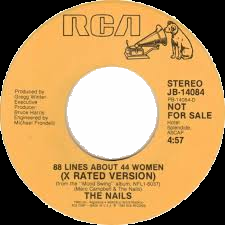
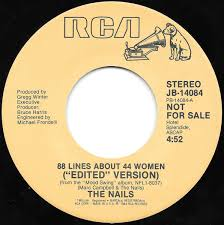
There was a minor Alternative hit in 1984 by The Nails titled "88 Lines About 44 Women". When RCA released it as a promo 45, it had one side with the song as it appeared on the album, labeled "x-rated version" and an edited version which replaced four specific words with the backing track on its own. (A Google search on "88 lines about 44 women lyrics" will allow you to fairly accurately guess where those edits were.)

1727201310034.png1727201049065.png

I happen to have a copy of the promo 45 (even though these are not my scans) and can confirm where the edits are.

The song still gets some plays on some Alternative stations, and it is not uncommon for them to play the edited version in the daytime but switch to the x-rated one in late nights and overnights.

For my part, The Eighties Channel™ includes this song in our weekly "Flashback Weekend" programs, and I actually managed to duplicate the edited version myself by "splicing in" the backing track using Audition.
 
You're over focusing on the money aspect, which apparently is union scale.

Your assumption is they were fired because of money. Perhaps the new PD felt they were underperforming their daypart. It's not unusual for a new PD to clean house and bring in some of his own people.

The company said they were downsizing for monetary reasons.

Maybe just read the basics of a story, and then . . . we'd be further in the conversation.

I don't think talking about the shi**y pay is over focusing on the money aspect. In 1972, the afternoon person on KLOS made - guess it - $70K. lololol

RADIO! lololol

241a98ae-3ce0-46dd-badb-1f6ca03a9280_1024x1024.png
 
Year 2024$522,438.44

Twas a grand time back then.

I was gonna say---but I got weary of BigA telling me all the ways a major market afternoon jock could cobble together a living---that I would bet this was the first time KLOS' afternoon drive paid under $100,000 a year in the last 40 years.
 
I was gonna say---but I got weary of BigA telling me all the ways a major market afternoon jock could cobble together a living---that I would bet this was the first time KLOS' afternoon drive paid under $100,000 a year in the last 40 years.

Nobody's forcing anybody to work there. If the money's too low, work someplace else. Problem solved. It worked for me.

Apparently this is a union shop, and the salary range is set by the union. The rest is negotiable.
 
Unless you were in L.A. and listened to KROQ, in which case you might think it went Platinum, along with "Teenage Enema Nurses in Bondage."

I have a copy of that in my library as well but have found no justification yet for playing it on Flashback Weekend.
 
Nobody's forcing anybody to work there. If the money's too low, work someplace else.

I agree with you on that, A, and I make more money as a consultant/independent programmer than I did at any of my on-air gigs.
 
What about "Walk With an Erection" on Peter North's birthday (May 11) next year? It's a Sunday....
NO.

And besides, Flashback Weekend is only on Fridays and Saturdays. (On Sunday, we air an encore of that week's American Top 40: The 80s show.)
 
Status
This thread has been closed due to inactivity. You can create a new thread to discuss this topic.


Back
Top Bottom