• Get involved.
    We want your input!
    Apply for Membership and join the conversations about everything related to broadcasting.

    After we receive your registration, a moderator will review it. After your registration is approved, you will be permitted to post.
    If you use a disposable or false email address, your registration will be rejected.

    After your membership is approved, please take a minute to tell us a little bit about yourself.
    https://www.radiodiscussions.com/forums/introduce-yourself.1088/

    Thanks in advance and have fun!
    RadioDiscussions Administrators

Denver KTLF runs into translator issues for the Denver metro

I guess it's too much to ask you to read the preceding posts in the thread before posting something about it, especially if the thread is still at one page.

KQMT-HD3 is already in use by KTLF to feed translator K292FM. The petition for reconsideration that ECCS (KTLF) has filed asks to use KQMT-HD3 for a second translator, K213EG/K214FV, which is licensed to Littleton but which will be on Lookout Mountain, just like K292FM, and will have similar coverage to K292FM. There is no "secondary format" on KQMT-HD3. If two translators both use KQMT-HD3 as their source, then they are going to have the same programming.
I have read them, so dont assume i hadnt. This is kinda confusing to follow to begin

K237CY​
95.3​
Fort Collins​
The Light​
KTLF​
fccdata.org primary station listed is incorrect​
FCC data says the primary as of July 7th is KRKU Hillsdale, WY via another translator which im guessing is K222DS 92.3 (listed on KRKYs own website)

The 95.3 was owned by KTLF, sold it to Cedar cove..was also listed as off air till 7/6 as it didnt assume the lease KTLF had for it and is now located about 100 100 yards away from the KXJJ 1570 tower (a cedar cove related company used to own 1570 and 95.3 is now rebroadcasting another Cedar cover station.) (useless trivia, the set of calls mountain community translators/cedar cove love to use are KKHI.. theyve been on 9 stations in Northern CO/Southeast WY and KVAM have been on a few)

See, told you this was tough to follow
 
Between the duplicate IDs, IDs of stations that don't exist, incorrect city of license for a full-power station, and so on, does ECCS even know what they have?

My two cents' worth: That's the question that needs to be unraveled and answered before there's any hope of really figuring out what's going on.
 
FCC data says the primary as of July 7th is KRKU Hillsdale, WY via another translator which im guessing is K222DS 92.3 (listed on KRKYs own website)
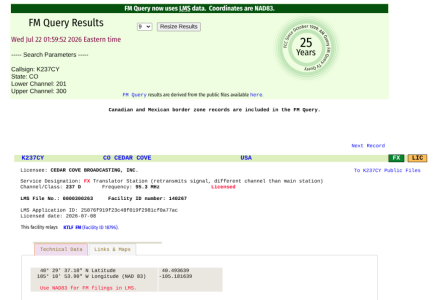
This screenshot for translator K237CY is from the FCC's own FM query. It clearly shows KTLF as the primary for K237CY. It does show Cedar Cove Broadcasting as the owner.

1784685725434.png

If you want to tell the FCC that their data is wrong, be my guest.
 
The station licensed to Dolores, CO, is KTCF at 89.5 mHz. Here is the fccdata.org link to the station's information:

Thank you, Ted! If you picked that up from hearing the audio file, then your hearing is better than mine! I kept hearing "KTZT" or "KTCT" and I knew that "KTCT" had to be wrong. I'll update the spreadsheet but won't post that here to avoid giving people any more headaches than there already have been.
 
My two cents' worth: That's the question that needs to be unraveled and answered before there's any hope of really figuring out what's going on.
The Dolores mystery, at least, is solved. The rest of it just seems like inventory control that needs improvement.
 
This screenshot for translator K237CY is from the FCC's own FM query. It clearly shows KTLF as the primary for K237CY. It does show Cedar Cove Broadcasting as the owner.

View attachment 12435

If you want to tell the FCC that their data is wrong, be my guest.

I will, because a modification application filed March 19, specifies the new primary.... KRKU Hillsdale, WY via another translator

Try reading applications before you assume I havent.
 
I will, because a modification application filed March 19, specifies the new primary.... KRKU Hillsdale, WY via another translator

Try reading applications before you assume I havent.
Before you fall off your high horse, keep in mind that the discussion here originated in a petition for reconsideration involving a couple of translators in the Denver area and the rationale for that petition. The Fort Collins translator is ancillary to that discussion at most, and not essential in understanding the Denver petition. Moreover, the FCC data reflects current state as does the spreadsheet that I put together.

If you want to argue about FCC data regarding a stinkin' translator, that's your choice. I couldn't care less. There's a bigger issue that the petition hints at, and @fybush correctly pointed it out: the inconsistency and complexity of the translator rules. It's possible they're at the point where a court could consider them capricious and arbitrary. The really interesting future development is whether ECCS pursues its argument far enough for a court to examine it. Whether it's worth spending that much money on a couple of translators is a whole other question in itself, but ECCS has at least taken the first step.
 
Before you fall off your high horse, keep in mind that the discussion here originated in a petition for reconsideration involving a couple of translators in the Denver area and the rationale for that petition. The Fort Collins translator is ancillary to that discussion at most, and not essential in understanding the Denver petition. Moreover, the FCC data reflects current state as does the spreadsheet that I put together.

If you want to argue about FCC data regarding a stinkin' translator, that's your choice. I couldn't care less. There's a bigger issue that the petition hints at, and @fybush correctly pointed it out: the inconsistency and complexity of the translator rules. It's possible they're at the point where a court could consider them capricious and arbitrary. The really interesting future development is whether ECCS pursues its argument far enough for a court to examine it. Whether it's worth spending that much money on a couple of translators is a whole other question in itself, but ECCS has at least taken the first step.

And i dont think this is the last filing that KTLF will make, because if i recall what they said in their rebuttal was they were due a due reason/explination.. theyre goin to get that and then argue against that

If the FCC ends up acquiescing to KTLF, this will open a can of worms and set a precedence they will regret settig
 
We can agree on that point.


I assume that, by "they", you mean the FCC. The FCC may not have a choice in the matter if it goes to court.

If you read the letter of the law, the way its currently written, the way i interpret it.... its not legal. Because while youre broadcasting an HD Sub channel, its still under the main license...... and this would open up a licensing nightmare
 
Station
Frequency
City
Program
Primary
Additional Information
K234AJ​
94.7​
Colorado Springs​
Reflections​
KTLF (HD3)​
identical coverage to K248AS​
K248AS​
97.5​
Colorado Springs​
Reflections​
KTPL (HD?)​
actual COL: Woodland Park​
KTLF-HD3​
90.5​
Colorado Springs​
Reflections​
K247BP​
97.3​
Pueblo​
Reflections​
KTLF (HD3)​
K204GY​
88.7​
Brush​
See Note 4​
KTLF (HD?)​
Note 4 – also see K220IM entry for The Legacy​
K218DB​
91.5​
Vilas-Springfield​
Reflections​
KTLF (HD3)​


Between the duplicate IDs, IDs of stations that don't exist, incorrect city of license for a full-power station, and so on, does ECCS even know what they have?
It seems like that was a lot of work to post all of that. Thanks.

Stepping back from the waiver discussion, I'm curious how folks in Colorado view the ECOCS network. I plotted out some of the better signals on RadioLand. It seems they can cover most of the population centers along I-25 and many of the larger communities around the state with about half of their signals. It obviously isn't the same as owning a network of full power FM's, but the total population coverage seems substantial.

Is it generally viewed by locals as an impressive statewide build-out, or more of an unwieldy collection of translators and small market full power FM's?
 
It seems like that was a lot of work to post all of that. Thanks.

Stepping back from the waiver discussion, I'm curious how folks in Colorado view the ECOCS network. I plotted out some of the better signals on RadioLand. It seems they can cover most of the population centers along I-25 and many of the larger communities around the state with about half of their signals. It obviously isn't the same as owning a network of full power FM's, but the total population coverage seems substantial.

Is it generally viewed by locals as an impressive statewide build-out, or more of an unwieldy collection of translators and small market full power FM's?

The general public doesnt understand the difference between low power translators and full power signals... .. they have no idea what a translator is, just that they dont reach as far
Owning translators in sparsley populated areas is a much less expensive way to get a signal on the air and cover what counts in terms of population without wasting signal on tumbleweeds
 
Owning translators in sparsley populated areas is a much less expensive way to get a signal on the air and cover what counts in terms of population without wasting signal on tumbleweeds

Paul, I really wish you would stop acting in this thread as if you were a Denver resident. You're not. I am. Richard is asking how locals perceive ECCS. That's not a question you can answer.

It seems like that was a lot of work to post all of that. Thanks.
The data-gathering was most of it. Spreadsheets may be a lowest common denominator when it comes to data analysis, but they're still useful and flexible. It also helped that the board software was smart enough to translate a screen-scraping cut-and-paste to a tabular format.

I'm tempted to do the same thing for a couple of the public radio networks, but not right away.


Stepping back from the waiver discussion, I'm curious how folks in Colorado view the ECOCS network. I plotted out some of the better signals on RadioLand. It seems they can cover most of the population centers along I-25 and many of the larger communities around the state with about half of their signals. It obviously isn't the same as owning a network of full power FM's, but the total population coverage seems substantial.

Is it generally viewed by locals as an impressive statewide build-out, or more of an unwieldy collection of translators and small market full power FM's?
ECCS is based in Colorado Springs, which historically has been a center of evangelical activity. You'll note that the second and third KTLF networks are mostly based in southern Colorado, though not exclusively so. I think the Denver-area operations are a relatively minor addition for them, but they clearly want to have a presence here. The K292FM translator covers some suburban areas where there might be an interest in KTLF's genre of programming. It also covers areas in Denver where there's likely to be very little such interest (LoHi, Berkeley, and so on, possibly even Capitol Hill or City Park if you have a good receiver).

Aside from that, the contemporary-Christian marketplace in Denver is almost as saturated as the market for sports talk. (There's an idea: Christian sports talk. You heard it here first!) Just among full-power stations, there's K-Love, Way FM, and Pillar Media (three stations). K-Love's Air1 is on a translator, as is KTLF "The Light". So I think it would be hard for any one such station to be predominant in this environment. The Light probably has its listeners, and it appears they would like to expand based on their recent purchases, but most people aren't going to know about the extensive network, even if they hear the full TOH ID. When you listen to the audio of that ID, you'll notice that, aside from the parent KTLF, the first stations that are mentioned are both Denver.

Some of the ECCS outstate stations are full-power stations that are just a little more powerful than a translator. That guarantees they won't be displaced (unlike the situation in Brush, which seems to have an uncommon amount of broadcast activity for a community its size).

But I think the core ECCS audience is in Colorado Springs and Pueblo. Other locations, even Denver, are a nice addition for them but not as central to their mission. But it's enough for them to acquire a couple more translators (one of which is to be reconfigured for better Boulder coverage, though Boulder also seems like a community where there wouldn't be that much interest in KTLF's programming) and to lease an HD channel on a full-market FM.

 
Paul, I really wish you would stop acting in this thread as if you were a Denver resident. You're not. I am. Richard is asking how locals perceive ECCS. That's not a question you can answer.

KTLF used to have a signal here, one I actuall went up the hill to work on with another engineer, but they have since sold it., I have a different perspective than you on some things and im not trying to act like or claim to be a Denver resident but Im not far away and may have different perspective or opinion than you.

So, again, don't assume what I'm implying or thinking
 
If you read the letter of the law, the way its currently written, the way i interpret it.... its not legal. Because while youre broadcasting an HD Sub channel, its still under the main license...... and this would open up a licensing nightmare
That's kind of an odd perspective, and I wonder how much different it would be if you were actually in the trenches dealing with the FCC on a regular basis instead of observing and pontificating from the outside.

From where I sit as someone who regularly deals directly with the FCC and with clients who are trying to get the regulatory changes they need to stay alive, here's what I see:

There are no "licensing nightmares." The FCC's rules have always been subject to change at the behest of broadcasters and constituents. So much of what we now treat as "normal" - 250-watt translators, translators for AM stations, translators fed by HD2/3/4, on-channel boosters - was once "not legal" and would probably have been considered a "regulatory nightmare" by the Paul Walkers of the day.

If I were trying to make this case on behalf of ECOCS or another client, I would do it pretty much the way I did upthread - suggest that just as with TV licenses sharing channels, that the salient point the FCC should be looking at is what the commercial/NCE status of the *translator license* is, and so long as the specific program feed that the translator is using complies with all NCE programming guidelines, it really shouldn't matter (and should be in the public interest) to allow that feed to come from an HD sub of a station that's otherwise licensed commercially.

No different, really, from a TV translator of a NCE TV station carrying only the NCE streams from a full-power transmitter that's sharing channel capacity between commercial and NCE TV stations.

One of the things I love most about the part of my current career path that has me doing FCC work is when I'm able to help a client do something that's right on the edge of "is this legal?" because I know how to make a persuasive case that what I'm trying to do is ultimately in the public interest, even if it requires a reinterpretation of the rules. I don't brag on it much, because that's not what I do, but I have had some nice wins on those fronts recently, and I'm very happy for my clients when I can get them.
 
KTLF used to have a signal here, one I actuall went up the hill to work on with another engineer, but they have since sold it.
Which bears no relevance to the petition for reconsideration involving the two translators in the Denver area. So why even mention it?

I have a different perspective than you on some things
Different perspective is fine; incorrect facts are not. This was evident in the thread in the Iowa board where you made assumptions about coverage of Des Moines FM stations based upon the coverage of a station that had lesser facilities than several other stations in the market. I may be an ex-Iowan, but folks currently in the market backed me up when I pointed out the inaccuracies of your assumptions.

Most of what I'm discussing in this thread isn't a matter of opinion. I've tried to stick to the facts as best I can.

So, again, don't assume what I'm implying or thinking
I'm not the one making the assumptions here. Especially since this involves a Christian broadcaster, a type of entity about which I've expressed definite opinions, I've tried to be fair by keeping to the facts, not speculating (either positively or negatively) about ECCS's motives, and focusing on the regulatory implications of what ECCS is seeking.

If you want your writing to be interpreted the way you want it to be interpreted, then you should take the time to write clearly, spell correctly, and punctuate properly so that there is no confusion. Not every post needs to have an instant response.
 
Yes, Colorado Public Radio stations - almost as complex as ECOCS. Thanks for the responses.
Probably more so with the addition of KRCC. Also, where you get CPR versus KUNC is not always clearly delineated geographically.
 
Last edited:
While what I'm about to say may be off the initial thread topic, it might be worth noting for @mark Robert's list. The biggest populated area in Colorado *not* served by KTLF and its translators at this time is Durango, but that was not always the case. At one time, the full power signal at 88.5 mHz in Durango had the callsign of KTDL and was owned by ECOCS. Its programming was a full simulcast of KTLF. Sometime (I think it was right before, or right after, COVID-19 hit), what is now K-Love, Inc. purchased the signal from ECOCS and changed the callsign to KLCQ, and it now carries the "K-Love" network.

As one media giant of the past might say, "Now you know 'The Rest of the Story'."
 
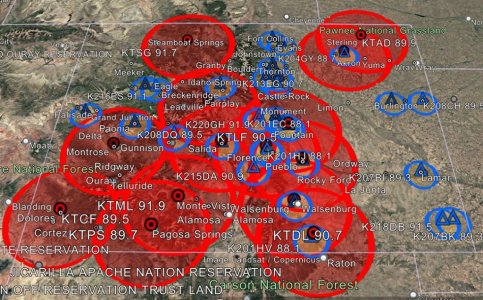
Thanks to Chatgpt, fccinfo..... it came up with this map for all the KTLF Related signals... but there are 4 on here that arent mentioned on the KTLF Listen/Frequencies page of their website

aaaa.jpg


Back
Top Bottom