The other issue not mentioned here: KFRC's far-superior signal on 610 AM. In Marin where I grew up, unless you were close to the Bay, KYA on 1260 was hard to pick up.

-
Get involved.
We want your input!
Apply for Membership and join the conversations about everything related to broadcasting.
After we receive your registration, a moderator will review it. After your registration is approved, you will be permitted to post.
If you use a disposable or false email address, your registration will be rejected.
After your membership is approved, please take a minute to tell us a little bit about yourself.
https://www.radiodiscussions.com/forums/introduce-yourself.1088/
Thanks in advance and have fun!
RadioDiscussions Administrators
You are using an out of date browser. It may not display this or other websites correctly.
You should upgrade or use an alternative browser.
You should upgrade or use an alternative browser.

Yeah, but if you go back and look at my post, the KFRC signal advantage never really paid off for them against KYA in the 1960s.The other issue not mentioned here: KFRC's far-superior signal on 610 AM. In Marin where I grew up, unless you were close to the Bay, KYA on 1260 was hard to pick up.
KYA was beating KFRC even in 7-midnight, where the signal advantage should have been major for KFRC.
The May-June, 1968 Hooper, which KFRC won overall by 2/10ths of a point---KFRC 8.6, KYA 8.4---in 7-Midnight, it was KYA 11.3, KFRC 9.1.
The October 1968 ARB---KYA beat KFRC overall 7.0-6.1 and from 7-midnight it was KYA 13.3 to KFRC's 7.4 (Tom Campbell damn near doubled Dave Diamond's numbers with a much weaker signal).
In the October-November 1970 ARB---KFRC beat KYA overall by a tenth of a point---8.0 to 7.9---but 7-midnight, it was KYA 11.4 to KFRC's 10.6.
It wasn't until Tom Campbell left KYA for KNEW that KFRC finally won nights---the October/November 1971 Pulse shows KFRC with an 11.0 to KYA's 9.0, but in that same book, KYA ties KFRC in morning drive with an 8.0 (that would have been Cliff Saunders versus Jim Carson).
So there's nothing to indicate that the signal difference hurt KYA at all. The dip in KYA's numbers beginning in 1972 corresponded with a new PD and a largely unknown air staff that stopped doing the outreach and community involvement. When KFRC put Dr. Don Rose in mornings in the fall of '73, that slammed the door.

I lived in San Rafael and can second that. But when KYA was on nighttime power we'd just go to KEWB.The other issue not mentioned here: KFRC's far-superior signal on 610 AM. In Marin where I grew up, unless you were close to the Bay, KYA on 1260 was hard to pick up.
Thanks Michael for digging up those very specific daypart numbers from the 60s. Maybe KYA's signal disadvantage was less of an issue in the 1960s-early 1970s than today, because there was so much less man-made noise back then?Yeah, but if you go back and look at my post, the KFRC signal advantage never really paid off for them against KYA in the 1960s.
KYA was beating KFRC even in 7-midnight, where the signal advantage should have been major for KFRC.
The May-June, 1968 Hooper, which KFRC won overall by 2/10ths of a point---KFRC 8.6, KYA 8.4---in 7-Midnight, it was KYA 11.3, KFRC 9.1.
The October 1968 ARB---KYA beat KFRC overall 7.0-6.1 and from 7-midnight it was KYA 13.3 to KFRC's 7.4 (Tom Campbell damn near doubled Dave Diamond's numbers with a much weaker signal).
In the October-November 1970 ARB---KFRC beat KYA overall by a tenth of a point---8.0 to 7.9---but 7-midnight, it was KYA 11.4 to KFRC's 10.6.
It wasn't until Tom Campbell left KYA for KNEW that KFRC finally won nights---the October/November 1971 Pulse shows KFRC with an 11.0 to KYA's 9.0, but in that same book, KYA ties KFRC in morning drive with an 8.0 (that would have been Cliff Saunders versus Jim Carson).
So there's nothing to indicate that the signal difference hurt KYA at all. The dip in KYA's numbers beginning in 1972 corresponded with a new PD and a largely unknown air staff that stopped doing the outreach and community involvement. When KFRC put Dr. Don Rose in mornings in the fall of '73, that slammed the door.

That is some of it, but the larger issue was that the Pulse and Hooper ratings service area was much smaller than the Arbitron one.Thanks Michael for digging up those very specific daypart numbers from the 60s. Maybe KYA's signal disadvantage was less of an issue in the 1960s-early 1970s than today, because there was so much less man-made noise back then?
Thanks Michael for digging up those very specific daypart numbers from the 60s. Maybe KYA's signal disadvantage was less of an issue in the 1960s-early 1970s than today, because there was so much less man-made noise back then?
Well, yeah, but KYA-AM hasn’t existed in 40 years. There was not a significant degradation in signal between 1970, when they were beating KFRC and 1972, when they fell more than a point behind them for the first time.
What there was and is provable at that time was a change in PD, of the complete air staff and of the commitment to outreach and engagement in the community.
And before they could recover under the next PD and air staff, KFRC hired Michael Spears, Dr. Don Rose, Chuck Buell, Bobby Ocean and John Mack Flanagan, and started relating to the community instead of doing Drake template radio. That’s when it was game over.

Notwithstanding everyone else's excellent answers, KYA was literally king of the hill. They broadcast from the top of Candlestick Hill, in Bayview/Hunters Point. (Today 1260 is KSFB, the Catholic broadcaster "Relevant Radio". Their tower is still there, visible as you drive by on 101, just north of where the Giants and 49ers used to play.)In the 60s which station was king of the hill in S.F. (KYA or KFRC) [?]
KFRC's tower was adjacent to I-80, right at the foot of Ashby in Berkeley. (Still is, but it's been Family Radio's KEAR for most of the current century.) No hill there to be king of, strictly sea level.
Tony Pigg was successful on WPLJ doing early evenings, generally 6-10pm, but I wouldn't quite call him a legend. (Jim Kerr's a legend, Pat St. John too. Generally the "legends" were on the AM side, WABC, names like Ingram, Morrow, Lundy, Harrison, etc.) He became much better known for his many years as the off-screen announcer for Regis and Kathy Lee, Regis and Kelly, Kelly and Michael, and currently Kelly and Ryan.Tony Bigg went east, had his name changed to Pigg and became a legend doing nights at New York's Best Rock WPLJ.
Elevation helps with FM, but not with AM. Still, the 1260 transmitter building is a landmark—-designed by famed architect Julia Morgan.Notwithstanding everyone else's excellent answers, KYA was literally king of the hill. They broadcast from the top of Candlestick Hill, in Bayview/Hunters Point. (Today 1260 is KSFB, the Catholic broadcaster "Relevant Radio". Their tower is still there, visible as you drive by on 101, just north of where the Giants and 49ers used to play.)
KFRC's tower was adjacent to I-80, right at the foot of Ashby in Berkeley. (Still is, but it's been Family Radio's KEAR for most of the current century.) No hill there to be king of, strictly sea level.
IIRC, it wasn't just KYA that had a change in PD around then. KFRC brought Sebastian Stone in from WOR-FM NYC around Spring 1971. I suspect he had at least some input into the air staff changes.Well, yeah, but KYA-AM hasn’t existed in 40 years. There was not a significant degradation in signal between 1970, when they were beating KFRC and 1972, when they fell more than a point behind them for the first time.
What there was and is provable at that time was a change in PD, of the complete air staff and of the commitment to outreach and engagement in the community.
And before they could recover under the next PD and air staff, KFRC hired Michael Spears, Dr. Don Rose, Chuck Buell, Bobby Ocean and John Mack Flanagan, and started relating to the community instead of doing Drake template radio. That’s when it was game over.
Well aware of that, Mike. I wasn't claiming otherwise. But few AM transmitters are landmarks. Many people know where the KGO towers are, adjacent to the Dumbarton Bridge, even if they haven't listened in years and couldn't tell you the current excuse for a format. But few could point out stablemate KSFO's tower array along the bay around Dogpatch. Or KNBR's in Redwood Shores. Most of them are nondescript sticks in the sky with blinking lights at the top. KYA's tower was an exception, for anyone who cared to glance up as they headed down 101 towards the airport or the peninsula. I forget if the big neon call letters were on the tower or the xmtr building, but they were there, and geeks like me noticed them.Elevation helps with FM, but not with AM. Still, the 1260 transmitter building is a landmark—-designed by famed architect Julia Morgan.
True to a point, but if you look at Tom Campbell's dominance in evenings, his departure to KLOK (I had said KNEW previously, but that came after KLOK) alone was a huge blow to KYA.IIRC, it wasn't just KYA that had a change in PD around then. KFRC brought Sebastian Stone in from WOR-FM NYC around Spring 1971. I suspect he had at least some input into the air staff changes.
Six months in, Sebastian Stone had only opened up a one-point lead over KYA---which tied KFRC in mornings (Oct-Nov '71 Pulse). Stone inherited and kept Jim Carson, Joe Conrad and Frank Terry for '71 and brought in Bob Foster, Gene West, Steve Lundy, J.J. Johnson and Don Kelly.
In '72, Stone replaced Joe Conrad with Bobby Ocean, Steve Lundy with Eric Chase and Bob Foster with Mike Novak. But the margin between KFRC and KYA was still only 1.2.
KYA PD Julian Breen responded with a complete staff overhaul, and a lot of Buzz Bennett influence, without going full "Q". This was the "KYA Gives A Shirt"/"Keep On Truckin'" era. Here's a playlist from the summer of '72---24 songs:
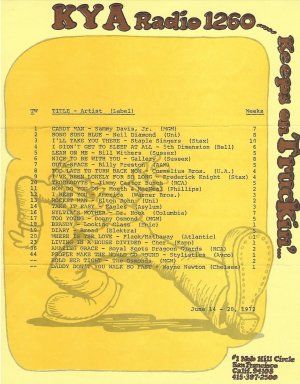
Guys nobody in the market knew (yeah, KFRC was bringing in hired guns from out of town, too but they always had---KYA was erasing people who'd made connections with the audience), doing almost nothing in terms of community involvement, just playing the hits and giving away albums and T-shirts.
For comparison, here's KFRC's list for the same week:
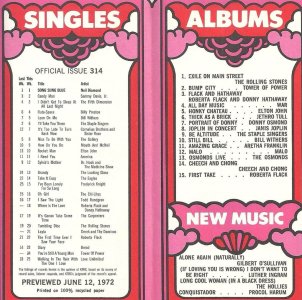
Breen was gone by mid-'73, but his replacement as PD was Christopher Cane from KCBQ, who just tried to make the same approach work with some refinements.
It was Drake's departure in May of 1973, giving Paul Drew oversight of KFRC, and the hiring of Michael Spears as PD, who then built the team of Dr. Don Rose, John Mack Flanagan, Bobby Ocean, Chuck Buell, Mark McKay, Beau Weaver and Dave Sholin that spread the margin to five and a half points over KYA within a year and a half.
And from there, KYA was a revolving door of PDs and talent, with numbers that sank below a 2 share by 1977.
Last edited:
KYA PD Julian Breen responded with a complete staff overhaul, and a lot of Buzz Bennett influence, without going full "Q". This was the "KYA Gives A Shirt"/"Keep On Truckin'" era. Here's a playlist from the summer of '72---24 songs:
So Julian left Rick Sklar and WABC to program KYA? Wow. Looking at that list, it is more east coast than KFRC. At least KFRC played the SF band Tower of Power. After that Julian went to Philadelphia and developed the Magic format.
Well maybe not legendary but very well known and respected by my peers who were all big PLJ fans.Tony Pigg was successful on WPLJ doing early evenings, generally 6-10pm, but I wouldn't quite call him a legend. (Jim Kerr's a legend, Pat St. John too. Generally the "legends" were on the AM side, WABC, names like Ingram, Morrow, Lundy, Harrison, etc.) He became much better known for his many years as the off-screen announcer for Regis and Kathy Lee, Regis and Kelly, Kelly and Michael, and currently Kelly and Ryan.
What does it take for someone to be a "legend?" In my estimation, s/he either has to have been with a really successful station for an atypically long time, or to have had success at multiple stations in a major market. It's not just that listeners remember and like someone. So by definition 1, Bruce Morrow qualifies, George Michael doesn't, or Don K Reed does but Dick Heatherton doesn't. (I have no animus with either George or Dick, but neither stuck around long enough. Bruce was at WABC for 12 or 13 years, and Don for a whopping 33.) By definition 2, Jim Kerr is a legend from his stints at WPLJ, WPIX, WYNY and WAXQ, all reasonably successful. Bruce Morrow (WINS, WABC, WNBC, WCBS-FM and again at WABC) also qualifies. Tony Bigg/Pigg was at WPLJ for about a decade as I recall, but he executed the format and not much more, and then went on to doing voiceovers and TV announcing. Absolutely nobody from the Drake WOR-FM makes my list, although a bunch from WNEW AM or FM do.Well maybe not legendary but very well known and respected by my peers who were all big PLJ fans.
San Francisco-relevant examples from that era would definitely include Dr. Don Rose and Tom Campbell, and probably Don Bleu and Bobby Ocean. But I can't summon up any others. Maybe you guys can.
And, if I recall correctly, the offices were at 1 Nob Hill Circle. I was about 13 when I visited the station when I was in San Francisco with my mother who was attending a hospital administrator's conference.Notwithstanding everyone else's excellent answers, KYA was literally king of the hill. They broadcast from the top of Candlestick Hill, in Bayview/Hunters Point.
At the time, they were using the experimental Ampex audio disks, which were sort of like floppy discs. They had the commercials and music on them. I never saw that device in use anywhere else, and it disappeared from the market soon after.
The staff at KYA was very nice, giving me a complete tour of the station where I even met whoever was the midday jock at the time.
My only other memory was listening to KYA in our hotel and hearing for the first time Ike & Tina Turner's "Mockingbird".
It was like a San Francisco proxy war, WABC vs. WOR-FM, KYA vs. KFRC, Julian Breen vs. Sebastian Stone. You can even see the difference in playlist philosophies, Sklar (keep it short) vs Drake (not too short).So Julian left Rick Sklar and WABC to program KYA? Wow.
John Mac Flanagan is on my list.San Francisco-relevant examples from that era would definitely include Dr. Don Rose and Tom Campbell, and probably Don Bleu and Bobby Ocean. But I can't summon up any others. Maybe you guys can.
When he went from KRUX to KFRC, I was the ops manager at KRUX while finishing up at ASU. He was nervous about his interview with Spears (scheduled for one of those Billboard drink-and-snort record and radio conventions) so I drove him to LA myself to meet with Spears.
Of course he got the job. While I did not like losing him at KRUX, he deserved the "big break" as he was a genuinely nice person.
We always remember our first time, huh David? ;-) Mine was WMCA at 415 Madison, and I think I was 14, but (except for those Ampex disks) our experiences are similar. I did get to work for a couple of years right next to that big Ampex sign that used to be along 101, on the campus that used to be Ampex. Our six degrees of separation.And, if I recall correctly, the offices were at 1 Nob Hill Circle. I was about 13 when I visited the station when I was in San Francisco with my mother who was attending a hospital administrator's conference.
At the time, they were using the experimental Ampex audio disks, which were sort of like floppy discs. They had the commercials and music on them. I never saw that device in use anywhere else, and it disappeared from the market soon after.
The staff at KYA was very nice, giving me a complete tour of the station where I even met whoever was the midday jock at the time.
My only other memory was listening to KYA in our hotel and hearing for the first time Ike & Tina Turner's "Mockingbird".
- Status
- This thread has been closed due to inactivity. You can create a new thread to discuss this topic.