• Get involved.
    We want your input!
    Apply for Membership and join the conversations about everything related to broadcasting.

    After we receive your registration, a moderator will review it. After your registration is approved, you will be permitted to post.
    If you use a disposable or false email address, your registration will be rejected.

    After your membership is approved, please take a minute to tell us a little bit about yourself.
    https://www.radiodiscussions.com/forums/introduce-yourself.1088/

    Thanks in advance and have fun!
    RadioDiscussions Administrators

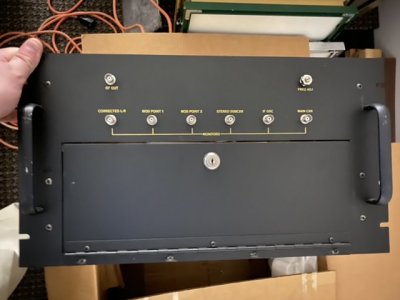
Leonard Kahn’s CAM-D

Some of the other Kahn products were when AM radios used analog tuning and did not use sharp cut off ceramic IF filters. Distinction should be made between pre and post 125 percent positive peak rule. Also note that $600 in 1965 is equivalent to approximately $5,000 in 2020. Some of these things don't seem like a big financial deal in today's dollar, but they were then.
An Audimax and Volumax in 1964 each cost about $650. I bought them for my first Quito station when the monthly billing was just short of $5,000 so it was a big decision. But some of those technical advances in the 60's and 70's made all the difference in competitive sound, so there were times when a new piece of gear was more valuable than a big contest!
 
No. You're thinking of Kahn's PowerSide. That's the device that used only part of the stereo exciter.
The Cam-D was a totally different device. Cam-D used the analog AM for low and lower mid frequencies and added a digital signal in the sidebands for the upper mid and high frequencies. It was a rather bizarre system which did nothing to reduce or eliminate the AM impulse noise. I'm not sure that anyone manufactured receivers for the system.
It's nice to know that I got the information right. I just had the wrong name! Thank you, Frank.
 
Cam-D used the analog AM for low and lower mid frequencies and added a digital signal in the sidebands for the upper mid and high frequencies. It was a rather bizarre system which did nothing to reduce or eliminate the AM impulse noise. I'm not sure that anyone manufactured receivers for the system.

"Transmit first; build receivers later".

Reading years ago (and recently rereading) his angry tirades on Wrath it appeared to me that CAM-D was mostly his attempt to show up a big corporation (in this case, the FCC and the then-Ibiquity cartel). Probably it was because he saw the new transmission system's mediumwave variant coming out and was still pissed off about Motorola "stealling his thunder" decades earlier (flawed as ISB was) so he figured maybe this time he'd have better luck with another go-round; never mind how oddball or flat out unworkable the system was. Or something. Who knows what delusions go through the minds of senile Americans when there's money, patents and/or ego involved.

 
Last edited:
"Transmit first; build receivers later".

Reading years ago (and recently rereading) his angry tirades on Wrath it appeared to me that CAM-D was mostly his attempt to show up a big corporation (in this case, the FCC and the then-Ibiquity cartel). Probably it was because he saw the new transmission system's mediumwave variant coming out and was still pissed off about Motorola "stealling his thunder" decades earlier (flawed as ISB was) so he figured maybe this time he'd have better luck with another go-round; never mind how oddball or flat out unworkable the system was. Or something. Who knows what delusions go through the minds of senile Americans when there's money, patents and/or ego involved.
I wouldn't call Leonard necessarily senile, but more like a curmudgeon. Leonard was a very smart engineer, but a horrible business person with a caustic temper. If one said the wrong thing at the wrong time, Leonard was quick to move you to his enemies list forever. Toward the end, his enemies WAY out numbered friends and allies.
 
When I was CE at a 50kw AM station and thinking about going stereo, Leonard called me on a number of occasions and was just as nice as he could be. When I decided to go with the C-QUAM system, he called me and went on a tirade ... finally hanging up on me.
 
KSL, and the old KDYL, thought the Kahn stereo system was better in some ways, but both finally threw in the towel. With no "approved" single standard, and almost no receivers capable of doing both systems in one box, marketplace became futile.
I think KDYL was using CAM-D. KSL used PowerSide for many years.
And, yes, Leonard was a curmudgeon, but a brilliant engineer. He was living in a motel in Florida when he died. He called KSL, looking for someone to chat with, just a few days before he died.
 
In the long run, KSL used the sideband level adjustment capabilities of the ISB system more than stereo. I can't recall what station it was, but KSL had an adjacency issue which they thought the ISB/Powerside helped them with when it came to fringe area coverage. In essence, they modulated the sideband opposite of the adjacent station harder. The problem was; like ISB, one could only notice the difference on a capacitive-tuned radio. Modern digital VFO's always went to carrier center, which made the 'Powerside' features of one hotter sideband over the other, useless.
 
An Audimax and Volumax in 1964 each cost about $650. I bought them for my first Quito station when the monthly billing was just short of $5,000 so it was a big decision. But some of those technical advances in the 60's and 70's made all the difference in competitive sound, so there were times when a new piece of gear was more valuable than a big contest!
Kahn's claim to fame(as opposed to infamy)was Symmetra Peak.
 
What I want to hear, assuming working equipment still exists, is somebody pumping their stereo music library/a local college or noncomm FM station/a satellite feed into an ISB stereo exciter and low-power transmitter, fed via direct cable connection into a stereo AM receiver (or pair of mono receivers) and streamed via 44100 or 48000 Hz 256 or (preferrably) 320 Kb LAME MP3. THAT would be cool.

I know the old farts will probably immediately shoot the idea down, but for somebody who was born when Kahn-Hazeltine was on its death bed, would be interesting to hear.

Chris? Vwestlife??
 
Last edited:
stereo AM receiver (or pair of mono receivers)

I know the old farts will probably immediately shoot the idea down, but for somebody who was born when Kahn-Hazeltine was on its death bed, would be interesting to hear.
And there in lies the problem. There were no Kahn ISB receivers. The Sony portables never even approached the stereo separation and frequency response a true ISB system could produce. It amounted to something that appeared as wider, but for songs that had really wide separation, like The Beatles or Doobie Bros, it all sounded the same, just wider.
There was one partially-Kahn receiver given to stations running his system for their air monitors. It was a Radio Shack tuner that had a breadboard inside. The Aux setting had whiteout over the letters and instead was the switch for ISB stereo. Good luck ever finding one of those.
 
There was one partially-Kahn receiver given to stations running his system for their air monitors. It was a Radio Shack tuner that had a breadboard inside. The Aux setting had whiteout over the letters and instead was the switch for ISB stereo. Good luck ever finding one of those.
55 North 300 West, Salt Lake City. Second floor (north wing) of KSL Broadcast House, on the top of the grey shelves behind the radio equipment racks.
Right next to the McKay Dymek tuner.
 
55 North 300 West, Salt Lake City. Second floor (north wing) of KSL Broadcast House, on the top of the grey shelves behind the radio equipment racks.
Right next to the McKay Dymek tuner.
That's probably the last one in existence. I'm sure the original three others are several layers under landfill somewhere.
 
I seem to remember it was a Sony...maybe a different run?
What I miss was the Radio Shack units that had AM, FM and TV (BTSC Stereo and SAP). We bought a slew of those, and installed them at area radio stations, so we could feed news promos out at the last minute, for quick-turnaround rebroadcasts.
When we quit, the PDs at all those stations took them home 😉 .
 
I seem to remember it was a Sony...maybe a different run?
What I miss was the Radio Shack units that had AM, FM and TV (BTSC Stereo and SAP). We bought a slew of those, and installed them at area radio stations, so we could feed news promos out at the last minute, for quick-turnaround rebroadcasts.
When we quit, the PDs at all those stations took them home 😉 .
The ones that Leonard gave to stations that had tried/purchased his AM stereo exciters were simulated wood grain (plastic) case stereo tuner from good ol' Crap Shack. He had added the ISB tuner breadboard to the aux input on the switch. Sony made a silver two speaker baby boom box that received both CQUAM and ISB AM stereo, sort of.
 
This one was a big hi-fi home stereo sort of unit, but I remember the hand-lettered label on the switch, and the board. Could it be that it was a one-of-kind? That should be a museum piece 😁 .
(Leonard and KSL had a mutual admiration for each other.)
 
This one was a big hi-fi home stereo sort of unit, but I remember the hand-lettered label on the switch, and the board. Could it be that it was a one-of-kind? That should be a museum piece 😁 .
(Leonard and KSL had a mutual admiration for each other.)
Same happened at a NYC station I was involved with. There was a Symetri-peak lover who would turn it on as soon as I was gone, and I'd have it patched around whenever I heard it. That went on for years until the Symetri-peak had an "internal failure" of unknown causes... :unsure:
 
Not so. I was with our KTNQ chief engineer in an area with better than 50 mv/m when he had to pull over on the freeway to get out and vomit; he was very susceptible to the platform motion. That same evening we took the device out of the chain.
When was this? I was working at WJDX-AM when they were AM stereo in the late 80's. I never noticed the platform motion on my Sparkomatic car radio or my Sony portables. I do know platform motion was an issue early on, as CW stated.
 
When was this? I was working at WJDX-AM when they were AM stereo in the late 80's. I never noticed the platform motion on my Sparkomatic car radio or my Sony portables. I do know platform motion was an issue early on, as CW stated.

Around 1995.
 
Status
This thread has been closed due to inactivity. You can create a new thread to discuss this topic.


Back
Top Bottom