Old Music of Your Life tapes might rival MeTV's chicken-rock oldies as an advertiser-repellent format!Not a surprise. It's basically a promotional platform for their TV network. There is no appeal to advertisers. As far as radio formats go, it's one notch below the True Oldies Channel on the list of formats to put on a station where there's nothing better to program. It might even be worse than sports betting, if you can believe it!!

-
Get involved.
We want your input!
Apply for Membership and join the conversations about everything related to broadcasting.
After we receive your registration, a moderator will review it. After your registration is approved, you will be permitted to post.
If you use a disposable or false email address, your registration will be rejected.
After your membership is approved, please take a minute to tell us a little bit about yourself.
https://www.radiodiscussions.com/forums/introduce-yourself.1088/
Thanks in advance and have fun!
RadioDiscussions Administrators
You are using an out of date browser. It may not display this or other websites correctly.
You should upgrade or use an alternative browser.
You should upgrade or use an alternative browser.
MeTV FM?
- Thread starter A_b_m_90
- Start date
I stream the station a lot on weekdays and I consistently hear local commercials for a local furniture store in Chicago with (I believe) 5 locations. Don’t remember the name of the store but they refer to their locations as being in Chicagoland.I was in Chicago on 7/5. The whole weekend had a title sponsor. Other than that, I don't think I heard a single spot ad.
I occasionally listen to MeTV Music (that's what they call it) via the HD2 feed of WMYX in Milwaukee. It is the straight feed of WRME in Chicago, local ads and all. Possibly for the agreement to stream it on the Audacy app, and possibly for Weigel management running the Milwaukee TV operation. And yes, they do run advertising. WBBM-TV is a big one, but it might be part of some partnership. But local businesses do advertise on the station. They might, however, do some occasional title sponsorship thing on themed weekends.I was in Chicago on 7/5. The whole weekend had a title sponsor. Other than that, I don't think I heard a single spot ad.
All that said, it probably operates mostly as a co-promotional vehicle with their TV operations.

K.M. Richards
Program Director, The Eighties Channel™
Old Music of Your Life tapes might rival MeTV's chicken-rock oldies as an advertiser-repellent format!
I think you are using an incorrect definition of "chicken rock", which was originally used by traditional MOR stations to describe competitors that were doing a more "contemporary" MOR by playing cover versions of recent hits by the Ray Conniff Singers, et al.
Later, when those same stations adopted a similar strategy in an attempt to stay afloat, they changed their usage to describe the early A/C stations, which were essentially softer top-40s with larger gold libraries.
I wouldn't call Wiegel's Oldies format "chicken rock".
(Side trivia: Ray Conniff's name had the accent on the second syllable ... con-NIFF.)
A lot of Top 40s played those more MOR cover versions. Sergio Mendes and Brasil 66 was a big cover artist. I must say that even at a young age, I often preferred those to the originals. But they were a staple on the MOR stations. I always thought of Chicken Rock as what we call Adult Top 40 or Hot AC today. And like Chicken Man, Chicken Rock was everywhere!
K.M. Richards
Program Director, The Eighties Channel™
A lot of Top 40s played those more MOR cover versions. Sergio Mendes and Brasil 66 was a big cover artist.
The difference is that those cover versions got enough airplay to make the national charts. The Ray Conniff Singers never did.
The difference is that those cover versions got enough airplay to make the national charts. The Ray Conniff Singers never did.
Actually, the Ray Coniff Singers did chart nationally once with "Somewhere, My Love," the theme from Dr. Zhivago back in July of 1966. Keyboardist Roger Williams had the original instrumental, but I believe that the Ray Conniff Singers vocal version ultimately made it into the U.S. top 10 in Billboard.
"Somewhere My Love" hit No. 9 on the Billboard Hot 100 in 1966. I remember hearing it on WBZ Boston that summer when 'BZ was still very much a Top 40 station, playing songs like "Psychotic Reaction" and "Reach Out I'll Be There."The difference is that those cover versions got enough airplay to make the national charts. The Ray Conniff Singers never did.
K.M. Richards
Program Director, The Eighties Channel™
"Somewhere My Love" hit No. 9 on the Billboard Hot 100 in 1966. I remember hearing it on WBZ Boston that summer when 'BZ was still very much a Top 40 station, playing songs like "Psychotic Reaction" and "Reach Out I'll Be There."
I forgot that one. Still, the vast majority of his cover versions didn't chart. Sergio Mendes did, several times.
BRAIN FREEZE !!!!!!!!
I agree there is no appeal to agencies. Selling such a format requires a local staff to directly, to include F2F meetings, with potential local advertisers. An outlet that cumes above $500k might appeal to a local or regional concern that cannot afford to go through an agency, but carrying the staff to maintain those enagagments also carries a cost.There is no appeal to advertisers.
KRKE is a daytime only AM with 1000 watts with a translator at 93.7 FM at 250 watts with no on air local talent that just plays music from the 1980’s. I would speculate the narrower playlist limits its potential so no other station has picked up the format. Since they don’t subscribe to any rating service we don’t know the audience numbers. The third rated station in the market and the closest competitor is KABG with a broader playlist, on air talent and an ERP of 14000 watts. Is there any other successful stations anywhere that narrows its playlist to one decade?Technically, what I am doing in Albuquerque with KRKE was designed as a syndicated format. It still technically is, even though I only have one client station, because it could be easily installed in any other market that wanted to run it.
The difference is that KRKE's owner has essentially allowed me to be a remote PD, with a huge amount of autonomy in how I program the station. He will be the first to tell you that his strengths are engineering and sales, and my strength is in programming. We make an excellent team, have no arguments about what we are doing, and the station is in the black less than four years after launch.
Yeah, it's a jukebox. But it seems that's what works now. Don says a lot of our ad sales is to local business owners who listen themselves to 93.7 and like what they hear. My conclusion is that those owners have a mindset that "if I like the station, other people who like the station will be good customers for me". And we deliver ... we have a lot of clients who have been running continuously for long periods of time (years, for some) and neither one of us cares what Nielsen says.
What makes a station "OK" is programming that attracts an audience that can be monetized. I get the impression that "MeTV FM" affiliates (not counting Weigel-owned stations, who run it because it's their format) have minimal ad sales staff, and/or an inefficient sales strategy. That, in my opinion, is a major part of what went wrong with John Sebastian's format. Success is measured in ad dollars, and KOAI didn't bring in enough of those dollars.
It also helps that I tweak my playlist constantly, especially the Forgotten 45s category. The days of "sign with Drake-Chenault, receive the reels, put them on a Schafer 903 and let it run" are long gone.

That's a good question. We know the all 70's format back in the early and mid 90's was a big flop. I don't know of any all 60's or other decades. I remember there was at one time another "The 80's Channel" on a marginal signal in Sacramento (103.9 FM) at one time. That format ended after a sale to Salem.Is there any other successful stations anywhere that narrows its playlist to one decade?
Actually, there are a few other 80s rock stations though most are in small markets. KGKG (1340 kHz, Salida, Co) and KFLX (92.5 mHz, Chino/Prescott, AZ) immediately come to mind. The closest thing to an all-80s music station broadcasting at a large market (like what KRKE-AM is doing) is KWMZ (104.5 mHz) which targets New Orleans from its southeast and is licensed to Empire, LA. All of these radio stations do stream so you can check them out for yourself.KRKE is a daytime only AM with 1000 watts with a translator at 93.7 FM at 250 watts with no on air local talent that just plays music from the 1980’s. I would speculate the narrower playlist limits its potential so no other station has picked up the format. Since they don’t subscribe to any rating service we don’t know the audience numbers. The third rated station in the market and the closest competitor is KABG with a broader playlist, on air talent and an ERP of 14000 watts. Is there any other successful stations anywhere that narrows its playlist to one decade?
There was also "The Eighties Channel" on Big City Radio's 103.1 "synchrocast" in Chicago at the turn of the century.That's a good question. We know the all 70's format back in the early and mid 90's was a big flop. I don't know of any all 60's or other decades. I remember there was at one time another "The 80's Channel" on a marginal signal in Sacramento (103.9 FM) at one time. That format ended after a sale to Salem.

There was also an all 80’s station known as “The Mall” in Omaha around 25 years ago, and another Omaha station known as “Retro 106.9”:
KCTY Becomes Retro 106.9 - Format Change Archive
Previous Format: Alternative “106.9 The City” KCTY New Format: 80s Hits “Retro 106.9” Date & Time Of Change: March 12, 2004 at 3:00pm More Info: Wikipedia Related Changes: KQKQ Relaunches As Q98Five Aircheck Contributed by NebraskaRadio.com
formatchange.com
K.M. Richards
Program Director, The Eighties Channel™
KRKE is a daytime only AM with 1000 watts with a translator at 93.7 FM at 250 watts with no on air local talent that just plays music from the 1980’s. I would speculate the narrower playlist limits its potential so no other station has picked up the format.
Try defining "success" by ad sales and we are doing just fine, thankyouverymuch.
Your speculation is just that ... speculation. And your conclusion is incorrect.
Do you think they would still be paying me to program it, almost four years after the launch, if it was a failure?
K.M. Richards
Program Director, The Eighties Channel™
There was also "The Eighties Channel" on Big City Radio's 103.1 "synchrocast" in Chicago at the turn of the century.
The subsequent Big City bankruptcy is how I acquired the service mark and the animated logo on our stream page. And Jeffrey T. Mason, APD/MD from the Chicago version, remains a good acquaintance.
My question was why no other station has picked up your format. I appreciate your feedback that your station is successful. If the reason isn’t the narrow playlist then why haven’t other stations signed on? Are there any stations in the top 50 markets that are successful with playing music from only one decade? Thanks.Try defining "success" by ad sales and we are doing just fine, thankyouverymuch.
Your speculation is just that ... speculation. And your conclusion is incorrect.
Do you think they would still be paying me to program it, almost four years after the launch, if it was a failure?
K.M. Richards
Program Director, The Eighties Channel™
My question was why no other station has picked up your format. I appreciate your feedback that your station is successful. If the reason isn’t the narrow playlist then why haven’t other stations signed on? Are there any stations in the top 50 markets that are successful with playing music from only one decade? Thanks.
First, thank you for clarifying your intent. As I often say, it is difficult sometimes on a message board to see what a poster intended to say, since there are no facial expressions or tone of voice to interpret.
The simplest answer to your question is one that keeps me humble. Not enough station owners and managers know who I am ... and I doubt any of them are looking at markets like Albuquerque for ideas. The other reason goes to why KRKE works in market #72: Our competitor, KABG -- who you correctly referenced in your original post -- is the heritage station in the format, going back to the days when Classic Hits was still called Oldies. As such, they get the benefit of listener inertia, as in people who never change the station because they are satisfied enough.
At this point, I would like to point out why our translator is competitive with KABG's Class C signal. We are both up on Sandia Crest, which is 10,679 feet above the city of Albuquerque. Since translators are allowed to use the maximum 250 watts regardless of height and also use directional antennas to keep the signal within the contour of the originating station, we essentially cover the Albuquerque metro as well as anyone:
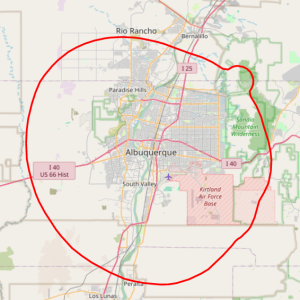
KABG is non-directional, which lets them reach the area on the east side of Sandia, including the state capitol of Santa Fe ... but that is of little use to Albuquerque businesses as an advertising medium:
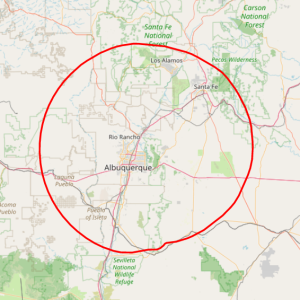
Other than that, that big signal covers a lot of uninhabited area.
(Maps from @Michi's fccdata.org site, of course.)
This is also why KRKE doesn't subscribe to Nielsen. When you are targeting local businesses as potential advertising clients, the numbers don't matter. The business owner is going to decide, in large part, based on your format and whether you get an audience that they believe would be good customers for them. In fact, we have gotten a lot of buys on the first cold call because 93.7 is the business owner's personal favorite station. (That's the real "rating".)
KRKE's owner has managed to get some data out of Nielsen anyway, and among other things, we have discovered that a lot of KABG's P1s are our P2s, and vice versa. I suspect that those listeners flip back and forth when KABG has one of its horrendously long (six to seven minute) stopsets --ours are a maximum of four spots or three minutes, fifteen seconds -- and/or when their morning man has used up five minutes of airtime and essentially said nothing.
(That's the potential problem with having a local, live on-air staff in smaller markets. Sometimes they don't know when to "shut up and play another song".)
Another thing I do that they don't: Instead of trying to second guess which songs prior to 1980 or after 1989 fit the station sound, I go deeper once an hour with a feature I call Forgotten 45s. It has a separate library of about 400 songs which are still recognizable but which don't get enough airplay across the 88 stations I monitor across the U.S., I only let a song play 12 times across all dayparts when it is active before resting it again, and that rest period is a minimum of six months. Makes us sound like we have the biggest library in the universe ... and we kinda do.
The reason I do only that decade is partially because I believe WXXY got cut off too soon back when it was the original Eighties Channel. In the intervening years, I have watched Classic Hits stations try to move forward, only to find that there is no general consensus about the post-1990 songs ... the listeners who grew up hearing the rhythmic songs when they were currents hate the songs that were grunge rock and vice versa, to give an example. But the 80's are still the "center lane"' in the format (otherwise I wouldn't be able to find 88 stations to monitor) and so I just stay in that lane. The result is a very consistent format which attracts a large enough audience to be saleable.
Why aren't there stations in the top-50 markets doing it the same way? Mostly because those markets are dominated by the major station group owners, who tend to do each format they air in a similar way across all markets. Even when they have tried -- KOSF in San Francisco being a recent example -- they still didn't get it right, because their research wasn't designed for that format variation.
Obviously, I'd love it if other stations, regardless of market size, called me and expressed an interest in The Eighties Channel™. It would be very easy for me to replicate elsewhere.
Again, thank you for making your interest clearer. It gave me a chance to give you a more complete reply.