• Get involved.
    We want your input!
    Apply for Membership and join the conversations about everything related to broadcasting.

    After we receive your registration, a moderator will review it. After your registration is approved, you will be permitted to post.
    If you use a disposable or false email address, your registration will be rejected.

    After your membership is approved, please take a minute to tell us a little bit about yourself.
    https://www.radiodiscussions.com/forums/introduce-yourself.1088/

    Thanks in advance and have fun!
    RadioDiscussions Administrators

NAB asks for ATSC 3.0 mandate by 2030

More chatter about 5GTV. My question: Where and what are the devices capable of receiving this? Yes, smartphones are 5G capable, but they currently don’t receive the frequencies that LPTV 5G transmissions would use, nor do they have any software/firmware that would allow such services.


Here is another study on how antenna use for TV's are down for some time. Also the companies pushing for ATSC 3.0 needs to explain how it can be an alternative to TV apps.

The number of Americans who regularly use antennas to watch television has declined over the past five years, according to a new report released by Horowitz Research on Thursday.

The data point was part of the “State of Media, Entertainment and Tech” report that focuses mainly on the adoption of subscription-based video services, though it also inquires about how consumers are watching other forms of video content, including broadcast TV.

The report claims antenna use in American homes declined from 32 percent in 2020 to 19 percent this year, a figure that is largely in line with estimates released by Nielsen last year, which put the number of antennas in American homes at nearly 18 percent.

At the same time, consumers continue to move away from pay TV services, largely due to cost considerations. The number of Americans paying for cable, satellite or a streaming cable-like product went from 81 percent in 2020 to 44 percent in 2025, Horowitz said.


Also at the same time production companies have been putting emphasis on forming FAST channels on the various TV platforms to syndicate their content to reach the viewers.
 

Here is one thats tied to this and its Sinclair justifying keeping their OTA stations and this could also be tied to justifying ATSC 3.0 into the mix.

That was the overall message Sinclair presented to current and prospective advertisers during the company’s UpFront presentation this month, one that could be distilled into three simple but powerful words: “Broadcast is back.”

Broadcast TV, as a medium, never really went away. But gone are the days when Americans had just three networks to watch. Over-the-air channels now compete in the attention economy with a staggering amount of options — from free streaming linear networks on platforms backed by hardware developers, to on-demand apps that let viewers watch premium shows and movies on their schedules.

And, yet, broadcast TV remains the most-accessible and lowest-cost option of the bunch. You don’t need a broadband connection to watch dozens of free, digital TV channels — you just need a $20 antenna plugged into the back of a TV set.

Many Americans are doing just that. Around one in five American households now has a TV antenna installed to watch free, over-the-air broadcast stations, according to measurement data reviewed by The Desk. The reasons for installing an antenna are innumerable. Local news remains widely available on broadcast TV, as does premium sports from the National Football League (the most-popular sports brand in the country) and Major League Baseball. Local broadcasters have also recaptured live sports rights from the National Hockey League and National Basketball Association, and inked new distribution agreements to offer women’s professional sports and college-level athletic events on their channels and networks.

 
Yes, plenty of people are "cutting the cord" and setting up an antenna to receive free over-the-air TV -- as the success of the Antenna Man channel on YouTube indicates. But plenty more people are switching entirely to streaming and giving up on linear TV altogether.


Here is one thats tied to this and its Sinclair justifying keeping their OTA stations and this could also be tied to justifying ATSC 3.0 into the mix.
Just because a claim is made that something is “back” doesn’t make it so.

 
Many Americans are doing just that. Around one in five American households now has a TV antenna installed to watch free, over-the-air broadcast stations, according to measurement data reviewed by The Desk.

If that was the case, we should see an increase in broadcast TV ratings, sometime somewhere. Until someone can present Nielsen data to show that viewership of broadcast TV networks is not correlated with declines in the cable bundle, I will remain skeptical of claims like this from broadcasters.
 
What value proposition does ATSC 3.0 offer to a 50+ year old viewer? No one under 40 watches OTA TV regularly. It's streaming or cable. NAB is about to blow their foot off with a shotgun by forcing a shutoff of grandma's TV. Good luck. I'd rather give UHF TV spectrum to Tmobile to deploy more 5G. Much better benefit to the public. And data casting? LOL who needs that with cheap low latency 5G everywhere? NAB is so far behind and out of touch with what's happening today it's comical.
I don't have recent figures but my son and his friends never watch "live" OTA TV no mater if its on cable, or on a TV with an antenna. Too many commercials. UTube has fewer commercials.
 
I believe that, although it will be lesser in intensity, there will continue to be pushback from OTA viewers, just as was the case when we transitioned from NTSC to ATSC. The "transition period" was incredibly lengthy, and only happened when it did because it was mandated in the Telecommunications Act of 1996 (and even then was delayed to three years after originally mandated).

The first digital television broadcast on the Coast was October 28, 1998 when KTLA-DT/31 signed on. It took ten years to finally shut down full-power analog and until 2021 (2022 in Alaska) for low-power analog stations to all go dark.

One of the concerns, as I recall, was that OTA viewers would lose access to the major networks if NTSC broadcasts shut down too quickly. That led to the famous "free converter" program, but I have my doubts that a similar accommodation will (or even can, technically) be implemented for ATSC 3.0 ... and despite my trying to be well-read on the subject, I still do not completely understand what happens to the subchannel diginets under ATSC. Here in L.A., the five stations simulcasting their main programming in the new transmission format -- all network O&Os, BTW -- are all sharing RF channel 13. How much bandwidth does that leave for subchannels?

This becomes a more critical issues in places where the major networks are in some cases on .2 subchannels. I only have to go down I-5 to San Diego to find a major DMA (#22) where that is the case; both The CW and MyNetwork TV share KFMB-DT/8.2 already.

I happen to have a fairly recent model of TiVo which was designed for ATSC 1.0; it has four digital tuners (meaning I can watch one live while recording three, or record four simultaneously when not wathcing live). There is no capability for it to even be adapted for use with digital cable or streaming, so if there is a hard cutoff date for the current standard without some grandfathered provision for -- at the very least -- ABC/CBS/CW/NBC/PBS* as ATSC 1.0 OTA streams, they lose me (and pretty much all viewers like me) permanently.

Is that what the NAB wants? Further attrition in viewership?

(* - To be fair, I would include Univisión and Telemundo in that group.)
 
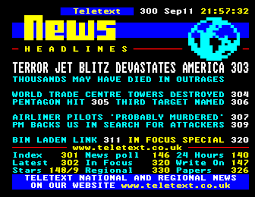
Largely due to multiple incompatible systems being in use. The Reagan FCC's "let the marketplace decide" approach worked even better for Teletext than it did for AM Stereo.
The CBS TV network ran Teletext in the vertical interval for a number of years in the 1980s, but it varied from station to station as to whether it was passed through on local affiliates.

An interesting sidelight to Teletext: Some enthusiasts collecting vintage VCR recordings from the 1980s have realized that the Teletext datastream is present on a few of those old tapes, and have attempted to retrieve and restore the graphics. Problem is that VCR head switching in the vertical interval tends to destroy the integrity of the data, so recovery isn’t possible.
 
An interesting sidelight to Teletext: Some enthusiasts collecting vintage VCR recordings from the 1980s have realized that the Teletext datastream is present on a few of those old tapes, and have attempted to retrieve and restore the graphics. Problem is that VCR head switching in the vertical interval tends to destroy the integrity of the data, so recovery isn’t possible.
But the features of XDS (eXtended Data Services) still work remarably well on old VHS recordings of analog TV:

 
But the features of XDS (eXtended Data Services) still work remarably well on old VHS recordings of analog TV:
XDS used the same scan line area (“below” the VITS signals and “above” the program video) as the various captioning services, so not affected by VCR head switching. Teletext appeared “above” the VITS signals higher in the raster, where head switching takes place.

 
XDS used the same scan line area (“below” the VITS signals and “above” the program video) as the various captioning services, so not affected by VCR head switching. Teletext appeared “above” the VITS signals higher in the raster, where head switching takes place.
XDS used line 21 (same as closed captioning) and optionally line 20. GCR (Ghost Cancelling Reference) used line 19. I actually bought a Magnavox "ImageLock" GCR box just to see if it will activate on any of my old VHS TV recordings.
 
XDS used line 21 (same as closed captioning) and optionally line 20. GCR (Ghost Cancelling Reference) used line 19. I actually bought a Magnavox "ImageLock" GCR box just to see if it will activate on any of my old VHS TV recordings.
You're only the second person I have ever encountered who knows what GCR was. It was a miracle in terms of the improvement it brought to over-the-air video reception. Such a shame it had poor adoption and came so late in the analog game.


Back
Top Bottom