ATSC 3.0 DRM concerns: Broadcasters bungled free antenna TV. Now they want a bailout?

-
Get involved.
We want your input!
Apply for Membership and join the conversations about everything related to broadcasting.
After we receive your registration, a moderator will review it. After your registration is approved, you will be permitted to post.
If you use a disposable or false email address, your registration will be rejected.
After your membership is approved, please take a minute to tell us a little bit about yourself.
https://www.radiodiscussions.com/forums/introduce-yourself.1088/
Thanks in advance and have fun!
RadioDiscussions Administrators
You are using an out of date browser. It may not display this or other websites correctly.
You should upgrade or use an alternative browser.
You should upgrade or use an alternative browser.
NAB asks for ATSC 3.0 mandate by 2030
- Thread starter Mediafrog+
- Start date

K.M. Richards
Program Director, The Eighties Channel™
That article is remarkably accurate. Thanks for finding and posting it.
What the ATSC 3.0 proponents don't seem to realize is that if they get their way, the majority of consumers won't upgrade ... they will do without or start subscribing to streaming services (if they aren't already).
I wonder: What is the value of a ATSC 3.0 television station license if the public refuses to watch?
What the ATSC 3.0 proponents don't seem to realize is that if they get their way, the majority of consumers won't upgrade ... they will do without or start subscribing to streaming services (if they aren't already).
I wonder: What is the value of a ATSC 3.0 television station license if the public refuses to watch?
It actually popped up on my Google News feed. Guess the algorithms spotted my posts and other internet readings on the subject!That article is remarkably accurate. Thanks for finding and posting it.
One thing that helped the transition from analog to ATSC 1.0 was the advent of flatscreen TVs at the same time, so people were purchasing new sets that were a major practical and technological step forward as well as being digital HD compatible. No similar situation today.What the ATSC 3.0 proponents don't seem to realize is that if they get their way, the majority of consumers won't upgrade ... they will do without or start subscribing to streaming services (if they aren't already).
Owners of AM stations wonder the same thing.🤪🤣I wonder: What is the value of a ATSC 3.0 television station license if the public refuses to watch?
K.M. Richards
Program Director, The Eighties Channel™
One thing that helped the transition from analog to ATSC 1.0 was the advent of flatscreen TVs at the same time, so people were purchasing new sets that were a major practical and technological step forward as well as being digital HD compatible. No similar situation today.\
That is an excellent point, and is another factor the "we want OTA pay television" consortium have failed to take into account. I know I kept my analog Zenith set for a couple of years after everything went digital, using a Zenith (coincidentally) D-to-A receiver to feed my old Series 2 TiVo for a couple of years before the latter announced they were going to end support for that model and it would eventually stop working because the "mothership" would no longer accept calls from the old units.
But they offered an upgrade to the TiVo I have now, which was designed to work with OTA digital -- it doesn't even have a provision to use cable video -- with the capability to view/record four channels simultaneously and keep my lifetime subscription. (I seem to recall that they briefly discounted the new TiVo, so it wasn't a huge bite out of my budget.)
And that was what forced me to replace the Zenith with a flat screen from Best Buy ... the new TiVo's menus were practically unreadable on the analog set. And I was one of the last holdouts, as near as I can figure.
"We have a new, higher quality transmission mode which you will need a paid subscription to watch" is the reverse of a compelling argument to buy a new TV to receive. Honestly, they're as clueless as the Keystone Kops and their demand for ATSC 1.0 to sunset is, pure and simple, a desperation move to get revenue from this expensive upgrade in transmitting facilities. The public isn't demanding it, and -- as you say -- there is no logical reason why the average consumer is going to be in the market for a new TV unless it stops working (or is demolished by one of the stupid people I see all the time on America's Funniest Home Videos).
Owners of AM stations wonder the same thing.🤪🤣
My primary client is of the opinion that Brendan Carr will eventually get to the point where AMs with translators will be allowed to license the latter as standalone stations with their existing facilities, take the attached AM permanently silent, and move the call letters, replacing the clunky "K288ZZ" ones.
IMNSHO, owners of AMs who did not take advantage of the "revitalization" that allowed AMs to use translators were short-sighted. I note that the only successful AMs these days are either high powered stations with large signal footprints, lesser signals in larger markets with ethnic or religious formats, or very small markets where they are pretty much the "hometown" station.
I do not believe the AM band will be even one-half as populated in several years.
I have found the Zenith DTT901 digital-to-analog converter box to be the best inexpensive converter they came out with in 2009. It is very sensitive and decodes the signal nicely, and also allows for menu tuning to unoccupied channels in search of signals. It is also able to juggle multiple stations with the same PSIP information, such that you can have, for instance, 3.x information for both WBTV and WSAV if you can get both stations (as I can on occasion). It also handles stations sharing the same OTA channel, such as WSOC and WCSC both on RF 19. These boxes can be found occasionally on eBay.That is an excellent point, and is another factor the "we want OTA pay television" consortium have failed to take into account. I know I kept my analog Zenith set for a couple of years after everything went digital, using a Zenith (coincidentally) D-to-A receiver to feed my old Series 2 TiVo for a couple of years before the latter announced they were going to end support for that model and it would eventually stop working because the "mothership" would no longer accept calls from the old units.
But they offered an upgrade to the TiVo I have now, which was designed to work with OTA digital -- it doesn't even have a provision to use cable video -- with the capability to view/record four channels simultaneously and keep my lifetime subscription. (I seem to recall that they briefly discounted the new TiVo, so it wasn't a huge bite out of my budget.)
And that was what forced me to replace the Zenith with a flat screen from Best Buy ... the new TiVo's menus were practically unreadable on the analog set. And I was one of the last holdouts, as near as I can figure.
"We have a new, higher quality transmission mode which you will need a paid subscription to watch" is the reverse of a compelling argument to buy a new TV to receive. Honestly, they're as clueless as the Keystone Kops and their demand for ATSC 1.0 to sunset is, pure and simple, a desperation move to get revenue from this expensive upgrade in transmitting facilities. The public isn't demanding it, and -- as you say -- there is no logical reason why the average consumer is going to be in the market for a new TV unless it stops working (or is demolished by one of the stupid people I see all the time on America's Funniest Home Videos).
My primary client is of the opinion that Brendan Carr will eventually get to the point where AMs with translators will be allowed to license the latter as standalone stations with their existing facilities, take the attached AM permanently silent, and move the call letters, replacing the clunky "K288ZZ" ones.
IMNSHO, owners of AMs who did not take advantage of the "revitalization" that allowed AMs to use translators were short-sighted. I note that the only successful AMs these days are either high powered stations with large signal footprints, lesser signals in larger markets with ethnic or religious formats, or very small markets where they are pretty much the "hometown" station.
I do not believe the AM band will be even one-half as populated in several years.
K.M. Richards
Program Director, The Eighties Channel™
These boxes can be found occasionally on eBay.
I still have mine, although I have not needed it since the TiVo upgrade. Sentimentality, I guess.

There was also the fact that stations (AM and FM) are allowed to have more than one translator. The FCC should have limited all stations to one translator only per station. There are stations like KGYM-AM with two. Is there a limit (FCC or otherwise) to how many translators a station can have?IMNSHO, owners of AMs who did not take advantage of the "revitalization" that allowed AMs to use translators were short-sighted. I note that the only successful AMs these days are either high powered stations with large signal footprints, lesser signals in larger markets with ethnic or religious formats, or very small markets where they are pretty much the "hometown" station.
K.M. Richards
Program Director, The Eighties Channel™
There was also the fact that stations (AM and FM) are allowed to have more than one translator. The FCC should have limited all stations to one translator only per station. There are stations like KGYM-AM with two. Is there a limit (FCC or otherwise) to how many translators a station can have?
No, and the lack of a limit is an acknowledgement of reality. For example, when Randy Michaels acquired WAKY in June, I plotted the contours of the full-power FM and the three translators on a single map and without all three, the coverage would be far from adequate to the north and east.
You are basing your opinion on faulty logic, without considering probabilities that do not meet the usual goals of AMs on translators. That said, if my client is guessing correctly about Carr's possible deregulating AM/translator combinations (as I detailed above), WAKY -- and other stations with similar circumstances -- will no doubt need waivers to maintain their existing service area.
Another possible "hiccup" if Carr does make that a reality ... some of the AM/translator combos already have FMs with the same base call letters (in fact, WAKY is one), so what happens then? I can only guess that the "keep the call letters" part of the equation will need to have waivers for the "new" FMs to apply for different calls.
Simply put: A "one size fits all" scenario is not always viable. Not now, and not if the deregulation happens.
Last edited:

There's no limit, and in fact there are AMs with five or more translators.
I don't think that's a bad thing in some cases. WCJW in Warsaw NY is one of only two commercial stations between Rochester and Buffalo, serving a huge but thinly populated rural area that the big city stations don't really think much about.
It's a daytime-only AM with 8 kW, and those translators provide the only 24-hour local service to most of four counties that would otherwise have nobody serving them.
As for the call letters, it would be easy enough to add a suffix like -FX to the AM's base callsign. For the FCC's own record keeping purposes, the facility ID number is what really matters anyway.
I don't think that's a bad thing in some cases. WCJW in Warsaw NY is one of only two commercial stations between Rochester and Buffalo, serving a huge but thinly populated rural area that the big city stations don't really think much about.
It's a daytime-only AM with 8 kW, and those translators provide the only 24-hour local service to most of four counties that would otherwise have nobody serving them.
As for the call letters, it would be easy enough to add a suffix like -FX to the AM's base callsign. For the FCC's own record keeping purposes, the facility ID number is what really matters anyway.
K.M. Richards
Program Director, The Eighties Channel™
As for the call letters, it would be easy enough to add a suffix like -FX to the AM's base callsign. For the FCC's own record keeping purposes, the facility ID number is what really matters anyway.
I think §73.1201 has become obsolete, for precisely that reason. The number of stations identifying with them around the clock keeps getting smaller ... for example, why should "Alt 98.7" here in L.A. still need to say "KYSR Los Angeles" once an hour?
There's no limit, and in fact there are AMs with five or more translators.
I don't think that's a bad thing in some cases. WCJW in Warsaw NY is one of only two commercial stations between Rochester and Buffalo, serving a huge but thinly populated rural area that the big city stations don't really think much about.
It's a daytime-only AM with 8 kW, and those translators provide the only 24-hour local service to most of four counties that would otherwise have nobody serving them.
As for the call letters, it would be easy enough to add a suffix like -FX to the AM's base callsign. For the FCC's own record keeping purposes, the facility ID number is what really matters anyway.
I remember reading a long time ago that while noncommercial FM outlets could have an unlimited number of translators, commercial FMs were (mostly) limited to translators where their coverage did exist but was weak. I also distinctly remember reading somewhere around the time that the FCC began allowing AM stations to have FM translators that the translators had to roughly be in the coverage areas served by the AM station they were supposed to be translating. Did I get this wrong?
FM translators of AM service must be within 25 miles of the AM transmitter, or the 2mV/m contour, whichever is more lenient for a particular licensee.I also distinctly remember reading somewhere around the time that the FCC began allowing AM stations to have FM translators that the translators had to roughly be in the coverage areas served by the AM station they were supposed to be translating. Did I get this wrong?
There is also rule that multiple translators of the same AM area serve non-overlapping areas. I don't recall which contour is used for that judgement. So one station I worked for had a translator 10 miles south of the CoL and one 6 miles north to provide decent coverage of the 3 largest communities in the AM's coverage area.
K.M. Richards
Program Director, The Eighties Channel™
I remember reading a long time ago that while noncommercial FM outlets could have an unlimited number of translators, commercial FMs were (mostly) limited to translators where their coverage did exist but was weak. I also distinctly remember reading somewhere around the time that the FCC began allowing AM stations to have FM translators that the translators had to roughly be in the coverage areas served by the AM station they were supposed to be translating. Did I get this wrong?
You are correct, Ted. Translators rebroadcasting commercial stations on either band are restricted to the primary (protected) service contour of the originating stations. For AMs, that is the daytime contour if the station has authorized nighttime facilities.
As @PTBoardOp93 just posted, there is an exception for AMs, based on the radius around the transmitter site.
Non-commercial stations can have translators as far away as they want, provided they can get the programming to it.
I am not as certain about the non-overlapping rule, as I do remember some overlap on WAKY's translators when I mapped them. Perhaps I should recreate that map.
K.M. Richards
Program Director, The Eighties Channel™
I recreated the map using the contour maps at FCCdata.org and whatever rule @PTBoardOp93 remembered apparently either no longer exists or there are waivers in place here:
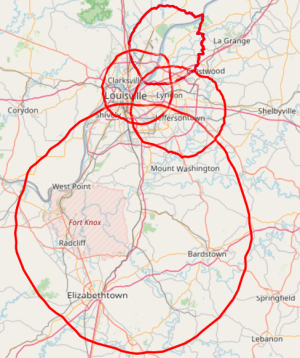
The three small contours are the translators. The big contour to the south is full-power WAKY-FM.
Not only is there overlap, there's a spot in the middle where all three translators overlap.
The three small contours are the translators. The big contour to the south is full-power WAKY-FM.
Not only is there overlap, there's a spot in the middle where all three translators overlap.
The rule, when it's observed at all, is that you can't have two translators with the same program source that have more than 50% of their 60 dBu coverage areas overlapping.
In the case of the WAKY-lators, it looks like each of those signals has no more than 50% overlap with any other translator.
The FCC will waive this rule if there's a showing provided that there's a good public interest benefit from allowing the overlap - if, for instance, there's an important population center that wouldn't otherwise be served, or if there's a terrain showing that the overlap won't exist in the real world.
In the case of the WAKY-lators, it looks like each of those signals has no more than 50% overlap with any other translator.
The FCC will waive this rule if there's a showing provided that there's a good public interest benefit from allowing the overlap - if, for instance, there's an important population center that wouldn't otherwise be served, or if there's a terrain showing that the overlap won't exist in the real world.
Excellent article. Their getting this wish granted would be so symbolic of the anti-consumer regulatory climate in America today. When the public refuses to buy into your combine's crippleware, just lean on regulatory capture to force sales at gunpoint. This quote in particular ...ATSC 3.0 DRM concerns: Broadcasters bungled free antenna TV. Now they want a bailout?
Weigel Broadcasting Company, which operates MeTV and several other popular digital subchannels, has told the FCC that televisions may eventually block or hinder users from viewing stations that haven’t purchased an encryption certificate. That effectively could turn the A3SA, a private entity, into a gatekeeper for the public airwaves.
... reads like the sort of corporate cartel maneuvering the Justice Department would have once instantly stopped on sight. If I may be sarcastic, it also sounds like something Dear Leader and his engineers at KCNA would lovingly engineer for "truth control" of pesky cross-border television signals beaming in from South Korea...
Agreed. This move is the television equivalent of making the public "want" IBOC by suddenly forcing every analog FM signal off the air. All that the people who don't already have it will do is reach for their phones and search "pandora playlist that sounds like KXYZ-FM used to."What the ATSC 3.0 proponents don't seem to realize is that if they get their way, the majority of consumers won't upgrade ... they will do without or start subscribing to streaming services (if they aren't already).
The same as the value of a DIVX player, I suspect.I wonder: What is the value of a ATSC 3.0 television station license if the public refuses to watch?
I have its internally identical, Best Buy house-branded clone, the Insignia NS-DXA1. I remember researching what the best unit was back then too and settling on this same box. Although from doing a search now, one source from that era claims that a ChannelMaster unit was slightly superior.I have found the Zenith DTT901 digital-to-analog converter box to be the best inexpensive converter they came out with in 2009.
I keep mine so I can do occasional re-scans in search of new signals and subchannels without blowing up my actual television's carefully pruned channel up/down whitelist.I still have mine, although I have not needed it since the TiVo upgrade. Sentimentality, I guess.
Last edited:
More thoughts on ATSC 3.0: Analysis: NextGen TV transition exposes tensions between public airwaves and private control
K.M. Richards
Program Director, The Eighties Channel™
More thoughts on ATSC 3.0: Analysis: NextGen TV transition exposes tensions between public airwaves and private control
Good, thorough, and accurate article. Thanks for finding it and posting the link.
K.M. Richards
Program Director, The Eighties Channel™
Yeah, what else would you expect from an industry "news" site that caters to television broadcasters?