Re: Happy, Happy, Happy
> > Just as I suspected, your signal-strength figures
> > were substantially more fantasy than fact.
>
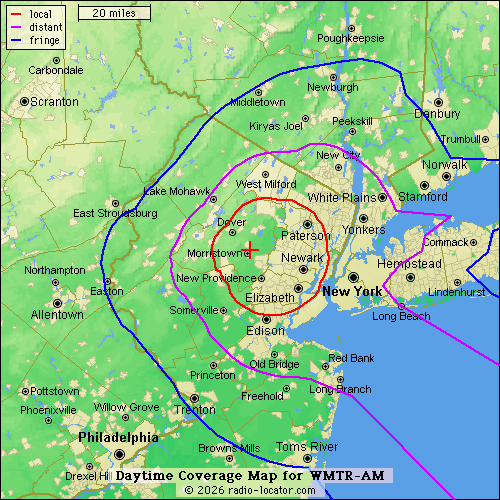
> Allow me to correct what I said. WMTR's daytime 0.5 mV/m
> FCC Protected Signal Contour (the purple line on this map)
> covers ALL OF MORRIS COUNTY. So if you are in Morris County
> and you are not getting an acceptable daytime signal from
> WMTR, GET A BETTER RADIO!
>
Ah Ha!! Radio-locator.com. Your source for
those field-strength readings. But does
reality match the map you presented? Why
don't we ask the people who presented it on
the Web..radio-locator.com themselves. Here's
what they say about their own maps:
"...we also hope you understand that they are
"predictions" based upon the information that
we have available to us, and that your actual
reception of these stations may vary considerably."
Yes, my friend, predictions!! Fact? No. A guess?
Yes!! The phrase to remember here is "vary
considerably."
The next time you look at one of these maps from
radio-locator.com remember that they describe
them only as predictions, not representative of
the actual coverage area.
That all being said, remember that terrain, ground
conductivity, antenna construction, etc. all affect
how a coverage pattern will look. As any chief would
tell you, field-strength readings vary, even during a
single day.
For those of you from out of the area, rest assured
that WMTR does not have a good signal to the west of
their Hanover transmitter. Receivable? Yes. Sounding
punchy and strong? No. And the bottom line, engineering-wise,
is to produce a signal at the listener's receiver that's
going to make that listener a fan. If the received signal
doesn't rise enough above the local noise level than the
listener will become a...former listener. And advertisers
don't run ads for those who don't listen.
A bit about radios that westlife enjoys discussing.
When a station is designed a good chief engineer,
or the consulting company if they go that way, has
to consider the entire system, not just the resources
available at the transmitter site. No matter how much
power you squirt into the aether you still have to
understand what's happening at the listener's end.
Many listeners are in the challenging environment of
the automobile. Even the best car radio has difficulty
coping with the noise-filled world of New Jersey's
highways and byways. Ignitions, traffic signals, power lines,
etc. make listening marginal in many areas. The solution,
of course, is for the station to provide enough signal to
mask the locally generated noise. However, many drivers
will tolerate noise if what's on the radio is sufficiently
interesting. But not for too long. If another station has
an interference-free signal that listener will be tempted
to linger on that spot on the dial.
Listeners at home have a choice of table radios, clock radios,
and portables, such as walkmans. Most of those appliances
aren't built for DXing. In fact, without sounding like a
codger, many of the All-American Five tube radios from the
1950s exhibit finer reception than the stuff you take off
the shelf in Wal-Mart's electronics department.
It's curious how passionate some people are in defending
anything they sense is a slur against WMTR. I wasn't
demeaning the station. Only pointing out that it doesn't
have a good signal to the west. I suspect their chief would
acknowledge that. So why all the vitriole, sarcasm, etc.?
Beats me. Perhaps one or both of my challengers work for
or have some other connection with WMTR. No problem there
but gee, you don't have to get bent out of shape.
Maybe I'll start another thread. How about discussing the
merits of a 3-letter callsign versus a 4-letter one? That
thread would run off the right edge of my monitor!!