• Get involved.
    We want your input!
    Apply for Membership and join the conversations about everything related to broadcasting.

    After we receive your registration, a moderator will review it. After your registration is approved, you will be permitted to post.
    If you use a disposable or false email address, your registration will be rejected.

    After your membership is approved, please take a minute to tell us a little bit about yourself.
    https://www.radiodiscussions.com/forums/introduce-yourself.1088/

    Thanks in advance and have fun!
    RadioDiscussions Administrators

SiriusXM projected to have lower subscriber gains later in 2023

I also listen to satellite nearly all the time now. I don't like the music selection as well as tighter, more researched and stiff and dud free terrestrial services, but I can't take the long commercial breaks and the horrible production and creative in the ads today.
I agree. I listen to music exclusively on SXM, and news/talk on broadcast radio -- but only streaming -- never OTA, neither AM nor FM.

I'm happy to pay for ad-free music, and I hope the locally inserted ads on the streams will help to support the local stations I listen to.

Basically, I'll follow the content wherever it is. But "radios" are harder to find these days and reception issues are an ever increasing problem.
 
I can see why they would want to cut out free streaming -- it looks like they've been losing money for 17 years. 70% of their revenue goes to pay the royalties, which rumor mills say the music industry wants raised considerably (at least one artists' group called for Spotify to double what they pay). Even Apple reportedly pays 52 cents of every dollar made on their streaming service to royalties.

The problem, for Spotify at least, is that with cutting out free streaming, it's more than half of their listeners (who are free streamers).

So how does this all pencil out, if streaming is the future of radio? Streaming looks like a business model that -- unless big changes are made -- loses money.

Does this mean radio will lose money when they go all streaming, and get rid of their towers and transmitters? Or does it mean that OTA radio will probably be around for another 2-3 decades? My gut is probably the latter. But I'm just an observer.
I don't forsee that happening for a couple of decades. The elimination of free over-the-air broadcasting isn't something we should want.
 
I don't forsee that happening for a couple of decades. The elimination of free over-the-air broadcasting isn't something we should want.
Agreed, but what we radio types want and what the listening public chooses may be different things. If everyone under 30 is using their phone to hear streamed audio, as insisted upthread -- be it to radio stations' streams, SXM's streams, or Pandora or Spotify -- that sort of leaves OTA radio in the lurch. The 20 somethings today will be prime buying demos in just 5-10 years. If they already shirk OTA radio, and the audience drops, what will that do to OTA radio's business model?

And if some of the largest streaming services on the planet can't make a profit in 17+ years, that indicates something a bit awry in the business model. If royalties double, as some artists want, Spotify could be spending 140% of their revenue on royalties, as opposed to just 70. How is that going to work out for them, and what does that say about the streaming model?

The royalty rates probably won't stay where they are forever. They're only going to go up. And that would mean the subscription rates would have to go up.

Which could be a boon for OTA radio, I suppose.
 
Well there you go Chimp! Missed opportunity to trade-up.
I don't know whether they ran.

I went to church with a man who restored Model As. I didn't know that's what they were until his funeral. I just knew every now and then he'd show up at church in a very old car.
 
The 4 SiriusXM channels that provided traffic and weather for 8 cities have been dropped. I think that is a cost-saving decision which makes sense.
Whenever I tuned into them, they seemed to be a repeating loop, making them seem stale. And since each carried information for two cities, it would often be necessary to listen for a few minutes to traffic and weather for the other city. I much preferred the traffic reports from local terrestrial stations, which seemed more up to date.
 
The 4 SiriusXM channels that provided traffic and weather for 8 cities have been dropped. I think that is a cost-saving decision which makes sense.
Also a bit savings. Getting rid of all those traffic channels can be used for a music or several talk/news channels. Also, I believe SXM was paying a service for that traffic info.
 
I believe SXM was paying a service for that traffic info.

At one time, it came from Metro Traffic before that company was bought by Total Traffic.

When this was first launched, broadcasters cried foul about this, because it appeared to violate the rules for satellite radio.
 
I used to listen. When I was driving across the dessert on I-40 headed for LA, I used to check out the traffic long before I could get KNX on the radio. That way I could plan my route into LA given the choice of freeways.
 
I remember that too. Fortunately their concerns were assuaged because nobody actually listened.
And every subscriber could hear every one of the traffic/weather channels. XM's legal eagles found a clever loophole that allowed it to send out localized programming to a mass audience. What the regulators were concerned with was XM feeding each market's traffic/weather info only to that market's terrestrial translators, which would then transmit the info only to that market. The way it worked out, though, prohibiting XM from sending everything to everyone via the satellites and translators would be akin to prohibiting it from carrying network coverage of bad weather in a specific area.

I also used to listen on trips to Boston from Connecticut. It came in handy if I didn't have nine minutes to wait for WBZ's next "Weather on the 3's" update.
 
According to an article today in RadioInsight, the traffic channels had been dropped back in October 2016, and brought back a few months later, due to "subscriber demand."
That's RadioInsight unquestioningly swallowing SiriusXM's spin. Every time SXM brings back Billy Joel's channel for another run, or extends a pop-up channel's run past its original sunset date, it puts out a "subscriber demand" press release, often containing grandiose puffery from content czar Scott Greenstein. Of course, what determines when an outsourced channel on SXM ends is the same thing that got it on the satellites to begin with: cold, hard cash.
 
My recollection is that they also had some LP terrestrial frequencies in some cities, such as NYC, to augment their coverage, perhaps in the tunnels & bridges. Those couldn't be cheap, and there's probably big demand for those frequencies now.
 
My recollection is that they also had some LP terrestrial frequencies in some cities, such as NYC, to augment their coverage, perhaps in the tunnels & bridges. Those couldn't be cheap, and there's probably big demand for those frequencies now.
I believe you are referring to the many repeaters that are used to augment satellite radio reception in urban areas.
Satellite Radio Repeaters
 
My recollection is that they also had some LP terrestrial frequencies in some cities, such as NYC, to augment their coverage, perhaps in the tunnels & bridges. Those couldn't be cheap, and there's probably big demand for those frequencies now.
I don't recall them ever having a terrestrial FM frequency anywhere. They had translators in many places, though, with the XM programming on whatever frequency the satellites used, then processed by the receivers to match channel numbers and be heard on an FM frequency of the listener's choice (if the listener wasn't using a factory-installed car unit, that is.) They even had one in downtown Meriden, CT! There was talk years back, even before the Sirius takeover of XM, that the terrestrial repeater network would be trimmed. I doubt many of them are still around other than in big cities with significant concrete jungles blocking satellite signals.
 
My recollection is that they also had some LP terrestrial frequencies in some cities, such as NYC, to augment their coverage, perhaps in the tunnels & bridges. Those couldn't be cheap, and there's probably big demand for those frequencies now.
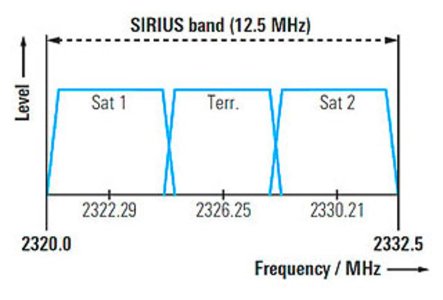
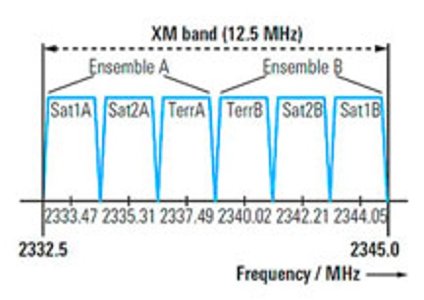
Those still use the same spectrum as the satellite, which has very little use beyond broadcast at 12.5Mhz each
 

Attachments

  • Siriusband_01_w1280_hX.jpg
    Siriusband_01_w1280_hX.jpg
    93.8 KB · Views: 3
  • XMband_01_w640_hX.jpg
    XMband_01_w640_hX.jpg
    45 KB · Views: 4
My recollection is that they also had some LP terrestrial frequencies in some cities, such as NYC, to augment their coverage, perhaps in the tunnels & bridges. Those couldn't be cheap, and there's probably big demand for those frequencies now.
The local boosters continue just as before, but they are intended to fill in shadow areas for the whole spectrum of either Sirius or XM channels. The shadow areas include terrain shadows, bridge / freeway shadows and high-rise building shadows.
 
Status
This thread has been closed due to inactivity. You can create a new thread to discuss this topic.


Back
Top Bottom