• Get involved.
    We want your input!
    Apply for Membership and join the conversations about everything related to broadcasting.

    After we receive your registration, a moderator will review it. After your registration is approved, you will be permitted to post.
    If you use a disposable or false email address, your registration will be rejected.

    After your membership is approved, please take a minute to tell us a little bit about yourself.
    https://www.radiodiscussions.com/forums/introduce-yourself.1088/

    Thanks in advance and have fun!
    RadioDiscussions Administrators

So Cal Hits

So, yeah....you could do it. In 1971, in a town of 3,500. Everyone's mileage absolutely varied.
Amazing story.

The closest I came might have been when I was at UC Santa Barbara--I thought about getting a program on KCSB. In those days you had to start out on the campus carrier current AM station. But other interests and issues directed me elsewhere.

Also in the early 1990s, a friend from high school had a Sunday afternoon gospel show on the 1220 station in Pomona for a few months; I used to listen when driving home from church...
 
The WLS airplay was heard regionally throughout the midwest, and other stations picked it up.
But we learned of the WLS playlist through the Gavin Report, Hamilton, FMQB and other "tip sheets" and not by listening. And WLS was fairly slow in going on new songs except for AAA artists.
 
But we learned of the WLS playlist through the Gavin Report, Hamilton, FMQB and other "tip sheets" and not by listening. And WLS was fairly slow in going on new songs except for AAA artists.

When you say "we" you mean radio stations. My post was about reaching radio listeners.

The original version of Gloria was released on Parrott records, owned by Decca, a major label that had Tom Jones and the Zombies on it. They had a national footprint. I'd suggest Parrott had access to the same trade publications to promote their music as Dunwich, but it wasn't the original that became the national hit. As a result, the song by Them was only a So Cal Hit.
 
When you say "we" you mean radio stations. My post was about reaching radio listeners.
As the 60's moved forward, more and more markets had Top 40 stations. By the early 70's, FM Top 40's popped up all over. Nobody other than in sparsely populated rural areas was listening to an AM from far away
The original version of Gloria was released on Parrott records, owned by Decca, a major label that had Tom Jones and the Zombies on it. They had a national footprint. I'd suggest Parrott had access to the same trade publications to promote their music as Dunwich, but it wasn't the original that became the national hit. As a result, the song by Them was only a So Cal Hit.
Anyone who wanted to could subscribe to the trades... even Billboard and Cash Box and Record World, too.
 
Anyone with $500 a year.
A lot less back in the 70's which I thought was the era we were talking about. Hamilton was $130 a year in '72 and FMQB was, I think, ten bucks less. The first year of R&R, 1973, was a competitive $130. In 1973, Billboard was $40 a year.

Gavin was the same.

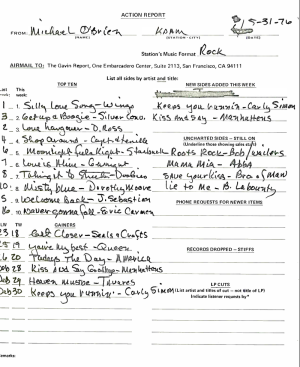
As a reference to how stations reported to R&R, Hamilton, Gavin, FMQB and the others, here is a "real" report from a "reporting station" from 1976 to the Gavin sheet:

1693537413784.png

Note that a station that called itself "Rock" was playing Silver Convention, Tavares and ABBA. That points out, rather dramatically, that format names and even music classifications have changed and morphed over the years.
 
If I recall, WLS covered 38 states with its nighttime signal. I don't think KRLA covered a third of a state.
I think WWWE/WTAM 1100 made the same claim but tagged it as "38 states and two countries", Canada of course being the other country. I heard that sometime back in the 70s or 80s that it was picked up regularly in South Africa in the summer and fall. I remember listening to it in the Tampa Bay area back in 1982. Nowadays......it might hit 3.8 states. And Google mapping their site they have, as of June this year, 12 acres up for sale.
 
Last edited:
It's a punishing shift in terms of sleep deprivation and lifestyle changes and I always marveled that Johnny Williams at KHJ (who was excellent, by the way) was able to do it for nine years.
With the exception of one station I always did overnights. Much preferred it that way, in the station by myself, nobody to bug me except the random wino that would beat on the door [usually another DJ that forgot his keys] so I could ignore them if I wanted. Catch hell for it later but so what? I have always been a night person. My mom says I'm half vampire and when I see the hint of daylight in the morning its "Damn, I need to get to bed NOW before I burst into flames!"
 
With the exception of one station I always did overnights. Much preferred it that way, in the station by myself, nobody to bug me except the random wino that would beat on the door [usually another DJ that forgot his keys] so I could ignore them if I wanted. Catch hell for it later but so what? I have always been a night person. My mom says I'm half vampire and when I see the hint of daylight in the morning its "Damn, I need to get to bed NOW before I burst into flames!"
I've always been a night person also, because as I was growing up, I became fascinated with DX'ing for AM stations at night across the nation to see how many I could pull in. I enjoyed sitting in the dark (I had to convince my parents that I was asleep, so I had to keep the light off) and searching for far-away stations. Radio at night is magical.

But because no one is listening, it is seen as "the graveyard shift" for people who are somehow unsuitable for daytime. (with the exception of talents like Johnny Williams, Larry King, Art Bell, etc.) I would have volunteered at no charge to work the overnight shift and make it into a show worth listening to. But unfortunately, station managers see the overnight shift as described above -- just play songs, say as little as possible, and keep the equipment up and running until the really important people arrive for the morning shift. - Daryl :)
 
So, I honestly have no idea whether I've told this story on this board or not in the past 20-something years, but if I have it's been forever, so...

I wanted to be on the radio starting at age 8. Heard Gary Owens on KMPC and that was it. But I thought you had to go to school, finish college and then God knows what.

Flash forward six years. My dad died the year I heard Gary Owens and we've moved 270 miles north of L.A. to Bishop, California, where my mom's side of the family had been for the past 45 years.

There's one radio station, KIBS. 1,000 watts daytime, 250 nighttime at 1230 on the dial. They hire high school kids for cheap talent.

One day, at age 14, I'm shooting hoops with some friends when Virginia Holmes, a substitute teacher and host of KIBS' daily "Coffee With Virginia" (light pop music, household hints and recipes) is visiting her sister, our next-door neighbor.

She recognizes me from school and remembers I read well. So she comes out to ask if I'd like a job at the radio station. I'd like a job at the gas station---are you kidding me? She clears it with mom, takes me down to KIBS, pulls a newscast off the wire machine and has me read it into a tape recorder.

She gives the tape to the General Manager, John Hemler, whose kids I go to school with. He calls and says if I can pass the FCC third-class (with endorsement) test, he'll give me a job. He loans me the books to study, mom takes a day off work, drives 270 miles to Los Angeles, waits in the hallway of the federal building while I take the exam, buys me a Big Mac (we didn't have McDonald's in Bishop yet), and drives 270 miles back to Bishop.

Three weeks later (during which I had turned 15), an official-looking envelope arrives from the FCC and inside is my license. I'm hired.

I start with the 6:00 a.m.-Noon shift on Sundays. Duties: Unlock the building, turn on the transmitter, hit the sign-on at 6:00 a.m. and play religious tapes and public affairs shows back-to-back for six hours. I can turn on the microphone (in fact, I have to) every half-hour to say "KIBS, Bishop." No more, no less.

After about six weeks of that, someone leaves, they hire a new kid, give him that shift and I move into Noon to 6 on Sundays, where I can actually play records and talk. Granted, they're not the records I'd want to play (those are only played at night), but it's something.

Six months in, I get the weekday evenings, and as David said, I rode my bike from school to the radio station. When I signed off at 10 p.m., Mom would be waiting in the parking lot, we'd put the bike in the trunk of her Mercury and go home.

Six months after that, I had a driver's license and 90 days after that I'd bought a used car, so I got myself to and from work.

At that station, in just under three years, I went from that "only the ID" Sunday morning shift to Sunday afternoons, weekday evenings, Music Director, Program Director and midday jock.

So, yeah....you could do it. In 1971, in a town of 3,500. Everyone's mileage absolutely varied.

Thanks to you and the others who have shared your stories. I love the just hanging around the studio, willing to do go-fer jobs, or riding the bike to the studio and then building a successful career from there. It is the American way. Rush Limbaugh did exactly the same thing and I believe his career worked out alright too.

I always wanted to be in radio when I was a kid, and in fact got to hang around a tiny station in Kings Beach, CA for awhile when I befriended one of the jocks. But I decided early on I wanted to make money and probably didn't have the talent to be on the air anyways, so I just let it be a dream for others to live. That is why I still hang around radio boards all these years later.
 
Thanks to you and the others who have shared your stories. I love the just hanging around the studio, willing to do go-fer jobs, or riding the bike to the studio and then building a successful career from there. It is the American way. Rush Limbaugh did exactly the same thing and I believe his career worked out alright too.

I always wanted to be in radio when I was a kid, and in fact got to hang around a tiny station in Kings Beach, CA for awhile when I befriended one of the jocks. But I decided early on I wanted to make money and probably didn't have the talent to be on the air anyways, so I just let it be a dream for others to live. That is why I still hang around radio boards all these years later.
Good post! I don’t know how young you are, but David says the qualifications for overnight DJ are: no criminal record, no drugs, and be able to read a few commercial spots correctly. Oh- plus, have a nighttime Circadian rhythm so as to not fall asleep on the job. So, that still might be a fun job for you to have as a hobby.
 
Good post! I don’t know how young you are, but David says the qualifications for overnight DJ are: no criminal record, no drugs, and be able to read a few commercial spots correctly.
Not even "read spots". I never saw more than a couple of buys in overnights, even when I was with very top stations in larger markets. And I never saw a live read at that time nor would I have accepted one. In fact, anywhere I managed or supervised sales, a "live read" meant the talent who did it laid down 8 or 10 different recorded versions that sounded live each week to 10 days and they rotated in that person's shift.
Oh- plus, have a nighttime Circadian rhythm so as to not fall asleep on the job. So, that still might be a fun job for you to have as a hobby.
I do all my www.worldradiohistory.com work after 9 PM, often seeing the sun rise. I always thought it came from been a DXer when an early teen and doing all my own basic engineering at stations for the next 10 to 15 years; most transmitter work is done after midnight.
 
Not even "read spots". I never saw more than a couple of buys in overnights, even when I was with very top stations in larger markets. And I never saw a live read at that time nor would I have accepted one. In fact, anywhere I managed or supervised sales, a "live read" meant the talent who did it laid down 8 or 10 different recorded versions that sounded live each week to 10 days and they rotated in that person's shift.

I do all my www.worldradiohistory.com work after 9 PM, often seeing the sun rise. I always thought it came from been a DXer when an early teen and doing all my own basic engineering at stations for the next 10 to 15 years; most transmitter work is done after midnight.
Yep ! LOL. That's how I became a night owl. I didn't want to sleep because I was busy DX'ing as a young teen. Night time is magical for that. I just had a little G.E. transistor that fit under my pillow. And DX'ing is not easy in L.A., where almost every frequency is already taken by an L.A. or San Diego station. But I was patient and managed to pull in KTAR Phoenix, KOMO Seattle, KSL Salt Lake City; "Yours Truly K-O-M-A, Ok. City, and even CKLW one clear winter night. Super fun.
 
Not even "read spots". I never saw more than a couple of buys in overnights, even when I was with very top stations in larger markets.

The stations I worked for maintained a minimum level (six minutes an hour) of spots (all bonuses, I'm sure) just to maintain some sense that there was a radio station.

KHJ actually did ten minutes an hour in overnights, likely all bonused, including live spots for Hillcrest Cadillac (owned by RKO board member Willet Brown, the owner of KGB in San Diego) and produced spots for big clients like Pan Am.

Most stations, though, didn't bother.
 
KHJ actually did ten minutes an hour in overnights, likely all bonused, including live spots for Hillcrest Cadillac (owned by RKO board member Willet Brown, the owner of KGB in San Diego) and produced spots for big clients like Pan Am.
I did not know that. Of course, it was the 60's.

When I had a totally dominant cluster of stations in Quito, Ecuador, in those same 1960's it got to the point that I only sold 24 hour a day, Monday to Sunday rotators. No fixed dayparts or times. So if you bought 20 spots a day, 5 would run in overnights.

After a while, we increased rates significantly and stopped the paid spots at Midnight.
 
I did not know that. Of course, it was the 60's.
Yeah, and 70s. The philosophy was that keeping a minimum spot level actually helped with music rotation control (done by hand in those days) and kept the station from sounding like nothing was happening. As a result, many people online have commented on Johnny Williams' shows as being a solid midday show, when in fact, it was 2 in the morning, not in the afternoon.
 
I’ve programmed in a number of major markets of up to 20 million people and, still, there was never much time to work with the overnight people as it did not matter. No sales, no revenue.

The main criteria for overnights was to find someone who showed up on time, didn’t drink or toke on the job, did not “party” during long sons and stayed awake. We limited them to very basic content. Usually they came from a smaller market where the had a decent but not necessarily great showing in a day shift, but had good references.

At very few stations was there time to do “career enhancement” training.
Growing up in Chicagoland in the 60s, we had several great all night hosts. Franklin McCormack on WGN, Yvonne Daniels and Duck Biondi on WCFL and WLS, Jay Andres on WBBM, Eddie Chicago Schwartz on WIND, and Don Phillips and Jerry Kaye on WLS. To me, many sounded better than their daytime colleagues. Most came from large markets like Milwaukee and Seattle. Many stayed decades on these shifts. Was Chicago uniquely good for all night radio back then?
 
Some of these (Billboard, at least) were available at larger public libraries (you might have had to go to the "main library" downtown to see them...)
Some even had R&R as well. But if they had Billboard, they likely had Cash Box and Record World until those closed up shop.
 
Yep ! LOL. That's how I became a night owl. I didn't want to sleep because I was busy DX'ing as a young teen. Night time is magical for that. I just had a little G.E. transistor that fit under my pillow.

And DX'ing is not easy in L.A., where almost every frequency is already taken by an L.A. or San Diego station. But I was patient and managed to pull in KTAR Phoenix, KOMO Seattle, KSL Salt Lake City; "Yours Truly K-O-M-A, Ok. City, and even CKLW one clear winter night. Super fun.
I remember getting up in the middle of the night, one summer night in 1977. Somehow the radio had found its way to KOMA-1520 (Usually I listened to KLAC-570 or KFI-640 at night...). Hearing that station, or perhaps picking up WBAP-820 from Northern Mississippi earlier that year, kicked off my DXing career.
 
Status
This thread has been closed due to inactivity. You can create a new thread to discuss this topic.


Back
Top Bottom