• Get involved.
    We want your input!
    Apply for Membership and join the conversations about everything related to broadcasting.

    After we receive your registration, a moderator will review it. After your registration is approved, you will be permitted to post.
    If you use a disposable or false email address, your registration will be rejected.

    After your membership is approved, please take a minute to tell us a little bit about yourself.
    https://www.radiodiscussions.com/forums/introduce-yourself.1088/

    Thanks in advance and have fun!
    RadioDiscussions Administrators

Some thoughts after reviewing the 3rd Window applicants

Both are secondary services. But they have different rules. A translator can go places where an LPFM cannot.

That's what Captain Kirk used to say about the Enterprise.
 
The concept behind LPFM was to make the application process so easy that it didn't require an engineering consultant.

LPFM spacing is, therefore, done entirely on a mileage basis. Every LPFM's initial application has to show full spacing based on the table in 73.807. The idea was that LPFM applicants wouldn't have the technical ability to make a DA showing to resolve spacing issues.

The current version of the LPFM rules allows for the use of DAs only to resolve second-adjacent interference issues. Otherwise, the expectation is that LPFMs will use a ND antenna.

As a result, there are lots of places where a translator can fit with a DA but a ND LPFM can't go.

(And that's not even getting into the way the LPFM rules assume that all full-power stations are operating at class maximum. I had one situation where an LPFM in the educational band would have fit perfectly in the real world, but I had to protect a 100-watt station 40 miles away as though it were a full 6 kW class A.)
 
The concept behind LPFM was to make the application process so easy that it didn't require an engineering consultant.

LPFM spacing is, therefore, done entirely on a mileage basis. Every LPFM's initial application has to show full spacing based on the table in 73.807. The idea was that LPFM applicants wouldn't have the technical ability to make a DA showing to resolve spacing issues.

The current version of the LPFM rules allows for the use of DAs only to resolve second-adjacent interference issues. Otherwise, the expectation is that LPFMs will use a ND antenna.

As a result, there are lots of places where a translator can fit with a DA but a ND LPFM can't go.

(And that's not even getting into the way the LPFM rules assume that all full-power stations are operating at class maximum. I had one situation where an LPFM in the educational band would have fit perfectly in the real world, but I had to protect a 100-watt station 40 miles away as though it were a full 6 kW class A.)
So who was the idiot anti-consultant consultant who proposed these things before the FCC? Wait a minute. It might have been me.
 
Another black-and-white rule in those initial written-test applications was that such LPFM's were non-transferable.
So naturally, well before our LPFM was granted a license to cover, one of the main people in the corporation got a phone call, an offer to buy the station. Either corporate maneuvres had tentacles out as early as THAT overture ..... or the station's morals were being tested.
Be that as it may: there was a LOT of industry concern back then, in one form or another. Scott Fybush's observation that the rules were simplified to the extent of being no more challenging than the written test for a driver's permit had to've caused some affronted scowls.
Still, the FCC didn't want to see a passing grade. Or a 90% gold star. They insisted on nothing less than a 100.
 
Last edited:
All full power frequencies in the commercial band had to meet milage or km separation requirements to be allowed on the FCC's table of allocations. The same was true for Class D low power NCE stations in the commercial band. Low Power FM's are not much different than the Class D low power FM's from the old days.
Sure someone who had a First Class Radio Telephone License or an Advanced Ham license could do this work. In other words, you need to have some expertise to be a consultant.

The FCC has added some tools that have made 2 days work into a computer mouse click.
 
Last edited:
The book Sex And Broadcasting was the Bible of the community radio movement. How many of you have read it?

What did the author get wrong?
Lorenzo Milam hated American commercial radio. He thought it was full of egomaniac backstabbers. The people with the biggest ego rose to the top and crushed talented people.

However, I have found plenty of egomaniacs and backstabbers in the community radio movement as well. I've seen many hostile takeovers of community radio stations. The human being like the chickens and dogs have a pecking order. Sorry to spoil the radio dream of utopia in the form of community broadcasting.
 
However, I have found plenty of egomaniacs and backstabbers in the community radio movement as well. I've seen many hostile takeovers of community radio stations. The human being like the chickens and dogs have a pecking order. Sorry to spoil the radio dream of utopia in the form of community broadcasting.
And that's a huge continuing hurdle when depending on volunteers to run a community radio station. It never fails that you'll have certain volunteers who feel like they're in charge or that part of their non-existent compensation is the ability to do what they please.
These same folks always ensure you know you owe them and frequently make life difficult for new or existing volunteers. It's like 'adult' middle school sometimes.
I've even heard of examples where volunteers asked to leave have lawyered up and gone after the community broadcasters for compensation for extra 'volunteer' hours worked, undo stress and anxiety, or what's considered a 'hostile work environment', despite the fact, they were the ones creating the hostility.
When it comes to using volunteers in broadcasting; volunteers suck.
 
And that's a huge continuing hurdle when depending on volunteers to run a community radio station. It never fails that you'll have certain volunteers who feel like they're in charge or that part of their non-existent compensation is the ability to do what they please.
These same folks always ensure you know you owe them and frequently make life difficult for new or existing volunteers. It's like 'adult' middle school sometimes.
I've even heard of examples where volunteers asked to leave have lawyered up and gone after the community broadcasters for compensation for extra 'volunteer' hours worked, undo stress and anxiety, or what's considered a 'hostile work environment', despite the fact, they were the ones creating the hostility.
When it comes to using volunteers in broadcasting; volunteers suck.
I try not to suck, but I do have my days where suckituge is the rallying cry.
 
Long ago there was a guy pirating on 91.9 MHz in Indianapolis. I owned a commercial FM in the market. We had a mutual friend. She was working at the BBC in the UK. She came for a visit and asked if I would help her friend get a license.

So, I had him over and helped him prepare FCC form 340 which resulted in a CP for 6 KW in a major city. He took his life savings and built the station. His studio was in his house in Indianapolis. He ran the station for more than a decade off donations and his savings. His wife and kids were on the board of directors. He also had volunteers and did the community radio thing.

Not long ago, he died. On his deathbed he and I were on the telephone with his FCC lawyer. He was also my attorney. He was pleading with the lawyer to not let anyone steal control of he station from his wife and kids. So sad!
 
And that's a huge continuing hurdle when depending on volunteers to run a community radio station. It never fails that you'll have certain volunteers who feel like they're in charge or that part of their non-existent compensation is the ability to do what they please.
These same folks always ensure you know you owe them and frequently make life difficult for new or existing volunteers. It's like 'adult' middle school sometimes.
I've even heard of examples where volunteers asked to leave have lawyered up and gone after the community broadcasters for compensation for extra 'volunteer' hours worked, undo stress and anxiety, or what's considered a 'hostile work environment', despite the fact, they were the ones creating the hostility.
When it comes to using volunteers in broadcasting; volunteers suck.
Respectfully, that's the situation in a lot of organizations where they rely heavily on volunteers. Inevitably you get some with big feelings or egos and they end up thinking they run the place and at times attempt to do so. There are many examples: Community theater where you get overeager volunteers who spend seemingly all their free time there and eventually start barking out orders or disagreeing with paid, professional staff though they're unqualified to do so. Where I grew up, most fire and rescue departments outside the larger cities were largely volunteer. While many were kind-hearted, dedicated and were doing it for the right reasons, there's often infighting and cliques in those types of organizations and younger guys especially develop a "god complex" with lights and sirens in their cars to move traffic, barking out orders at the public, etc. I've also seen other organizations where there are paid folks on staff and volunteers - and somehow instead of 1 large, well-managed organization, it becomes the volunteers vs. the paid folks and tensions develop. Silly and in many cases counter-productive to the end goal, but it happens all too often.
 
When it comes to LPFM, the Prometheus styled community stations tend to really have an attitude against anybody in radio. It s as if anybody in radio professionally is the enemy. As for egos, I know of one such station that methodically replaced board members until it reached the point the board stole the station from the original founder. It took almost a year for this egotistical board to implode from infighting and the original founder reclaim the station following an illegal move of transmitter and tower.

One operator I know simply stated he would be the head of the board and if board members didn't agree with him they'd be booted out. In other words, you agree with the mission as is or you don't stick around. His station is very organized and operates quite well in serving it's mission simply because the volunteer is kept in check. His station has ample funding and is actually providing a service to his underserved small community. The operator is very dedicated to doing things right. His station is not so different from the station above but this guy knows how to handle his volunteers and won't put up with the egos.

Keeping the Underwriting efforts under the board is a good idea too. There are stories of volunteers offering to sell and these volunteers never sell a thing according to the station, until the day the business owner calls to complain no underwriting acknowledgements were airing yet they had traded hundreds, if not a thousand or two dollars in trade with the volunteer underwriting person. I always advise boards to handle fundraising themselves versus using volunteers.

The craziest thing I know of is a town where two LPFM operators hated one another. Neither operated from the licensed site, proper height and proper tower (both higher on the stick and overpowered). Both ran commercials. We're talking price and item, sale today only and such. Both became so angry both stations complained to the FCC about the other station. Both were caught.

The thing that seems to happen is lots of board members and volunteers want to reject anything that is conventional commercial or non-commercial radio. They seem to think every station has it wrong. They think they can change radio. I tell them to change radio it starts with changing the listener's tastes and wants first. You don't do that by doing something so far out in left field it's out of the ballpark. There was the guy that went classic rock playing every track on every album because consumers bought the album, not the single. Then there was the guy that wanted to mix big band and bluegrass with classic rock because he liked it and figured everyone else did.

Some have no clue what local is. When a station vowing to be everything local came on, it opted for heavy rock and metal with a British voice talent doing the liners. I suggested he tone it down during business hours and add community announcements and weather but he said he was the median age of the population and he liked the music. He added doing community announcements and weather was just too much trouble. Somehow he has stayed afloat, likely from his pocket.

Then there was a station that operated almost a year playing a variety of rock oriented music leaning classic rock with deep tracks. The station NEVER ran a liner or legal ID ever. There was 100% music. There was absolutely zero words spoken from the station. Just 24/7 wall to wall music and not a single word. In a follow-up news story about month eight, the operator stated not a single donation had come in to the station. Heck, nobody even knew the call letters or where the station was located by listening to it. And given that, you need to ask for donations to get them.

Not wanting to end on a negative note, I know of a station that is generally oldies with local weather, community announcements, high school sports and a middle of town location where the station donated the building to the community as a community center. They say how much they need to operate for the month and listeners step up and keep them going. Granted the station is operated by a few folks that are household names in the town. Locals very much feel it's their local station and a needed service.
 
Last edited:
Lorenzo Milam the author of Sex And Broadcasting and pioneer of the community radio movement was also wrong about the FCC. He said don't call them because they won't be helpful. He's incorrect here. I phone the Commission when I need to. They always answer my question. The FCC attorneys and engineers are always professional and helpful.
 
Last edited:
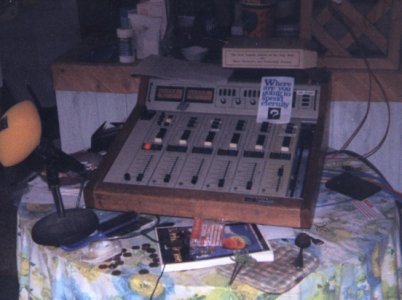
Dunno if this pict will 'take' here. I'll give it a shot. It's the second one the station used, part of a load of dumpster'd equipment retrieved from a late-night boat ride to a renowned port on Long Island Sound that often yielded bunty cast off by some big stations..
It didn't come with directions, of course, no manual. The chief engineer said wiring it all would be trial and error -- it had maybe fifty loose wires dangling out of it -- but we got it to work. About half of its wee light bulbs needed to be replaced.
After the frequency change, one of those Oxygen 3 boards was purchased.
@Flying Dutchman
Despite graduating from Brooklyn Technical HS, I'm certainly no techie. But the engineering types in the LPFM verified that the Nikom xmtr used was indeed type-approved/accepted. So was the antenna element (whatever brand it was). Looked sorta like bicycle handlebars. One of the fellas had a safety harness and installed it at the top of the tower. I only had the nads to go maybe 2/3rds up, to hand him tools.
 

Attachments

  • Control  Board.JPG
    Control Board.JPG
    84.6 KB · Views: 5
The LPFM up in these parts benefited from a few happenstantial occurrences and conditions from the very start until the very end -- and beyond, up until today.
It was said that 'luck is the residue of design', but I'd be cheaply trivial and presumptuous to try and point out any actual design the group used as a start other than friendship. There were two ex-radio types from these parts involved ; a few distant observers in radio, and an augmenting group of co-workers who actually comprised the bulk of the voices and 'air shifts' heard on the station even though they'd had no on-air work experience at all. Through several experiments and 'what-the-heck/I'll-give-it-a-shot' sessions at what was the practice studio (plus a temperate quaff or two of mixed drinks) , it became apparent that there were some actual radio voices among us that, with some adjustments and direction, came to blend in very well with the overall sound and mood of the station (easy-listening/MoR/Standards). The other local ex-radio fellow and myself also had that job made easier inasmuch as this region (thus its listeners) is quite accent-free in the first place. He and I, neither of us originally from here, were amazed at that advantage.
Perhaps more importantly, each individual of the resultant 'core' of the station -- the seven people pictured on our flyer -- had done and received some sort of favor or assistance for each of the OTHERS...... rides, chores, loans, house- and pet-sitting, job references; you name it. Added icing was the quirk like on the show Taxi ; there were only two Alex Reigers ; just the two people who considered themselves 'radio' lifers. The OTHER staffers and directors regarded themselves as having other lifelong vocations listed come 1040 filing time ; medics, two teachers, a social worker, a retiree, and two homebound / handicapped individuals who were and are quite 'live' to medicine and procedures.
Augment that with a few remote engineer types plus two DJs/PD-types who provided reams of music titles from similar formats, or theoccasional cart machines, control board, computers, sound programs ......
We were lucky throughout. No egos, no arguments, just a group of people who trusted each other and still do to this day.
Luck, borne of design or otherwise, provided us the start and the soft landing at the finish.
* * * * *
After reading some of the scary stories here, though, I admit that the idea of a separate, 'second' station at night .... like some of those old share-time broadcasts -- probably've been unwise. With the younger music and culture plus the emerging, identity-positioning peculiar to the demo, such a nice, communications gesture most likely would be nothing but pregnant with disaster.
 
Those Weather Alert folks were going to be dismissed. They applied for what, 176 stations? Maybe they need to apply for TIS stations using an association with a local government entity. It's a nice idea and I like the concept.
 
I was looking at FCC LPFM Frequently Asked Questions. I assume the Weather Alert Radio Network was thinking along these lines:

Q: Can my organization file multiple LPFM applications?


A:
No, with two exceptions. A Tribal applicant can file up to two LPFM applications, while a nonprofit/governmental entity with a public safety purpose has no restrictions on the number of applications it can file.

Quoted from: Low Power FM (LPFM) Frequently Asked Questions
 
Status
This thread has been closed due to inactivity. You can create a new thread to discuss this topic.


Back
Top Bottom