• Get involved.
    We want your input!
    Apply for Membership and join the conversations about everything related to broadcasting.

    After we receive your registration, a moderator will review it. After your registration is approved, you will be permitted to post.
    If you use a disposable or false email address, your registration will be rejected.

    After your membership is approved, please take a minute to tell us a little bit about yourself.
    https://www.radiodiscussions.com/forums/introduce-yourself.1088/

    Thanks in advance and have fun!
    RadioDiscussions Administrators

Starting a New SW Station

There's no market for consumers because they don't care. They didn't care all that much even in the Golden Age of Shortwave (roughly 1940-1990). How many shortwave radios were sold to non-hams in that era? A few thousand a year?
Not in the US, of course. But when I got to Ecuador in 1964, there were more SW stations than broadcast band AM stations. Same in Peru and Bolivia. All the major AMs in Venezuela had SW signals, too, as did the smaller market AMs in Brazil.

Over the decades, they have gradually all disappeared save one or two that will die when the transmitter gives out or the tubes it uses are no longer available.
 
Had not heard about it being dismantled, and really nothing new since the attempt by WBCQ to purchase it failed.

The WHRI equipment is about 40 years old, so likely a maintenance nightmare were it to be reactivated.
That means hollow state most of the way in the transmitters. Harder and harder... and more costly... to get replacement tubes. And fewer engineers able to deal with the high voltages and "big box" transmitters in general. Playing with a 50 kw or higher plate modulated rig is lethal if you are not experienced.
 
I am sure Pastor Melissa Scott would happily sell the hardware from their former Anguilla shortwave station.
If it has been kept on Anguilla in an un-airconditioned location for several years, it is worthless now. The tropics are unkind to electronics equipment: heat, humidity, rats and bugs destroy it quickly.
 
I know there are many other Christian stations, but I believe ours will be unique in that it will have that "prepper" flare, mostly about the "end times", what we believe will be upon us shortly in our world, etc. There is a hungry audience for that from what we see, at least in rural communities of this country that I travel in.
If you want to address preppers in the USA only, that is not a legal (buy widely unenforced) activity. And outside the US, the "end times" belief is much more rare and, unless you plan to do multiple languages, not going to reach many people.

I've worked in radio in Latin America for over 60 years and never run into a "prepper". Ever.
I know the SW bands are relatively empty -- I was an avid SWRLer in the 80s and 90s. However, I do believe it will be slowly coming back as our other sources of information censor so much and most likely will even moreso in the future.
People will not flock to ancient tech for content. They will use satellite services like what Musk is populating the sky for. Or VPNs and the like.
That, and the unique prepper flare we will bring is why I believe this can be successful. People are hungry for more news, more views. They no longer trust mainstream media.
In the US and some English speaking nations, maybe. Not Brazil or Mexico (combined more people than the USA) or Liberia or Burkina Faso.
I have to assume one can buy a SW radio from Amazon if they live in Africa or Europe or Latin America but I do not know this for a fact.
Nowhere nearly as easy as you think. If I'm in Ecuador (where I have most of my family, BTW) and I order something online, it may take a week or more to ship and then a long time in customs where it will pay a duty before being released.
I suspect a SS 50KWatt transmitter is somewhere between 150K and 500K.
A decent new one without audio gear, frequency monitoring gear, etc, installed with 3-phase power is going to be in the $250 k to $350 k range. Add in antennas, towers, cabling, switching, a building, a substation, and you have another couple of hundred though. Think of about $1 million to get it running. And 50 kw on SW is low power.

Buy time on an existing facility. They need clients, and there is more capacity than demand so you can start by buying unsold time "as available" for a discount rate.
 
A decent new one without audio gear, frequency monitoring gear, etc, installed with 3-phase power is going to be in the $250 k to $350 k range. Add in antennas, towers, cabling, switching, a building, a substation, and you have another couple of hundred though. Think of about $1 million to get it running. And 50 kw on SW is low power.
I’m not sure where you would buy a new 50kw SW transmitter except from BBEF in China. Continental Electronics and Ampegon have SW units at 100, 300 and 500kw but nothing at 50kw.

Used units are still floating around but these pretty much belong in a museum or the scrap yard. Radio graveyards are full of defunct SW transmitter manufacturers, and other still-extant companies dropped SW from their product lineup long ago.

RIZ (Croatia) had a 50kw unit among it’s offerings, but according to some recent SWDX forum postings they are now out of business. Apparent zombie website still online, but hasn’t been updated since 2018…supposedly bankruptcy proceedings were initiated in 2019.
 
I’m not sure where you would buy a new 50kw SW transmitter except from BBEF in China. Continental Electronics and Ampegon have SW units at 100, 300 and 500kw but nothing at 50kw.
I think you are right. I do not believe any of the European firms makes them any longer. And, as I said before, 50 kw is not enough for reliable SW international broadcasting.
Used units are still floating around but these pretty much belong in a museum or the scrap yard. Radio graveyards are full of defunct SW transmitter manufacturers, and other still-extant companies dropped SW from their product lineup long ago.
All the old ones use vacuum tubes, and some are nearly impossible to get now... and there is a limit to how many times they can be rebuilt.
RIZ (Croatia) had a 50kw unit among it’s offerings, but according to some recent SWDX forum postings they are now out of business. Apparent zombie website still online, but hasn’t been updated since 2018…supposedly bankruptcy proceedings were initiated in 2019.
And, IIRC, they used those brand-specific Svetlana / Russian tubes that you can not get now.
 
I would really like to hear more detail about this "no employees or payroll" concept.

It won't work.

Any SW transmitter plant big enough to make any impact is going to require on-site maintenance engineers. Antenna systems are complicated, transmitters need to be tended to, and who or what is running your programming? Even an automation system (which will also cost you well into five figures) needs an ops manager to keep the programming flowing smoothly.

It can't just be left unattended... so what's your plan? Volunteers? With what experience, training or ongoing commitment?

Tell us more about how you actually plan to operate this very complex thing day to day?
As far as I can tell, and I hate to be blunt, the poster hasn't done even the most basic of research. They don't know about transmitters or antennas, they don't know how much it costs to build a SW station, they don't know that 50kW is a minnow (as someone else put it, a "DX curiosity") in the >500kW world of international shortwave broadcasting. They haven't even bothered to listen around existing SW stations to hear what's on their schedules, and believe "end times prepper" programming would be some kind of new innovation that brings the punters flocking in, despite making up a good proportion of existing programs on leased time SW.

They don't seem to have even visited the websites/social media of WRMI and WBCQ which both have pictures of the operations to get a basic idea of what a SW station looks like. (For what it's worth, even the monster multi-million-dollar World's Last Chance antenna at 'BCQ is a weak and wobbly signal here in England, on all but the best propagation days and using anything other than a communications receiver and wire antenna. Forget "last chance", you've "no chance" of picking it up on a basic Tecsun with its telescopic.)

In any case, given that they said they have "unlimited funds", why aren't they paying any employees? Come to that, why aren't they paying some of their unlimited cash to a consultant to answer these questions for them privately rather than using free labor on an internet discussion board?
 
As far as I can tell, and I hate to be blunt, the poster hasn't done even the most basic of research.
Further, there is apparently a misinterpretation or lack of understanding of the percentage of the world population that fluently speaks and understands English. And there are somewhat fewer, still, who understand American English.

While it may appear to American tourists visiting the rest of the world that there is a mass of English speaking people, tourists discover a small fraction of the real population of other countries... people who have learned English for a job, not to use in private and personal pass times.

To be effective, a shortwave station with an agenda might need at least a half dozen languages in its content. Start with English, Mandarin, Spanish, Portuguese, Arabic and Swahili. Add in, next, Portuguese and Russian and then we get to ones like Italian, German, Japanese, Tagalog and Farsi and so on.
 
Last edited:
First of all, before diving into any kind of a shortwave venture that is based from the United States, I strongly suggest that you read through and have a full understanding of Part 73, Subpart F of the FCC rules, which discusses the International Broadcast Service.

HF stations must use directional antennas and must choose bands and azimuths that target locations outside of the Continental United States, even if you are beaming Mexico or the Caribbean.

While it is rarely enforced, §73.788 prohibits an HF broadcast station from being directed towards a CONUS audience.

You also need to have a good knowledge of HF propagation. That can influence where your station should be located. There is software available, such as the free VOACAP software package that can assist in this process. While you can beam a certain country (actually ITU zone) and are trying to pick up collateral area within the CONUS, you have to see what can be covered at one time during a certain time of the day on a certain band and it can vary based on different times of the year. If you are looking for a more nationwide coverage, you may not be able to achieve anything close to that using just one transmitter. Depending on the number of hours a day you wish to broadcast, you may find yourself needing to change frequencies throughout the day based on propagation characteristics. In addition, there are daily variables, such as the sunspot number that can impact your reception, especially in areas that are not the direct target area.

Many years ago, I consulted a venture that was going to purchase the former TDF broadcast facility in French Guyana (which was formerly used by Radio France International in the heyday of shortwave) in order to target the United States. We had found that in order to get a decent CONUS coverage, you had to run at least two transmitters, at least 100 kW (DSB) with differing beams with band changes throughout the day. It was not going to be easy.

WRMI has a nice advantage as they purchased the old WYFR facility at Okeechobee, FL., a site much more suitable for international broadcasting. Back in the day, WYFR was everywhere.

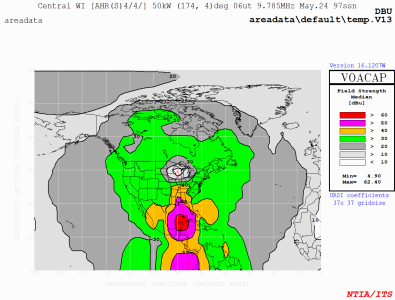
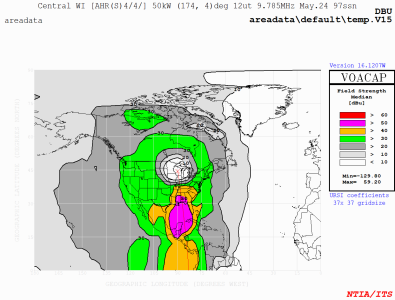
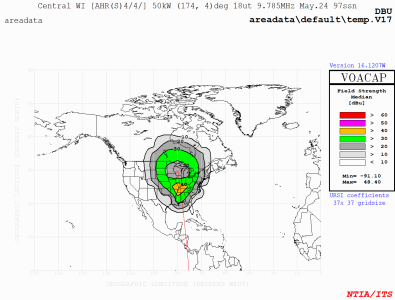
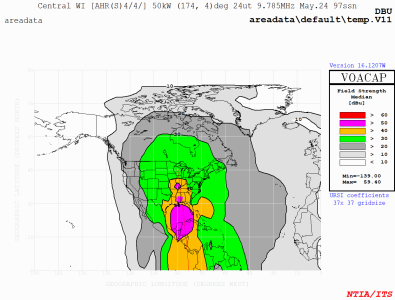
I chose a random HF broadcast antenna and looked at a 50 kW station in the 35m band with an azimuth of 170 (let's say we are beaming Central America) in the month of May with a sunspot number of 97 (which is around where we are at right now):

At 00:00 UTC
1684066380313.png

At 06:00 UTC
1684066409299.png
At 12:00 UTC
1684066432882.png
At 18:00 UTC
1684066460014.png

These plots were made with the VOACAP software and it can show how propagation does change throughout the day and why frequency planning is very important and depending on how many hours the station is on the air, how frequencies may need to be changed to reach a target area.

While the regulation could be subject to First Amendment challenges, §73.788(a) does state:
A licensee of an international broadcast station shall render only an international broadcast service which will reflect the culture of this country and which will promote international goodwill, understanding, and cooperation. Any program solely intended for and directed to an audience in the continental United States does not meet the requirements for this service.

I have yet to see anyone challenge this or the programming that is on some SW stations (I have heard some very anti-Semitic garbage on WWCR), but it is something to think about. I think the use of SW for "prepper" type programming is done in that manner because it gives that "clandestine" feel. Honestly, you will have more legal CONUS reach using a Shoutcast or Icecast server and streaming vs. using a power hungry service like SW. I am also with some of the others on here that you are better off buying some time on WRMI, WWCR or WBCQ and then promoting a streaming station on there.

 
I hope you see from Michi's post that there are a number of issues you are unaware of that vitally affect an SW endeavor.

Trying to reach parts of Latin America might be doable with 50 kw but in the Gulf Coast or Florida areas. And you'd have to do most programming in Spanish. You could do that and make it work with one frequency and antenna on the tropical band around 4.9 Mhz, but I don't know if the FCC licenses that band.

If you want to serve deeper South America, you are going to need 100 kw or more and a frequency agile transmitter with different antenna arrays for each time of the day. If you are going for consistent coverage of Europe, Asia or Africa, more power is needed and the antenna site is still going to be important. East coast for Europe and Africa, West coast or Hawaii or even Guam or American Samoa for SE Asia.

I've never given any thought at all to a SW station broadcasting from the US to other countries. And I think SW today is dead. Michi´s suggestions on Shoutcast and the like are very practical and cost effective.

The other thing is that "preppers" are not randomly looking for focused programming on shortwave, so you have to think of budgeting considerable money to put ads in publications and websites that appeal to that group.

Again, language is the killer here. There are only 375 million native English language speakers in the world; that's less than 5% of the world population. There are perhaps 1.5 to 2 billion that are ESL (English as a second language) but may of those know enough English to work in the duty free shop in Qatar, but would never listen to English language radio.
 
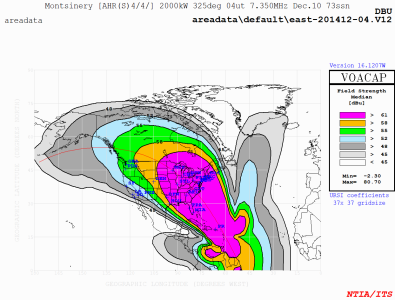
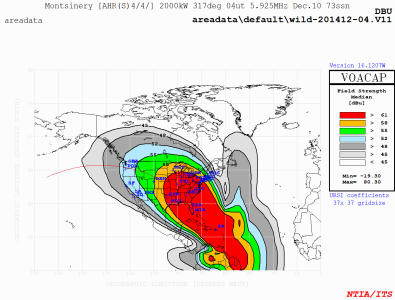
The concept that the folks I was working with was actually very interesting. They were already a manufacturer of radio receivers and had built some prototypes. They wanted to build a DRM receiver that would automatically tune in the transmitters and to operate DRM in an encrypted manner and offer it as a multi-channel subscription service (there was likely only going to be 3 channels). The headliner of the service was going to be Art Bell. They were going to use the old TDF facility at Montsinery, French Guyana that had those humongous ALLISS towers (similar to the one that was installed by the flat-earthers at WBCQ a few years ago). I had looked at three transmitters, likely 200kW DRM (equiv. of about 2MW in DSB) running to North America during a 24/7 period. An appropriately, I referred to them as "East of the Rockies", "West of the Rockies" (which both had appropriate beams for those regions) and the "Wild card" which was more of a central CONUS on a different band that the radio could go to based on band conditions. That was an interesting concept, but unfortunately, it did not gain any steam and looking back on it now, it would have crashed and burned badly, IMHO.
300px-05issoudun_alliss_Volga.JPG


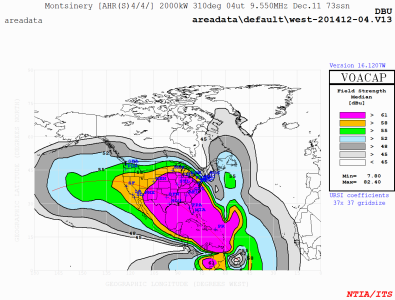
An example 3 transmitter operation could have looked like this:

35m "West of the Rockies" (0400 UTC, Midnight EST):
1684076782478.png

"East of the Rockies" - 41 meters (0400 UTC):
1684076896484.png

"Wild Card" 49 meters (0400 UTC):
1684077026975.png
While a 45+ dB field strength was good for DRM, we were shooting for 52+ dB.

Fun project... learned a lot.
 
I don't have much more to add to the excellent comments. Reading between the lines, it would appear the content you are proposing (end-times/prepper and I'm thinking somewhat militia-adjacent) would get banned from platforms like YouTube. There are plenty of sermons about end-times and prepper tips, but going beyond to ways of stockpiling ammunition or overthrowing governments would find a more receptive audience on 4-chan or 8-chan.
 
I agree with David, Scott, and all the blunt negative advice from others in this thread. You may as well take the second million dollars that would be required, and give it to several charities. The first million will evaporate into the thin air with zero positive results. In other words; what you suggest is one of the worst ideas ever suggested on this board. And trust me, there have been some doosies.
 
The concept that the folks I was working with was actually very interesting. They were already a manufacturer of radio receivers and had built some prototypes. They wanted to build a DRM receiver that would automatically tune in the transmitters and to operate DRM in an encrypted manner and offer it as a multi-channel subscription service (there was likely only going to be 3 channels). The headliner of the service was going to be Art Bell. They were going to use the old TDF facility at Montsinery, French Guyana that had those humongous ALLISS towers (similar to the one that was installed by the flat-earthers at WBCQ a few years ago). I had looked at three transmitters, likely 200kW DRM (equiv. of about 2MW in DSB) running to North America during a 24/7 period. An appropriately, I referred to them as "East of the Rockies", "West of the Rockies" (which both had appropriate beams for those regions) and the "Wild card" which was more of a central CONUS on a different band that the radio could go to based on band conditions. That was an interesting concept, but unfortunately, it did not gain any steam and looking back on it now, it would have crashed and burned badly, IMHO.


An example 3 transmitter operation could have looked like this:

35m "West of the Rockies" (0400 UTC, Midnight EST):


"East of the Rockies" - 41 meters (0400 UTC):


"Wild Card" 49 meters (0400 UTC):

While a 45+ dB field strength was good for DRM, we were shooting for 52+ dB.

Fun project... learned a lot.

@Michi
VOACAP is an interesting program, ive seen maps from it on various station sites over time, had no idea it was free.

i'm trying to use it to map a station i listen to, im well outside the target area but hear it so well so im curious... having some trouble figuring it out
 
I agree with David, Scott, and all the blunt negative advice from others in this thread. You may as well take the second million dollars that would be required, and give it to several charities. The first million will evaporate into the thin air with zero positive results. In other words; what you suggest is one of the worst ideas ever suggested on this board. And trust me, there have been some doosies.
Let's see.....drop balloons with shortwave radios and survivalist supplies over the third world.....
 
Let's see.....drop balloons with shortwave radios and survivalist supplies over the third world.....
... with cheap cassette players and English lesson tapes.
 
@Michi
VOACAP is an interesting program, ive seen maps from it on various station sites over time, had no idea it was free.

i'm trying to use it to map a station i listen to, im well outside the target area but hear it so well so im curious... having some trouble figuring it out
VOACAP can be a confusing program. If you are using it with existing stations, you probably also have to get data from the HFCC schedules (available at hfcc.org) to figure out the location of the transmitter, the power, the azimuth and the type of antenna they are using. It's not a simple process.
=m
 
@Michi
VOACAP is an interesting program, ive seen maps from it on various station sites over time, had no idea it was free.

i'm trying to use it to map a station i listen to, im well outside the target area but hear it so well so im curious... having some trouble figuring it out
Have you tried the online web-based version available here? For a quick check of a certain station, it is a lot easier than trying to figure out the desktop program (which is getting a bit antiquated now). For unclear reasons, it only does ham bands, but you can pick a nearby band to the broadcast you're wanting to check.

 
VOACAP can be a confusing program. If you are using it with existing stations, you probably also have to get data from the HFCC schedules (available at hfcc.org) to figure out the location of the transmitter, the power, the azimuth and the type of antenna they are using. It's not a simple process.
=m

I've got all that, @Michi .. what i cant do is get it to generate the pretty maps like you have shown here.
 
Status
This thread has been closed due to inactivity. You can create a new thread to discuss this topic.


Back
Top Bottom