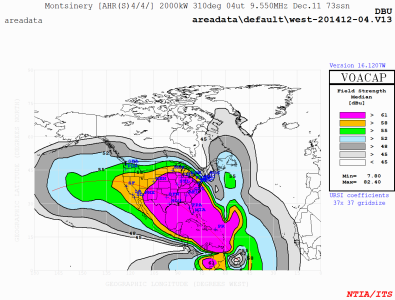
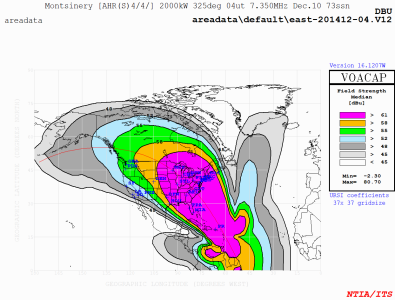
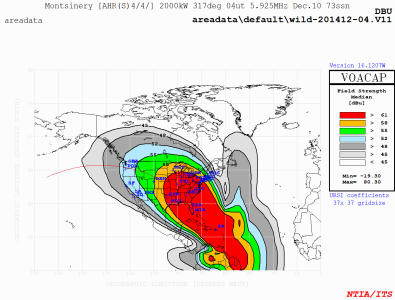
First of all, before diving into any kind of a shortwave venture that is based from the United States, I strongly suggest that you read through and have a full understanding of Part 73, Subpart F of the FCC rules, which discusses the International Broadcast Service.
HF stations must use directional antennas and must choose bands and azimuths that target locations outside of the Continental United States, even if you are beaming Mexico or the Caribbean.
While it is rarely enforced, §73.788 prohibits an HF broadcast station from being directed towards a CONUS audience.
You also need to have a good knowledge of HF propagation. That can influence where your station should be located. There is software available, such as the free VOACAP software package that can assist in this process. While you can beam a certain country (actually ITU zone) and are trying to pick up collateral area within the CONUS, you have to see what can be covered at one time during a certain time of the day on a certain band and it can vary based on different times of the year. If you are looking for a more nationwide coverage, you may not be able to achieve anything close to that using just one transmitter. Depending on the number of hours a day you wish to broadcast, you may find yourself needing to change frequencies throughout the day based on propagation characteristics. In addition, there are daily variables, such as the sunspot number that can impact your reception, especially in areas that are not the direct target area.
Many years ago, I consulted a venture that was going to purchase the former TDF broadcast facility in French Guyana (which was formerly used by Radio France International in the heyday of shortwave) in order to target the United States. We had found that in order to get a decent CONUS coverage, you had to run at least two transmitters, at least 100 kW (DSB) with differing beams with band changes throughout the day. It was not going to be easy.
WRMI has a nice advantage as they purchased the old WYFR facility at Okeechobee, FL., a site much more suitable for international broadcasting. Back in the day, WYFR was everywhere.
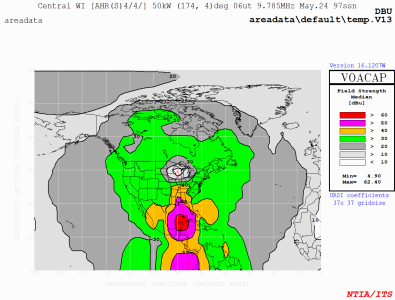
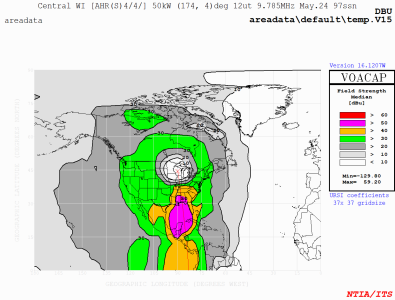
I chose a random HF broadcast antenna and looked at a 50 kW station in the 35m band with an azimuth of 170 (let's say we are beaming Central America) in the month of May with a sunspot number of 97 (which is around where we are at right now):
At 00:00 UTC
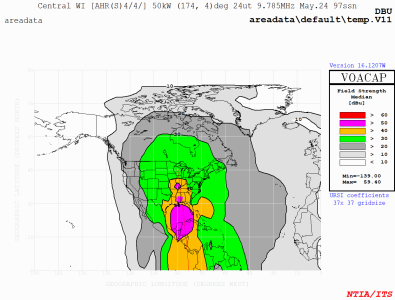
At 06:00 UTC
At 12:00 UTC
At 18:00 UTC
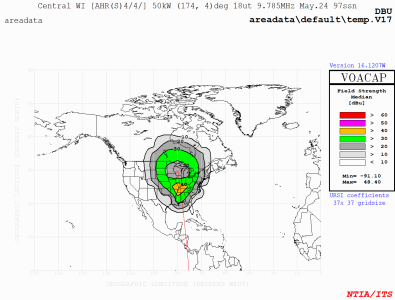
These plots were made with the VOACAP software and it can show how propagation does change throughout the day and why frequency planning is very important and depending on how many hours the station is on the air, how frequencies may need to be changed to reach a target area.
While the regulation could be subject to First Amendment challenges, §73.788(a) does state:
A licensee of an international broadcast station shall render only an international broadcast service which will reflect the culture of this country and which will promote international goodwill, understanding, and cooperation. Any program solely intended for and directed to an audience in the continental United States does not meet the requirements for this service.
I have yet to see anyone challenge this or the programming that is on some SW stations (I have heard some very anti-Semitic garbage on WWCR), but it is something to think about. I think the use of SW for "prepper" type programming is done in that manner because it gives that "clandestine" feel. Honestly, you will have more legal CONUS reach using a Shoutcast or Icecast server and streaming vs. using a power hungry service like SW. I am also with some of the others on here that you are better off buying some time on WRMI, WWCR or WBCQ and then promoting a streaming station on there.