• Get involved.
    We want your input!
    Apply for Membership and join the conversations about everything related to broadcasting.

    After we receive your registration, a moderator will review it. After your registration is approved, you will be permitted to post.
    If you use a disposable or false email address, your registration will be rejected.

    After your membership is approved, please take a minute to tell us a little bit about yourself.
    https://www.radiodiscussions.com/forums/introduce-yourself.1088/

    Thanks in advance and have fun!
    RadioDiscussions Administrators

Stories About BUDs (Big Ugly Dishes)

Canadian simultaneous substitution, a.k.a. simsub, is all about the commericials. Cable and satellite systems replace the American versions of shows (and their commercials) with the Canadian channel's version (and their commercials) on the spot on the system the American channel usually is, so the value of the Canadian commercial time isn't diminished.

For example, WDIV Detroit airs Wheel of Fortune at 7 p.m. weeknights. So does a Canadian channel. When Wheel begins on WDIV, it's replaced by the Canadian channel's version. Same episode, different ads.

It has nothing to do with censoring a show. It has to do with money.
 
I remember going to a county fair in Arkansas in the late '70s and seeing an early home satellite TV unit being demonstrated. Big dish, bigger price tag. Fascinating, but not something a one-man sports department for a small-town newspaper could possibly afford. Heck, I was just getting by on my $115 a week paycheck with an $85 a month rent payment. (What was I doing at the fair? Covering the big annual tractor pull, of course!)
That was around the time Bill Clinton was starting his political career. He could have been there for AG or Governor.
 

I had no idea C-Band still existed. Note the Big Ugly satellite dishes that used to pick up C-Band are rarely seen than they were in past decades. I thought C-Band faded away when the 2009 Analog shutdown took place.
 

I had no idea C-Band still existed. Note the Big Ugly satellite dishes that used to pick up C-Band are rarely seen than they were in past decades. I thought C-Band faded away when the 2009 Analog shutdown took place.

Assuming there's anything free-to-air still out there, I'd have a BUD if I could (the HOA would throw a fit, though I'm sure there's one rusting away out there that I could get if I volunteered to haul it off). The closest thing I have is a 1.3-meter dish that I have been trying, so far without success, to retrofit for Ku reception.
 
Assuming there's anything free-to-air still out there, I'd have a BUD if I could (the HOA would throw a fit, though I'm sure there's one rusting away out there that I could get if I volunteered to haul it off). The closest thing I have is a 1.3-meter dish that I have been trying, so far without success, to retrofit for Ku reception.
It probably depends upon your location relative to the sat footprint. Here in the Phoenix metro I've never seen a Ku dish smaller than 7 feet work well. I had a 3 meter dish and Ku was always problematic.
 
It probably depends upon your location relative to the sat footprint. Here in the Phoenix metro I've never seen a Ku dish smaller than 7 feet work well. I had a 3 meter dish and Ku was always problematic.
The bigger the better, I suppose, but 39 inches (smaller than mine which would be about 51 inches) seems to be the default size for FTA Ku-band dishes. The dish and feedhorns (I have several) were given to me by an installer who was just throwing them out, and I'm going to make them work if I can. Must be something simple that I'm doing wrong, either that, or the feedhorns are bad. I'm using a Koqit V5H H.265 that I bought new on Amazon.
 
The bigger the better, I suppose, but 39 inches (smaller than mine which would be about 51 inches) seems to be the default size for FTA Ku-band dishes. The dish and feedhorns (I have several) were given to me by an installer who was just throwing them out, and I'm going to make them work if I can. Must be something simple that I'm doing wrong, either that, or the feedhorns are bad. I'm using a Koqit V5H H.265 that I bought new on Amazon.
Years ago (late 80's) I built my own mesh dish and installed the combo feedhorn. The feedhorn alignment was the only tricky part. I could get all the C-band birds and all the Ku except for the Canadians. They used spot beams which weren't receivable this far south.
 
There are still scraps of things here and there. Have a look at the Youtube channels of Robbie Strike, Northcoaster Hobby, and Peter Farlie. For instance:

Thanks. I hopped around through this video (looking for the blue screens that listed the channels they got) and it is pretty much what I've looked up already. My bread and butter would be Montana and Louisiana PBS. Either there's some little something I'm doing wrong, or my feedhorns are bad. I'll keep tinkering around with it.

Dumb question, maybe, but my dish is a 1.3 meter one, presumably used for commercial applications (such as convenience stores, banks, and so on). Is it possible that the dish is too big, or the feedhorn too far out from the center of the dish, to make it viable for FTA satellite TV channels? I'm thinking that Ku-band is Ku-band, and it shouldn't matter, but I think the question is still worth asking.
 
Not as many wild feeds out there in 2026. Even some of the encrypted sports feeds are going to Internet distribution. Those that are still up are often using BISS or Digicypher encryption. Plenty of syndicated shows are being distributed via the Internet, too.
 
Thanks. I hopped around through this video (looking for the blue screens that listed the channels they got) and it is pretty much what I've looked up already. My bread and butter would be Montana and Louisiana PBS. Either there's some little something I'm doing wrong, or my feedhorns are bad. I'll keep tinkering around with it.

Dumb question, maybe, but my dish is a 1.3 meter one, presumably used for commercial applications (such as convenience stores, banks, and so on). Is it possible that the dish is too big, or the feedhorn too far out from the center of the dish, to make it viable for FTA satellite TV channels? I'm thinking that Ku-band is Ku-band, and it shouldn't matter, but I think the question is still worth asking.
I don't think the dish can be "too big" but the distance from the antenna to the feedhorn is critical. Receiving Ku is a bit trickier than C-band. Feedhorn alignment has to be spot on.
 
I don't think the dish can be "too big" but the distance from the antenna to the feedhorn is critical. Receiving Ku is a bit trickier than C-band. Feedhorn alignment has to be spot on.
The dish that I use has semi-circular ridges on the socket into which the feedhorn, which has ridges of its own, fits precisely. (I'm sure there are more precise terms than "ridges" and "socket", but my meaning should be clear.) They facilitate turning the feedhorn to whatever skew is needed. I'm assuming that all of this keeps the feedhorn at the ideal distance from the antenna.
 
My bread and butter would be Montana and Louisiana PBS.
The best things C-band ever offered were the backhaul feeds. Where else could you witness daily delights like Governor Moonbeam beaming up an entire bottle of Afrin before commencing a satellite media tour?

The endless commercial-free sports backhauls for games and other events were the main draw for most of the nerdy dish owners I knew. As were the similarly endless satellite ENG feeds for ordinary and major breaking news events alike. Once-off special event backhauls were quite possibly the absolute best treats, because their participants were typically told they were on "closed circuit television feeds," a reassurance so technically vague that it tended to disarm most everyone into behaving like they normally did in private. I remember an hours long Museum of Television and Radio roundtable event meant exclusively for students simultaneously attending closed-door lecture auditoriums at a handful of major American universities. It guested Matt Groening, Mike Judge, Matt Stone, and Trey Parker. Never heard so much cursing-laden blunt honestly about the television biz in my life, mostly from the latter two.

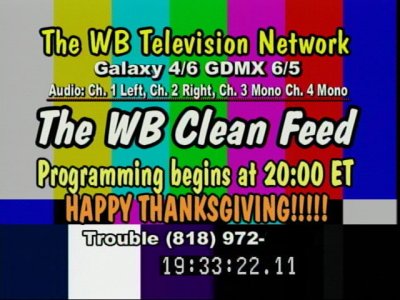
One of my personal favorite C-band institutions were the Canadian clean feeds and front-end syndication feeds. Being able to watch every new, prime time network and off-network show (e.g. first-run ST:TNG) days in advance without commercials, bugs, split-screen credits, or voice-overs, rolled right off direct dubs of the master tapes, was tits. With those, you could even psych out your friends like Bill Murray watching Jeopardy! in Groundhog Day, if you wanted.

jeopardy.jpg

wb.jpg

C-band was also how you could tap into everything you local cable system wouldn't or couldn't carry. Countless international news networks from countries all over the world (the era's equivalent of video shortwave) ... the domestic video newswire feeds from AP and Reuters ... tons of terrestrial AM, FM, and TV station uplinks meant for feeding translators or regional cable headends where topography made long-distance microwave links impossible (imagine listening to KLON 88.1 Long Beach from Yellowknife, Canada, or watching arctic Canadian and Alaskan independent stations serving widespread rural populations, often indigenous, with esoteric local programming and news, from your home in Los Angeles). There were also tons of fringe conspiracy theorist networks (yesterday's equivalents to today's WRMI, WBCQ, and WRMI program lineups), oddities like the Armed Forces Radio network, Muzak multiplexes, and the complete buffet of syndicated domestic radio programming from all the big and small distributors.

Compared to all that stuff, the regular cable networks that were up there, like TBS and ESPN, were the boring stuff. :)

Dumb question, maybe, but my dish is a 1.3 meter one, presumably used for commercial applications (such as convenience stores, banks, and so on). Is it possible that the dish is too big, or the feedhorn too far out from the center of the dish, to make it viable for FTA satellite TV channels? I'm thinking that Ku-band is Ku-band, and it shouldn't matter, but I think the question is still worth asking.
See what landtuna said. A dish can't be too big, only too small. The smaller the dish, the fewer dBs it can capture and reflect onto your feedhorn. In addition to the feedhorn distance issue he mentioned, the dish's shape must also be perfect, as being even slightly warped will ruin its ability to focus all of that signal properly onto the LNB.

Not as many wild feeds out there in 2026. Even some of the encrypted sports feeds are going to Internet distribution. Those that are still up are often using BISS or Digicypher encryption. Plenty of syndicated shows are being distributed via the Internet, too.
I guess the pre-satellite paradigm, where AT&T's vast copper network served as the distribution backbone for the broadcast industry, is gradually being returned to. Just replace all the old copper links (and AT&T) with fiber (and the internet).

 
OnSat and Satellite TV Week often had the schedule for the clean Canadian feeds. Usually on a random overnight timeslot or early/mid-morning. The old OnSat sitting at my desk from 1996 has the Law & Order clean feed at 3AM ET on Wednesday morning...likewise the new episodes of 90210 fed at 5pm Wednesday on a Fox transponder (T401 ch 9). Frasier was fed overnight around 2AM Friday morning, days before U.S. airing.

CBC North had both East feeds and West feeds on E2, which included Inuit-language newscasts and English newscasts for the 'north'. Weather reports for -30C and lower in the Yukon, for example. CBFT-2 and CBMT-6 were also carried in the clear. Great for learning French. CBC North had dozens of local translators in NWT, YT, northern Quebec, Labrador, Nunavut...and they all left the air over a decade ago.

And yes, all the Muzak channels were up there. The same ones played at your favorite grocery store. In fact, there were "in-store" radio channels up on one of the birds with advertising. "This week at Food Lion, save on Kraft American singles...only $1.49 each" and so on

Hey, did you know you could even play "bingo" on C-Band? Anyone remember the talking Basil dog on Spacenet 4?
 
OnSat and Satellite TV Week often had the schedule for the clean Canadian feeds. Usually on a random overnight timeslot or early/mid-morning. The old OnSat sitting at my desk from 1996 has the Law & Order clean feed at 3AM ET on Wednesday morning...likewise the new episodes of 90210 fed at 5pm Wednesday on a Fox transponder (T401 ch 9). Frasier was fed overnight around 2AM Friday morning, days before U.S. airing.

CBC North had both East feeds and West feeds on E2, which included Inuit-language newscasts and English newscasts for the 'north'. Weather reports for -30C and lower in the Yukon, for example. CBFT-2 and CBMT-6 were also carried in the clear. Great for learning French. CBC North had dozens of local translators in NWT, YT, northern Quebec, Labrador, Nunavut...and they all left the air over a decade ago.
Hah! I was just looking at an old post you made about those listings.

I remember pouring over them with great fascination as a kid whenever visiting the couple relatives who had early C-band installations. By my late teens, in the late 1990s, the only guides I had or needed were the ones published online, on newsgroups like rec.video.satellite.tvro, or hosted on web and FTP sites run by their maintainers. Birdfeed comes to mind. There are some other interesting, old school text resources still hanging around on the Robert Smathers TVRO site, which incredibly is still available.

And yes, all the Muzak channels were up there. The same ones played at your favorite grocery store. In fact, there were "in-store" radio channels up on one of the birds with advertising. "This week at Food Lion, save on Kraft American singles...only $1.49 each" and so on
There is a strange culture on Youtube now of people who've found and digitized analog tape reel versions of what those feeds once conveyed. If you search it for terms like supermarket music, possibly augmented with other relevant keywords like "muzak," "retro," or "K-Mart", you'll find plenty of them, including examples with the sales voiceover inserts you're describing.

Throughout the 1990s, another distribution method Muzak used was wideband analog FM carriers in the 900 MHz range. These could be heard with handheld and desktop police scanners, and there used to be one or two in most major cities. At least while sampling the ones in Sacramento and Los Angeles, I never heard any client-specific VO branding (or otherwise) on them. And unlike the satellite multiplexes where slightly more energetic formats were being offered, the muzak these signals pumped out 24/7 was true, 150 proof anesthetic -- the bona fide, eye-watering elevator pollutant the company originally became infamous for. (The Good Morning Vietnam Adrian Cronauer line, "you could put amphetamine freaks to sleep with this s*%t," would have been an understatement of their mind-sapping powers.)

Hey, did you know you could even play "bingo" on C-Band? Anyone remember the talking Basil dog on Spacenet 4?
The craziest surviving thing on C-band today has to be North Korean TV. If you visit Peter Farlie's Youtube channel, you can see multiple raw, hours-long C-band captures of modern KCNA, which according to him uplinks to a Euro-Asian satellite that's visible from the east coast of North America. Nothing like watching Dear Leader inspecting all his tanks, or receiving guided tours of The People's Toilet Seat Factory #191, in glorious HD.
 
CBC North had both East feeds and West feeds on E2, which included Inuit-language newscasts and English newscasts for the 'north'. Weather reports for -30C and lower in the Yukon, for example. CBFT-2 and CBMT-6 were also carried in the clear. Great for learning French. CBC North had dozens of local translators in NWT, YT, northern Quebec, Labrador, Nunavut...and they all left the air over a decade ago.

It's not FTA satellite, of course, but I'm reminded of the "Haiti TV Network" channel on Roku. All five of the main TV networks from France are available in live time (meaning, for instance, that you can watch the 7 am news from Paris at 1 am EST/EDT), as well as other things such as the French CBC news channel from Toronto and various Francophone channels from Africa. The Belgian French networks (where they speak a particularly intelligible, slower type of French, kind of the equivalent of Southern speech in the US) are supposed to be available but I haven't been able to get them lately.

Roku
 
the muzak these signals pumped out 24/7 was true, 150 proof anesthetic -- the bona fide, eye-watering elevator pollutant the company originally became infamous for. (The Good Morning Vietnam Adrian Cronauer line, "you could put amphetamine freaks to sleep with this s*%t," would have been an understatement of their mind-sapping powers.)
Don't insult good music!


Back
Top Bottom