• Get involved.
    We want your input!
    Apply for Membership and join the conversations about everything related to broadcasting.

    After we receive your registration, a moderator will review it. After your registration is approved, you will be permitted to post.
    If you use a disposable or false email address, your registration will be rejected.

    After your membership is approved, please take a minute to tell us a little bit about yourself.
    https://www.radiodiscussions.com/forums/introduce-yourself.1088/

    Thanks in advance and have fun!
    RadioDiscussions Administrators

Top-40 AMs transition in the 80s.

Listening to this KHJ aircheck, counting down the big hits of their Boss Radio time, the Boss 93 of 1965, the host mentions how KHJ had a "world premier" of The Beach Boys' California Girls.
Boss 93 KHJ
Great the great station was the first to play the great group's great song, one of their most known hits.

FYI... the song that played before The Beach Boys was Sonny and Cher's Just You, according to the music references below the Youtube video. I didn't recognize it and see it charted nationally @ No. 20, but isn't listed in that link as charting on KHJ.


Okay, so what you need to know for any of that to make sense is:


1: KHJ's 9:00 a.m.-12:00 noon disc jockey from the launch of Boss Radio in late April until September was Roger Christian, Brian Wilson's songwriting partner (though he did not help write "California Girls"). That gave the still-young and not-yet-highly rated KHJ an edge in getting the exclusive on "California Girls".

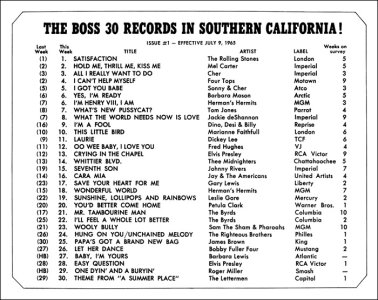
2: "Just You" was the flip side of "I Got You Babe". The reason you don't see a KHJ chart number for it was that KHJ did not have its own chart for its first 73 days.

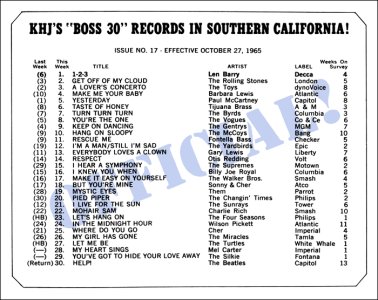
Boss 30 issue #1 came out on July 9, 1965.
khj_001b2_700.jpeg


From the day it launched until that moment, KHJ simply played what KFWB was playing---and on KFWB, "Just You" made it all the way to #10:


And the reason "Just You" and "California Girls" ended up next to each other on the KHJ Big 93 year-end survey---was that "California Girls" only peaked at #8 at KHJ.
 
Okay, so what you need to know for any of that to make sense is:


1: KHJ's 9:00 a.m.-12:00 noon disc jockey from the launch of Boss Radio in late April until September was Roger Christian, Brian Wilson's songwriting partner (though he did not help write "California Girls"). That gave the still-young and not-yet-highly rated KHJ an edge in getting the exclusive on "California Girls".

2: "Just You" was the flip side of "I Got You Babe". The reason you don't see a KHJ chart number for it was that KHJ did not have its own chart for its first 73 days.

Boss 30 issue #1 came out on July 9, 1965.

View attachment 10158


From the day it launched until that moment, KHJ simply played what KFWB was playing---and on KFWB, "Just You" made it all the way to #10:


And the reason "Just You" and "California Girls" ended up next to each other on the KHJ Big 93 year-end survey---was that "California Girls" only peaked at #8 at KHJ.

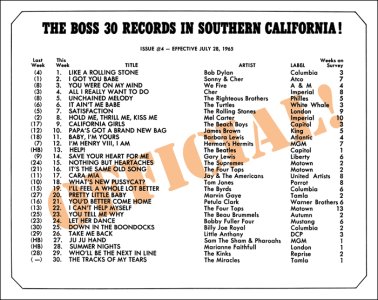
Any idea why “Hung on You” and “Unchained Melody” were listed at the same position? I’ve never seen an A and B side at the same position on any music survey before.
 
Any idea why “Hung on You” and “Unchained Melody” were listed at the same position?

I'm gonna guess that it's because KFWB was playing "Hung On You" and not "Unchained Melody":


The following week, July 14, KFWB added "Unchained Melody" and listed it as a two-sided hit:


By July 28, KHJ had dumped "Hung On You" and taken the record down to a single A-side:

khj_004b2_700.jpg


I’ve never seen an A and B side at the same position on any music survey before.

The few times that KHJ did double-sided hits, they usually put them at the same number.

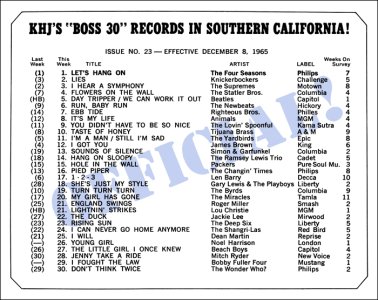
Beatles' "Help" & "I'm Down":

khj_012c2_700.jpg

Yardbirds' "I'm A Man" & "Still I'm Sad":

khj_017b2_700.jpg

Beatles' "Day Tripper" & "We Can Work It Out":

khj_023b2_700.jpg

If you scroll through this page on Ray Randolph's brilliant KHJ site, you'll see every song to hit the Boss 30 from 1965 through 1973, alphabetically by artist, and you'll see all the two-sided hits have one KHJ chart peak listed.


If you look at those KFWB charts I linked to in answer to the first question, you'll see they did single chart positions for double-sided hits, too. And checking the KRLA charts, so did they:


If you think about it, it makes sense. Sales data can't separate the two sides for you. Both of 'em are on the one single. You might see a marked preference for one side over the other in requests, but if the difference is really big, why are you playing both sides?
 
Okay, so what you need to know for any of that to make sense is:


1: KHJ's 9:00 a.m.-12:00 noon disc jockey from the launch of Boss Radio in late April until September was Roger Christian, Brian Wilson's songwriting partner (though he did not help write "California Girls"). That gave the still-young and not-yet-highly rated KHJ an edge in getting the exclusive on "California Girls".

2: "Just You" was the flip side of "I Got You Babe". The reason you don't see a KHJ chart number for it was that KHJ did not have its own chart for its first 73 days.

Boss 30 issue #1 came out on July 9, 1965.

View attachment 10158


From the day it launched until that moment, KHJ simply played what KFWB was playing---and on KFWB, "Just You" made it all the way to #10:


And the reason "Just You" and "California Girls" ended up next to each other on the KHJ Big 93 year-end survey---was that "California Girls" only peaked at #8 at KHJ.
I seem to recall reading in one of the comments on the late Richard Irwin's site that KHJ did not, in fact, use its own or any other charts to determine its year-end top 93 songs for 1965; instead, it asked its listeners to call in with their favorite songs and based the 1965 year-end chart on that.
 
I seem to recall reading in one of the comments on the late Richard Irwin's site that KHJ did not, in fact, use its own or any other charts to determine its year-end top 93 songs for 1965; instead, it asked its listeners to call in with their favorite songs and based the 1965 year-end chart on that.

Ted, a lot of stuff got said in comments in REELRADIO (some of it by me) that was from memory that later proved to be flawed memory.

Those comments now go back 29 years at their oldest. We didn't have most of what's on the internet in terms of radio information (thanks again to worldradiohistory.com) and we didn't have the easy access to airchecks that exists today.

That said, a couple of thoughts:

There is a KHJ Real Don Steele aircheck from December 22 and there's no mention of listener involvement in the Big 93 countdown.

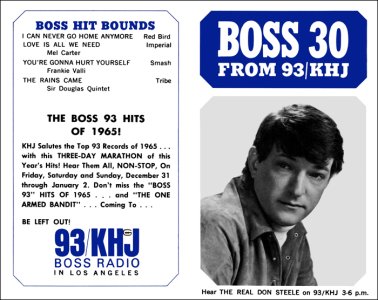
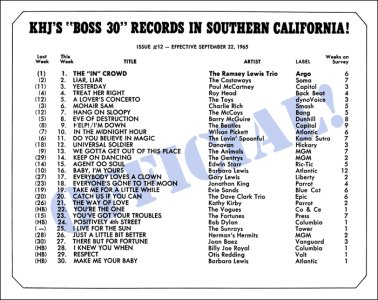
The first mention of the Big 93 on the Boss 30 playlist itself is simply an announcement that they're doing it---in the December 29 issue. No "the songs you voted for verbiage":

khj_026a2_700.jpg

A check via Newspapers.com of the papers in Los Angeles County for the month of December turns up no KHJ print ads soliciting listener input.

And finally---what are the odds that the Big 93 of 1965's rankings, if left to listener call-ins, would be a really close match to chart peaks, especially given KHJ's----let's just call it unique---chart methodology (sales, requests and "KHJ's judgement of the record's appeal")?

I think the only way you end up with Sonny and Cher's "Just You" and the Beach Boys "California Girls" next to each other at number 79 and 78 respectively in a year-end countdown that has Vic Dana's "Red Roses For A Blue Lady" at number 10 is to rank them by their performance on KFWB (pre-July 9) and KHJ's (after July 9) charts.
 
Ted, a lot of stuff got said in comments in REELRADIO (some of it by me) that was from memory that later proved to be flawed memory.

Those comments now go back 29 years at their oldest. We didn't have most of what's on the internet in terms of radio information (thanks again to worldradiohistory.com) and we didn't have the easy access to airchecks that exists today.

That said, a couple of thoughts:

There is a KHJ Real Don Steele aircheck from December 22 and there's no mention of listener involvement in the Big 93 countdown.

The first mention of the Big 93 on the Boss 30 playlist itself is simply an announcement that they're doing it---in the December 29 issue. No "the songs you voted for verbiage":

View attachment 10163

A check via Newspapers.com of the papers in Los Angeles County for the month of December turns up no KHJ print ads soliciting listener input.

And finally---what are the odds that the Big 93 of 1965's rankings, if left to listener call-ins, would be a really close match to chart peaks, especially given KHJ's----let's just call it unique---chart methodology (sales, requests and "KHJ's judgement of the record's appeal")?

I think the only way you end up with Sonny and Cher's "Just You" and the Beach Boys "California Girls" next to each other at number 79 and 78 respectively in a year-end countdown that has Vic Dana's "Red Roses For A Blue Lady" at number 10 is to rank them by their performance on KFWB (pre-July 9) and KHJ's (after July 9) charts.

Interesting. I know that one thing that I've never seen at the ARSA survey site was any end-of-year listings for KFWB. So if--and this is a big if--KFWB *never* published any end-of-year listings, that would have made it a lot easier for KHJ to use its own chart for the period when it published charts--and KFWB's chart for the period when it didn't--to create its end of-year survey. Your comment about KHJ's using KFWB survey information for the first part of 1965 also helps explain how KRTH-FM much later was able to use KFWB survey information to determine the songs that reached #2 and #1 in Los Angeles between January of 1958 and June of 1965.
 
Interesting. I know that one thing that I've never seen at the ARSA survey site was any end-of-year listings for KFWB. So if--and this is a big if--KFWB *never* published any end-of-year listings, that would have made it a lot easier for KHJ to use its own chart for the period when it published charts--and KFWB's chart for the period when it didn't--to create its end of-year survey.

I had never thought of it, Ted, but I don't recall KFWB ever doing a year-end countdown. And I'm not sure KRLA ever did, either.

The earliest one I've ever seen in Southern California was KMEN's 1963 year-end countdown:

KMEN 1290 San Bernardino Survey 1963-00-00

And Ron Jacobs was PD there at that time. Classic Jacobs---make it 129 songs to match KMEN's dial position.

When I corresponded with both Jacobs and Bill Drake, I learned that Jacobs was a big fan of countdowns (duh---he went on to co-create American Top 40), and that Drake hated them.

Drake's logic was "why should I play the weakest half of my playlist---either the weekly 30 or the year-end 93---all in a row?"

Jacobs' logic was the familiar "Americans love lists" and that we're suckers for a horse race and a suspense story ("who's gonna win?" "what's gonna be number one?").

Your comment about KHJ's using KFWB survey information for the first part of 1965 also helps explain how KRTH-FM much later was able to use KFWB survey information to determine the songs that reached #2 and #1 in Los Angeles between January of 1958 and June of 1965.

Yep. I think that was Sherman Cohen's idea. Or maybe Jim Pewter's.(EDIT: It was Jim's. Sherman never did KRTH). A bit of a calculated risk on their part (and, for that matter, on KHJ's for the first couple of months) to use KFWB's chart, given that KRLA was beating KFWB at the time.

When KRTH launched, it was Drake-Chenault's Classic Gold syndicated format. When Drake left, RKO did a homebrew version of it for itself and KFRC-FM, but when KFRC-FM started programming itself, it freed KRTH up to do the same.

And remember---in the earliest years of KRTH, they really weren't playing much if any KHJ music. KRTH began with 1954-1963 and it was a long time before they went beyond that.
 
Last edited:
I had never thought of it, Ted, but I don't recall KFWB ever doing a year-end countdown. And I'm not sure KRLA ever did, either.

The earliest one I've ever seen in Southern California was KMEN's 1963 year-end countdown:

KMEN 1290 San Bernardino Survey 1963-00-00

And Ron Jacobs was PD there at that time. Classic Jacobs---make it 129 songs to match KMEN's dial position.

When I corresponded with both Jacobs and Bill Drake, I learned that Jacobs was a big fan of countdowns (duh---he went on to co-create American Top 40), and that Drake hated them.

Drake's logic was "why should I play the weakest half of my playlist---either the weekly 30 or the year-end 93---all in a row?"

Jacobs' logic was the familiar "Americans love lists" and that we're suckers for a horse race and a suspense story ("who's gonna win?" "what's gonna be number one?").


Yep. I think that was Sherman Cohen's idea. Or maybe Jim Pewter's.(EDIT: It was Jim's. Sherman never did KRTH). A bit of a calculated risk on their part (and, for that matter, on KHJ's for the first couple of months) to use KFWB's chart, given that KRLA was beating KFWB at the time.

When KRTH launched, it was Drake-Chenault's Classic Gold syndicated format. When Drake left, RKO did a homebrew version of it for itself and KFRC-FM, but when KFRC-FM started programming itself, it freed KRTH up to do the same.

And remember---in the earliest years of KRTH, they really weren't playing much if any KHJ music. KRTH began with 1954-1963 and it was a long time before they went beyond that.

Just so you are aware: the ARSA surveys do contain KRLA end-of-year surveys starting in 1960. And, between 1964 and 1965, the station had two different end-of-year surveys--the "standard" KRLA one and one that the station was promoting as "what the teens liked." (In fact, that latter category also allowed KRLA to print some mid-week surveys different from its "standard" surveys, some of which are also on the ARSA survey site.)
 
Just so you are aware: the ARSA surveys do contain KRLA end-of-year surveys starting in 1960. And, between 1964 and 1965, the station had two different end-of-year surveys--the "standard" KRLA one and one that the station was promoting as "what the teens liked." (In fact, that latter category also allowed KRLA to print some mid-week surveys different from its "standard" surveys, some of which are also on the ARSA survey site.)

Thanks, Ted! ARSA has been very buggy for me for several months. Does it remember your login and password or do you need to reset every time?
 
Thanks, Ted! ARSA has been very buggy for me for several months. Does it remember your login and password or do you need to reset every time?

It does not remember my ID and password so I have to sign in each time I go onto the site. Also, I've noticed that some sort of timeclock has been placed on the site--if you sit on a particular page too long, the site will throw you out and you will have to resign in.
 
It does not remember my ID and password so I have to sign in each time I go onto the site. Also, I've noticed that some sort of timeclock has been placed on the site--if you sit on a particular page too long, the site will throw you out and you will have to resign in.

For me, it doesn't remember my ID and password when I enter it. I have to actually re-set the password each time.
 
Drake's logic was "why should I play the weakest half of my playlist---either the weekly 30 or the year-end 93---all in a row?"

I can definitely understand that logic when it comes to year-end countdowns. I used to make it a ritual to listen to the year-end countdowns when I was a kid growing up in Boston. I would listen to the AT40 year-ends and the local Kiss 108 year-ends. Particularly, by the 90s, the lower half of the countdowns were filled with songs that only a big nerd like me would remember and be excited to hear. The average listener would probably barely remember most of the bottom 1/4 to 1/3 (maybe even 1/2) of the songs.

However, from a weekly standpoint, I don't feel like the logic totally holds because there would be bonafide hits making their way down the chart mixed with new songs making their way up, some up which would make it to the top 10. Having said that, under Sunny Joe White's helm in the 80s through 1990, Kiss 108 never had downward movement on its reported weekly playlist. Songs dropped off their chart from their peak positions.
 
Last edited:
For me, it doesn't remember my ID and password when I enter it. I have to actually re-set the password each time.

Same here, but for some reason the new password doesn't "stick" long enough for me to login, and the site management has ignored my requests for assistance.
 
The earliest one I've ever seen in Southern California was KMEN's 1963 year-end countdown:

KMEN 1290 San Bernardino Survey 1963-00-00

And Ron Jacobs was PD there at that time. Classic Jacobs---make it 129 songs to match KMEN's dial position.

Rick Carroll did a variation on that at KKDJ ("Voice Of Change" as #102.7) and KROQ (a novelty title such as "Elvis Is Everywhere" as #106.7).
 
I can definitely understand that logic when it comes to year-end countdowns. I used to make it a ritual to listen to the year-end countdowns when I was a kid growing up in Boston. I would listen to the AT40 year-ends and the local Kiss 108 year-ends. Particularly, by the 90s, the lower half of the countdowns were filled with songs that only a big nerd like me would remember and be excited to hear. The average listener would probably barely remember most of the bottom 1/4 to 1/3 (maybe even 1/2) of the songs.

However, from a weekly standpoint, I don't feel like the logic totally holds because there would be bonafide hits making their way down the chart mixed with new songs making their way up, some up which would make it to the top 10. Having said that, under Sunny Joe White's helm in the 80s through 1990, Kiss 108 never had downward movement on its reported playlist. Songs dropped off their chart from their peak positions.

WLOF in Orlando did that on its charts between 1965 and 1972. So did KIQQ-FM in Los Angeles on its surveys between 1981 and 1984.

Also, I have read (I can't remember where) that there is evidence that people growing up during the 1980s and later decades were/are not as much into pop music as the boomers before them. This was why, according to what I've read, when IHeart launched replays of Casey Kasem's American Top 40 shows from the 1980s, it chose not to include the first hour. (My understanding now is that the first hour of the 1980s shows are available for radio stations who wish to carry the full four-hour episodes.)
 
WLOF in Orlando did that on its charts between 1965 and 1972. So did KIQQ-FM in Los Angeles on its surveys between 1981 and 1984.

Also, I have read (I can't remember where) that there is evidence that people growing up during the 1980s and later decades were/are not as much into pop music as the boomers before them. This was why, according to what I've read, when IHeart launched replays of Casey Kasem's American Top 40 shows from the 1980s, it chose not to include the first hour. (My understanding now is that the first hour of the 1980s shows are available for radio stations who wish to carry the full four-hour episodes.)
There are both 3-hour and 4-hour options, but most stations that carry the AT40 1980s flashback show do carry the 4-hour version.

The AT40 1970s flashback show gets tricky because AT40 expanded to 4 hours in fall 1978. Most stations still only air the latter 3 hours though Premiere does make the full 4-hour version available.
 
There are both 3-hour and 4-hour options, but most stations that carry the AT40 1980s flashback show do carry the 4-hour version.

By my own unscientific method (counting the stations I monitor through Mediabase and presuming a similar ratio for stations carrying the show but which are not in Mediabase), about 20% drop the first hour.

The AT40 1970s flashback show gets tricky because AT40 expanded to 4 hours in fall 1978. Most stations still only air the latter 3 hours though Premiere does make the full 4-hour version available.

It is for that reason that the first hour does not have any network commercials (all the breaks are designated for local ad sales), and because the same commercials run in both versions, the first hour of the 1980s version is also sans national ads.

From time to time, I hear rumblings that Premiere may combine the four-hour 1970s version with the early years' 1980s shows and make a separate "package" out of that, but so far I have heard nothing even close to definitive about that.
 
However, from a weekly standpoint, I don't feel like the logic totally holds because there would be bonafide hits making their way down the chart mixed with new songs making their way up, some up which would make it to the top 10.

And Bill Drake's problem was that the songs making their way down were past their peak popularity---approaching burnout and turnoff---and those making their way up hadn't achieved theirs yet, and might yet stiff out.

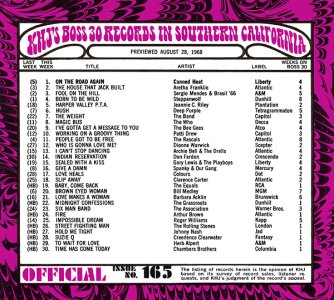
Let me amplify Drake's point (Bill Drake V/O: "57 years ago today"):

khj_165b1.jpg

Take a look at #30-#16 and imagine that playing back-to-back for an hour.

It did.

The four "bonafide hits making their way down"? "Give a Damn", "Brown Eyed Woman", "Love Makes A Woman" and an instrumental piano cover of "The Impossible Dream".

Yikes.
 
This is a good point in this thread for a reminder:

Chart positions aren't cumulative. They're week-by-week snapshots. You don't add sales from one week on top of another to "climb" the chart.

Each week is simply how the record did in comparison to the other records. It's a statistic, not an award.


Let's go back to "Heroes and Villains" by the Beach Boys, which we were discussing yesterday.

Some people will say that was a "Beach Boys hit". Peaked at #12 in Billboard.

Let's look at "Heroes and Villains" Hot 100 chart trajectory:

61-33-17-12-12-21-55-(gone)

What that means is that on its best two weeks, there were 11 more popular records than "Heroes and Villains".

On its third best week, there were 16.

On its fourth best week, there were 20.

On its fifth best week, there were 32.

On its sixth best week, there were 54.

On its seventh best week, there were 60.


So for those of you who remember me saying that #12 might not necessarily be a hit several times over the past several years, now you know why.
 
Last edited:


Back
Top Bottom