
• Get involved.
    We want your input!
    Apply for Membership and join the conversations about everything related to broadcasting.

    After we receive your registration, a moderator will review it. After your registration is approved, you will be permitted to post.
    If you use a disposable or false email address, your registration will be rejected.

    After your membership is approved, please take a minute to tell us a little bit about yourself.
    https://www.radiodiscussions.com/forums/introduce-yourself.1088/

    Thanks in advance and have fun!
    RadioDiscussions Administrators

TV Guide editions and online resources

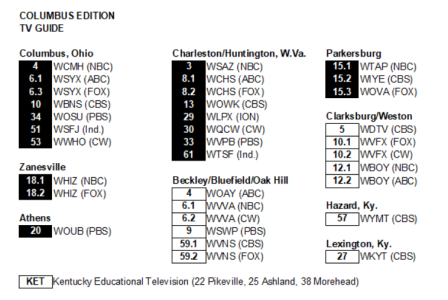
I see here also that I inadvertently omitted WTSF-61 Ashland KY from the Charleston-Huntington lineup. It is a Daystar station (not sure if they do any local origination) and was never listed in the West Virginia TVG, nonetheless, it is a full-power station, and Daystar is not a "diginet" strictly speaking (though it is carried on many LPTVs). I should have included it. I listed WTSF as independent, as I've never seen Daystar treated as a network in TVG lineups:

Here's a revised lineup, and I cleaned up 33 Huntington as well, made it WVPB instead of WPBY:
1733017225736.png
 
Does anybody know what the rationale was behind carrying WCBS-2 NYC on many cable systems in the northeastern US, sometimes quite distant from NYC, after 1:00 am?

The Eastern New York edition seems to indicate that it was carried in tandem with WPIX-11. Did WPIX go off the air at 1:00 am, and was WCBS then carried on their feed?
 
Does anybody know what the rationale was behind carrying WCBS-2 NYC on many cable systems in the northeastern US, sometimes quite distant from NYC, after 1:00 am?

The Eastern New York edition seems to indicate that it was carried in tandem with WPIX-11. Did WPIX go off the air at 1:00 am, and was WCBS then carried on their feed?
That's correct. Eastern Microwave was the company that supplied the WPIX and WOR feeds (and WNEW for a while) to cable systems, and since WPIX signed off around 1, it switched the feed to WCBS for its all-night movies after that.

By the early 1980s WPIX had gone 24 hours and the WCBS feed was gone.
 
That's correct. Eastern Microwave was the company that supplied the WPIX and WOR feeds (and WNEW for a while) to cable systems, and since WPIX signed off around 1, it switched the feed to WCBS for its all-night movies after that.

By the early 1980s WPIX had gone 24 hours and the WCBS feed was gone.

Thanks. That was the only thing that even remotely made sense to me, either that, or thinking that by 1 am, there would be so few viewers, that local stations wouldn't care whether an out-of-market network affiliate were available in the wee hours.

This too:

https://radiodiscussions.com/threads/remember-that-b-w-wcbs-tv-test-pattern.526665
 
If I ever find my old North Carolina edition, is this the place to post about the weird schedules of the CBS and NBC affiliates in Raleigh-Durham and Wilmington, NC?
 
If I ever find my old North Carolina edition, is this the place to post about the weird schedules of the CBS and NBC affiliates in Raleigh-Durham and Wilmington, NC?

As far as I'm concerned, it's the place to talk about anything pertaining to TV Guide editions.

Some markets, especially "short" ones such as Wilmington was back in the day, did indeed have weird schedules.
 
If I ever find my old North Carolina edition, is this the place to post about the weird schedules of the CBS and NBC affiliates in Raleigh-Durham and Wilmington, NC?

Now you've got me wanting to find one of those old editions (early- to mid-1970s) on eBay. I used to see this edition when we went to Myrtle Beach (got it on the way there) and it was the first time I'd ever seen a TVG with two of the same channel (in this case WBTV and WWAY both on channel 3, as well as WFMY/WUND, WSOC/WNCT, and WSJS/WCTI). I've been collecting TVGs for over 50 years, actually pushing 60 years. I got started early.

Old TVGs on eBay, searchable by edition, are fairly easy to find, but they are usually in poor condition due to the sheer age of the books (many of them have taken on a strong odor of old newsprint). They really need to be scanned into PDF files.
 
Thanks. That was the only thing that even remotely made sense to me, either that, or thinking that by 1 am, there would be so few viewers, that local stations wouldn't care whether an out-of-market network affiliate were available in the wee hours.

This too:

https://radiodiscussions.com/threads/remember-that-b-w-wcbs-tv-test-pattern.526665
Same thing happened in the Midwest in the 1980s. Microwave-fed WFLD Chicago was replaced in outlying market cable systems by CBS-owned WBBM Chicago at 1 a.m. whether WFLD was done for the night or not. I think it was Midwest Video here.
 
Same thing happened in the Midwest in the 1980s. Microwave-fed WFLD Chicago was replaced in outlying market cable systems by CBS-owned WBBM Chicago at 1 a.m. whether WFLD was done for the night or not. I think it was Midwest Video here.

Seems to me I've seen that in some older Midwest TVG lineups. I'll have to look it up.
 
As far as I'm concerned, it's the place to talk about anything pertaining to TV Guide editions.

Some markets, especially "short" ones such as Wilmington was back in the day, did indeed have weird schedules.
Throw in Raleigh/Durham having a very weak NBC affiliate and both Wilmington and Greenville/New Bern/Washington having very strong NBC affiliates - until the 1990s, WECT used to be de facto NBC for Fayetteville, Lumberton, and Southern Pines while WITN was de facto NBC for Goldsboro, Rocky Mount, and Wilson
 
And the same happened out west on OR and CA cable systems (and even some in MT!) When KTVU signed off the air in the late '70s, the microwave company switched over to channel 36, KGSC San Jose, which had all-night movies. KTVU was also on satellite for a very brief while and tried to be the next WTCG/WTBS - but it didn't last.
At one point, the microwave feed of KTVU/KGSC was seen all the way to Billings MT. In Billings, KUED SLC was brought in on microwave as a PBS station, as Montana had no PBS station.
 
And the same happened out west on OR and CA cable systems (and even some in MT!) When KTVU signed off the air in the late '70s, the microwave company switched over to channel 36, KGSC San Jose, which had all-night movies. KTVU was also on satellite for a very brief while and tried to be the next WTCG/WTBS - but it didn't last.
At one point, the microwave feed of KTVU/KGSC was seen all the way to Billings MT. In Billings, KUED SLC was brought in on microwave as a PBS station, as Montana had no PBS station.
That’s like Rockford, IL, which I think is the largest U.S. city without a PBS station. WTTW Chicago is imported there.
 
That’s like Rockford, IL, which I think is the largest U.S. city without a PBS station. WTTW Chicago is imported there.
Bakersfield CA is another mid-sized city with no PBS station. I'm not sure which market is bigger.
 
Throw in Raleigh/Durham having a very weak NBC affiliate and both Wilmington and Greenville/New Bern/Washington having very strong NBC affiliates - until the 1990s, WECT used to be de facto NBC for Fayetteville, Lumberton, and Southern Pines while WITN was de facto NBC for Goldsboro, Rocky Mount, and Wilson

In the 1970s, Wilmington cable carried WRAL, WTVD, WNCT, WITN, and WCTI. Not clear if they ever carried WBTW.

Before Myrtle Beach and Horry County became the population juggernauts that they are now, I always thought that Wilmington-Florence might make sense as a market, with the transmitters co-located between the two cities, but OTOH those cities have little in common, with negligible commercial interaction between them. For many years Horry County was actually in the Wilmington TV market, with WWAY having offices in the Flatiron Building downtown (logo on the side of the building), and WSFX had a sales office there in 1996 (I took a resume there).
 
Bakersfield CA is another mid-sized city with no PBS station. I'm not sure which market is bigger.

Bakersfield is #125, and Rockford is #137. Besides, RGV is the biggest market without a local in-proper PBS member station at #80 but at least they have PBS (nationally) via KCWT-CD 21.4. The biggest without PBS of any kind is #83 in Waco.
 
Bakersfield is #125, and Rockford is #137. Besides, RGV is the biggest market without a local in-proper PBS member station at #80 but at least they have PBS (nationally) via KCWT-CD 21.4. The biggest without PBS of any kind is #83 in Waco.
More holes in the PBS lineup than I expected. Thanks for the info.
 
Bakersfield CA is another mid-sized city with no PBS station. I'm not sure which market is bigger.

Wikipedia has a fairly lengthy explanation as to why Bakersfield has no in-market PBS station:

KVPT - Wikipedia

Something about a dispute between KVPT and KCET as to which one would serve Bakersfield. Back in the day, KQED had an extensive network of translators down the coast and the SJV, not sure if they ever got down as far as Kern County.
 
In the 1970s, Wilmington cable carried WRAL, WTVD, WNCT, WITN, and WCTI. Not clear if they ever carried WBTW.

Before Myrtle Beach and Horry County became the population juggernauts that they are now, I always thought that Wilmington-Florence might make sense as a market, with the transmitters co-located between the two cities, but OTOH those cities have little in common, with negligible commercial interaction between them. For many years Horry County was actually in the Wilmington TV market, with WWAY having offices in the Flatiron Building downtown (logo on the side of the building), and WSFX had a sales office there in 1996 (I took a resume there).
Our apartment in Myrtle Beach (two bedrooms and everything else one would need to live there all the time) had all the channels on what looked like a business card. I've posted this but there were two CBS stations (WCSC Charleston and WBTW Florence which was also ABC), two ABC stations (WUSN Charleston and WWAY Wilmington, which my TV Guide said was also NBC) and three NBC stations (WECT Wilmington, which was also CBS, WCIV Charleston and WIS Columbia)/ I don't think it said anything about PBS. There was a weather channel with NOAA audio and a camera going back and forth across weather readings and ads, and three channels with FM music.
 
Our apartment in Myrtle Beach (two bedrooms and everything else one would need to live there all the time) had all the channels on what looked like a business card. I've posted this but there were two CBS stations (WCSC Charleston and WBTW Florence which was also ABC), two ABC stations (WUSN Charleston and WWAY Wilmington, which my TV Guide said was also NBC) and three NBC stations (WECT Wilmington, which was also CBS, WCIV Charleston and WIS Columbia)/ I don't think it said anything about PBS. There was a weather channel with NOAA audio and a camera going back and forth across weather readings and ads, and three channels with FM music.

Yes, that was pretty much the usual setup in Myrtle Beach during the 1970s at least. Charleston stations can easily be received in Myrtle Beach proper with a good antenna, as can those from Wilmington. When I lived there (1996-1997), I had one of the RadioShack log periodics, I think it was the LP-190, and I actually received Charleston and Wilmington far more easily than I did the Florence/Myrtle Beach channels (all of the sticks were out at Hamer except for WHMC and WFXB, there was no WMBF). Cable at the time carried all of the locals, WIS and WECT for NBC (which had no local presence), but nothing from Charleston.

Kind of an aside, in the mid-1970s we were staying at one of the hotels in Wytheville VA (I think it was the Scottish Inn), and WECT came in on the cable in the wee hours before WVVA went on the air. That was back when stations still signed off at night.
 
Bakersfield is #125, and Rockford is #137. Besides, RGV is the biggest market without a local in-proper PBS member station at #80 but at least they have PBS (nationally) via KCWT-CD 21.4. The biggest without PBS of any kind is #83 in Waco.

I'm surprised KEDT or KLRN didn't try to get on cable in the RGV when KMBH went off.

Waco is an odd case, as there is a PBS member in the market (KAMU, based in Bryan/College Station), but it's not on cable in Waco or Temple. Cable companies carry KLRU in Waco and Temple (surprisingly them over KERA, which is carried in Abilene, Tyler/Longview, Sherman, Wichita Falls, and San Angelo, none of which have PBS members).

The dishes and OTT providers carry KAMU throughout the entire Waco/Temple/Bryan market.


Back
Top Bottom