• Get involved.
    We want your input!
    Apply for Membership and join the conversations about everything related to broadcasting.

    After we receive your registration, a moderator will review it. After your registration is approved, you will be permitted to post.
    If you use a disposable or false email address, your registration will be rejected.

    After your membership is approved, please take a minute to tell us a little bit about yourself.
    https://www.radiodiscussions.com/forums/introduce-yourself.1088/

    Thanks in advance and have fun!
    RadioDiscussions Administrators

TV Guide editions and online resources

Almost - but not quite.

The 819-line French standard was a monochrome standard, and it went into use right after WWII.

Aside from a handful of experimental broadcasts, SECAM color never used 819-line. SECAM in France and neighboring European countries was always 625-line, based on the CCIR 625-line monochrome system that was the European standard after WWII everywhere other than France, Belgium and the UK.

So the 819/625 line switch on this set actually chose between legacy monochrome 819-line French broadcasts, legacy monochrome 625-line that might have been seen in border areas from the Netherlands, Germany, Switzerland or Spain, and 625-line SECAM color broadcasts from France.

There was also some 525-line SECAM color in French territories outside Europe, including the Caribbean, which means yet another variety of multi-standard sets for those areas.
For clarification: Belgium used PAL color and a system that shared most characteristics with the Dutch, German, and Luxembourg systems (though Luxembourg, being Luxembourg, also had some French SECAM).

When I first started going to the Netherlands in the early 2000s, Flemish (i.e. Dutch-language) public television was carried on Dutch cable systems, but was only actively programming during the late afternoons and evenings.
 
For clarification: Belgium used PAL color and a system that shared most characteristics with the Dutch, German, and Luxembourg systems (though Luxembourg, being Luxembourg, also had some French SECAM).
I've never been there (would like to some day), but Luxembourg is this kind of liminal space between France and Germany, having characteristics of both, but its own thing entirely. The national language, Luxembourgish, sounds like garbled German. I was watching it tonight on RTL online, just out of curiosity.
 
I've never been there (would like to some day), but Luxembourg is this kind of liminal space between France and Germany, having characteristics of both, but its own thing entirely. The national language, Luxembourgish, sounds like garbled German. I was watching it tonight on RTL online, just out of curiosity.

This is what their evening news in Luxembourgish looks and sounds like:


RTL's domestic service is just a tiny part of the RTL Group, a major Luxembourg-based (bust mostly German-owned) media company that operates radio and television services in several European countries, many of them bearing the RTL name.

Here, from 2020, is a compilation of RTL Group's news opens in various languages from across the continent:


France's M6 is also owned by the RTL Group. Here's their news open:

 
Here's a part of a post, from Louis on vintage-radio.net, about the absolute standards mess that existed on France's borders:

until 1971 famous former "Tele-Luxembourg" private ch E7h used "belgian 819 lines" aka "narrow band 819 lines" (819 lines used with a CCIR 625 lines 7 MHz wide channel, that gave blurrier pics than ORTF). It then switched to 625 lines SECAM colour system C. Some years later, ch7h was replaced by two UHF channels : SECAM System L ch21 towards France and PAL System G ch27 towards Belgium; while chE7 converted to B-PAL was used to launch a new "RTL+" german-speaking channel beamed towards Germany. Some months ago, ch E7 was discontinued and replaced by a new DVB-T VHF transmitter that offers some networks from Luxembourg and French M6 (that could not find analogic channels to be broadcast in North-East of France, while being itself operated by RTL Group).

On the Riviera, on the other hand, TMC (Tele-Monte Carlo) used 819 lines until 1973 on its "official" French ch F10h , and also in the Sixties on an "experimental" band I ch F2h (audio 41.25 MHz - video 52.40 MHz). In 1973 TMC switched to 625 lines SECAM on its ch F10 (initially designed for 819 lines). In 1984 TMC moved to "new" French SECAM ch "L8" (French VHF System L' used by Canal Plus).

By the way, the abolition of the 819-line standard freed in France up many VHF frequencies, which were adopted by the newly launched Canal Plus in 1984. The channel was a broadcast pay-TV operation, a bit like the subscription services that ran on many independent stations in the U.S. back in the 1980s.

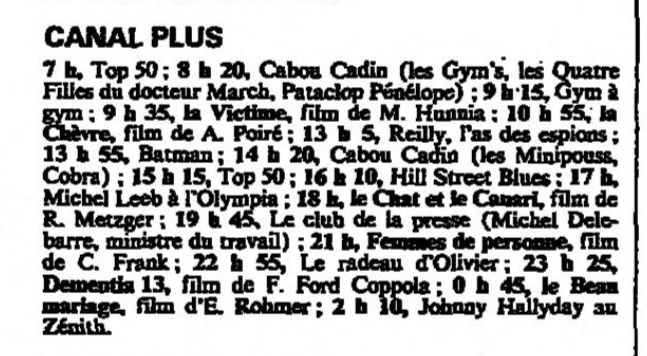
Here are some typical 1985 Canal Plus listings from Le Monde:


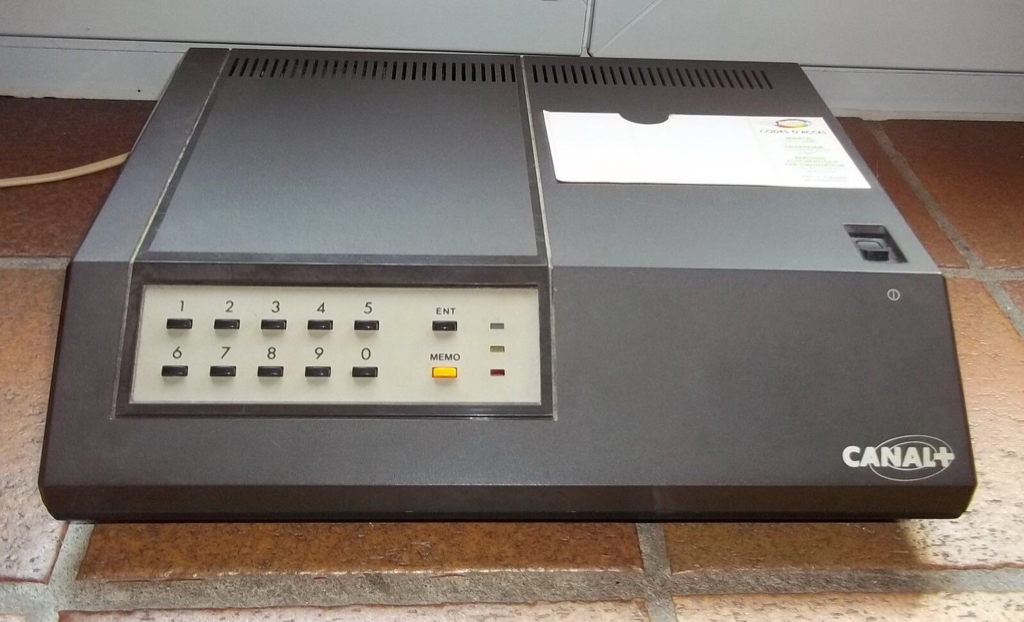
And here's an article about the decoder boxes used by Canal Plus:


Excerpt:

In France, the first nationwide cable channel was Canal+, which debuted on November 4th, 1984. They might have adopted the VideoCipher system used in the States and been done with it, but they couldn’t — VideoCipher was meant for NTSC broadcast systems. French television is broadcast in SÉCAM format, which uses the same frame rate and number of interlaced lines as PAL, but processes the color information differently. Canal+ needed an encryption scheme to match. The system they came up, Discret11, with was simple and effective, but perhaps a little bit short-sighted.

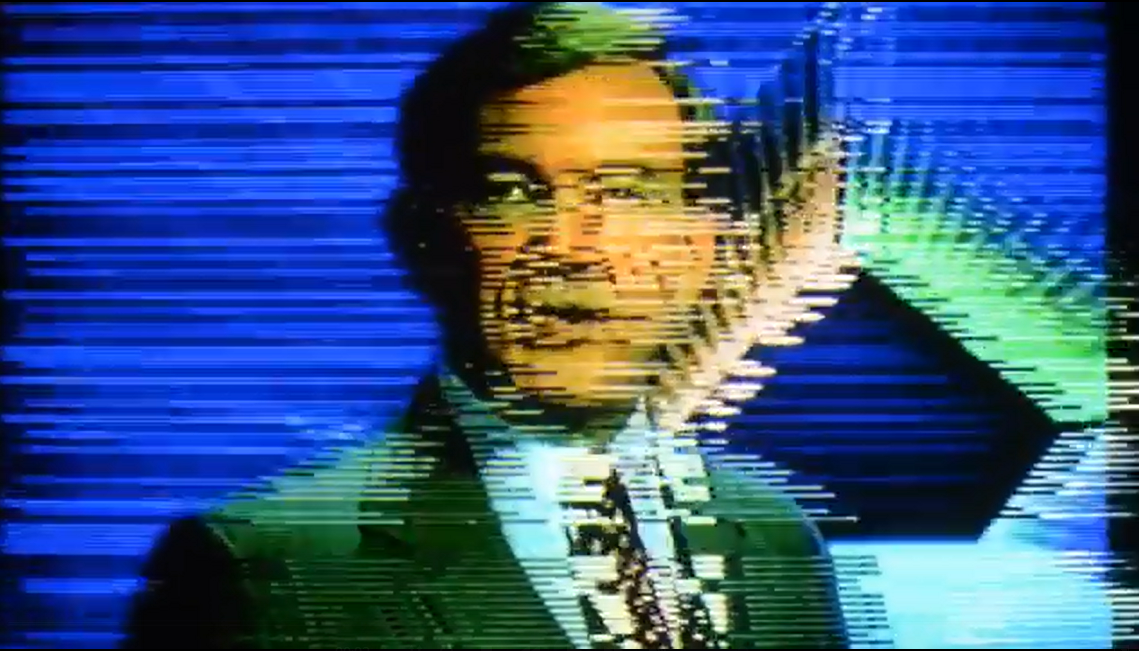
Analog televisions used electron guns to paint the picture on the screen one line at a time very quickly. Discret11 encrypted the Canal+ signal simply by delaying the lines being drawn — filleting the picture by pushing the information off the screen to the right and back-filling it with blackness from the left. The system turned the audio into an unbearable whine by splitting up the signal into two bands and inverting the high and low ends.

Discret11 was named for the 11-bit key that it uses to seed a linear feedback shift register, which in turn computes the delay time for the lines. Subscribers had to enter this key into their decoder box, and Canal+ changed the key every month in an attempt to prevent piracy.

Schematics for a DIY de-scrambler began to be passed around a mere month after the service premiered. Although Canal+ continued on and became quite successful, the Discret11 encryption scheme was phased out by 1995.


Source: Hackaday.com (see link above) and Home Cinema France

Unlike the over-the-air subscription services in the U.S., Canal Plus was a success and later involved into a major cable/satellite platform and movie production company.
 
I've never been there (would like to some day), but Luxembourg is this kind of liminal space between France and Germany, having characteristics of both, but its own thing entirely. The national language, Luxembourgish, sounds like garbled German. I was watching it tonight on RTL online, just out of curiosity.
It's a beautiful country, for one thing. It's also pretty wealthy; many European-based financial services are based there.

The language is most closely related to Low German (Plattdeutsch), with a lot of loan-words from French. French is still one of the official administrative and legal languages in Luxembourg and is widely spoken and understood. To my ears, Luxembourghish sounds a lot like Dutch without the gutturals.

I won't get into the situation in Belgium here. It's complex enough for people to say "Belgium is the world's most successful failed state."
 
It's a beautiful country, for one thing. It's also pretty wealthy; many European-based financial services are based there.

The language is most closely related to Low German (Plattdeutsch), with a lot of loan-words from French. French is still one of the official administrative and legal languages in Luxembourg and is widely spoken and understood. To my ears, Luxembourghish sounds a lot like Dutch without the gutturals.

I won't get into the situation in Belgium here. It's complex enough for people to say "Belgium is the world's most successful failed state."

A lot of the commercial signage in Luxembourg is in French (this can be seen on Google Street Maps).

As a practical matter, one living in Luxembourg would have to be conversant in both French and German. Luxembourgish, as I understand it, is more of a familiar spoken language, you'd want to learn it if you lived there, but strictly speaking it's not necessary for someone just visiting. And in many circumstances, you could probably get by with English. In Brugge (Bruges, in Belgium), English is almost universally spoken. At the Carrefour supermarket, the clerk simply said "thank you" to me, I guess she picked up that I wasn't a native, even though I didn't say anything to her. (She might have been saying "dank U", which sounds almost the same.)
 
This is what their evening news in Luxembourgish looks and sounds like:


The musical signature heard in the clip may be familiar to radio jingle/sounder collectors on this site. For decades, the melody was used as a sounder for the news on Radio Luxembourg's pan-European English service.

You can hear it in this 1977 clip announcing Elvis's death to European listeners:

 
The musical signature heard in the clip may be familiar to radio jingle/sounder collectors on this site. For decades, the melody was used as a sounder for the news on Radio Luxembourg's pan-European English service.

You can hear it in this 1977 clip announcing Elvis's death to European listeners:


The announcer sounds American, aside from when he says "superstAAAr" and "flooAH" for "floor".

Kind of like Lorne Greene, who had a kind of non-rhotic speech, he was a Canadian radio announcer for many years. His speech was typical of educated Canadians of the era.
 
The announcer sounds American, aside from when he says "superstAAAr" and "flooAH" for "floor".

Bob Stewart was British, but you can read about his accent here:

https://www.offshoreradio.co.uk/bstewart.htm

Excerpt:

"It was while working for Caroline that Bob developed his new accent. The bosses were concerned that his natural Scouse tones might not go down well with some of the listeners, especially on the southern station, so it was suggested he try something less polarising. His invented American accent was such a success that Bob stuck with it for the rest of his career."
 
On the subject of over-the-air pay TV, Sky in New Zealand (unrelated to the European satellite operations of the same name) was another successful venture.
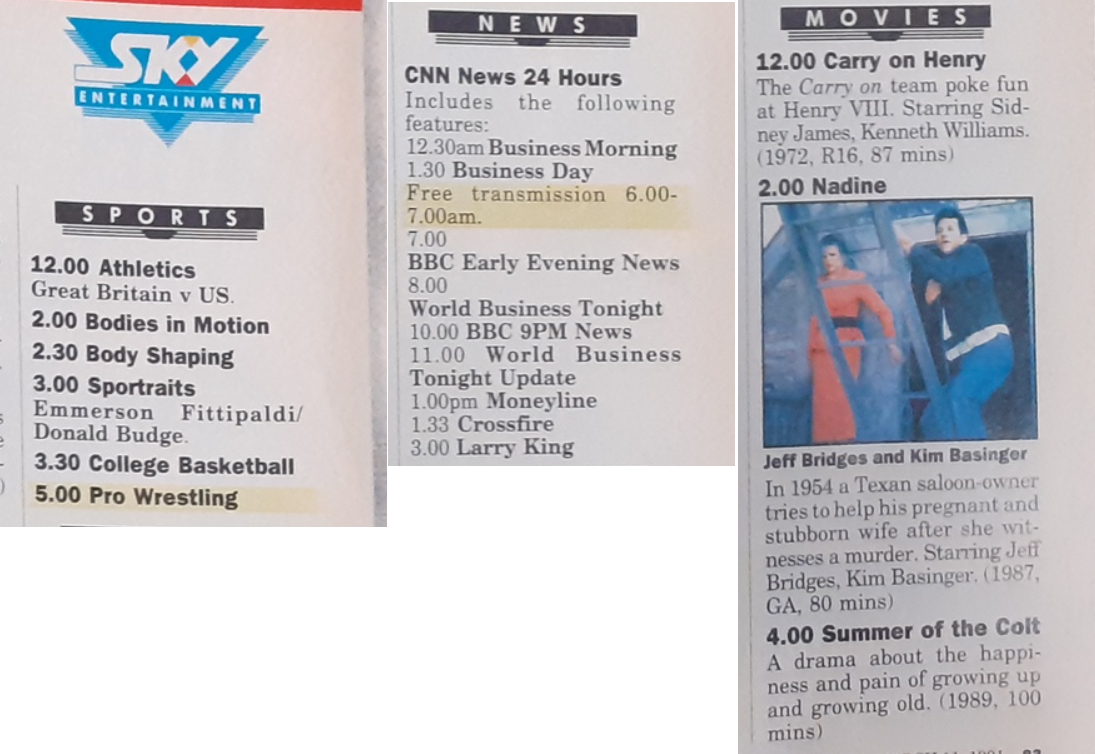
It launched in 1990 with three channels delivered via UHF: Sports, Movies, and News (the latter consisting of a CNN International programming interspersed with an occasional BBC newscast). There was no cable/DBS television in New Zealand at the time.

Here's a typical daytime lineup from 1991:


Source of excerpt: PaddyTePou at MediaSpy.org

Here's a report about the launch of Sky from 1990:


------------------------------------------------
------------------------------------------------

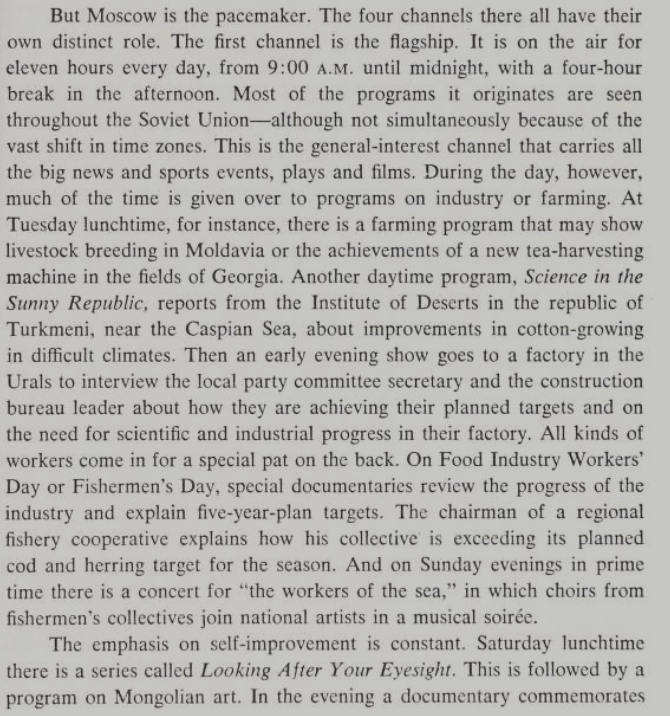
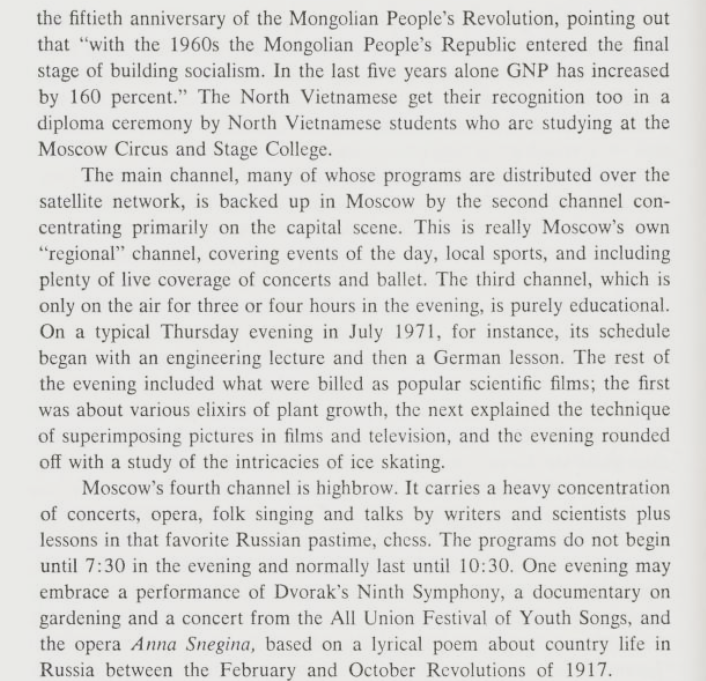
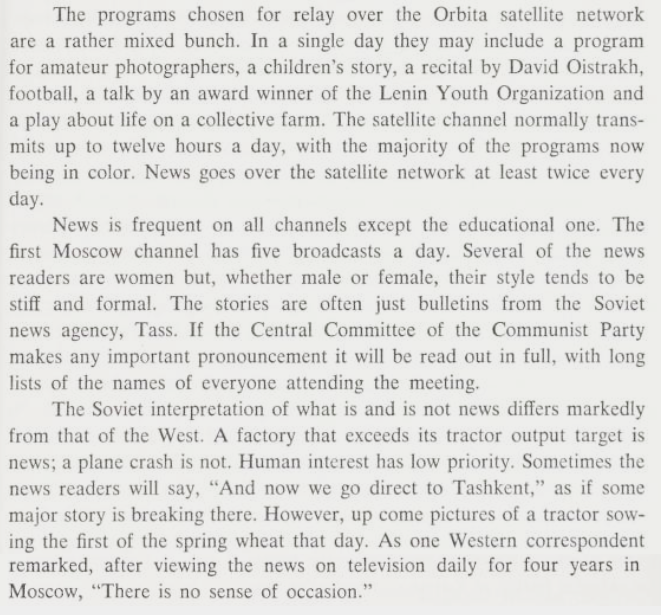
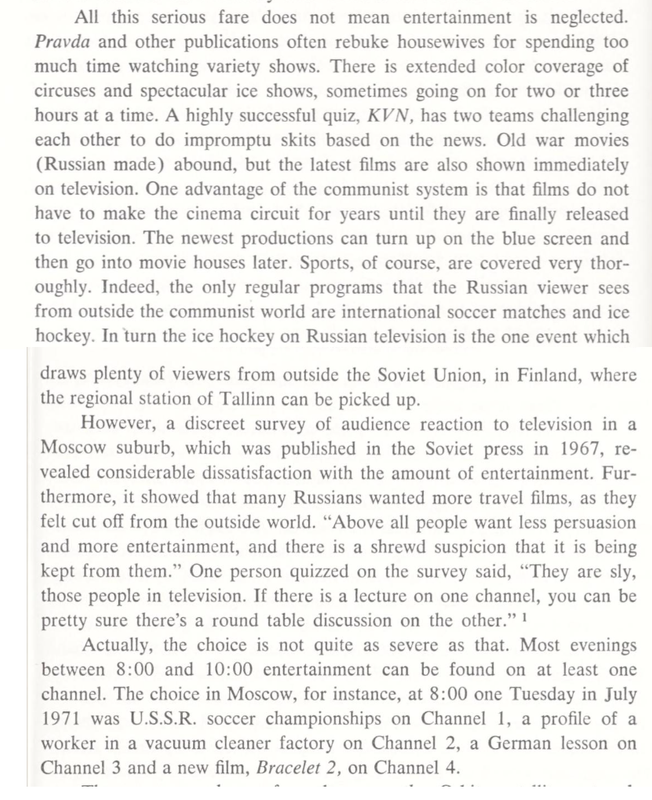
Ever wondered what a typical night's viewing in Cold War-era Moscow looked like? Here's another excerpt from Timothy Green's The Universal Eye: The World of Television (1972):


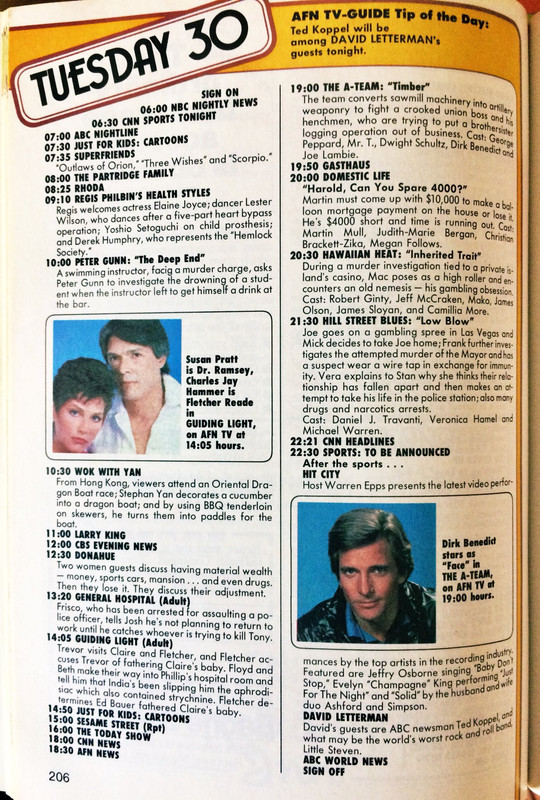
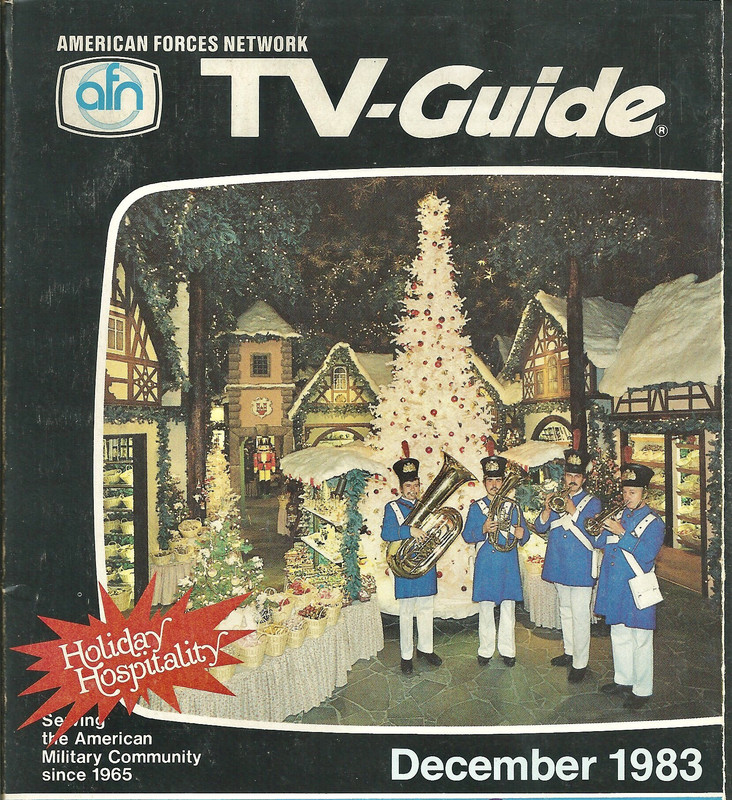
Here's some 1985 listings for the American Forces Network (AFN) TV in Germany as seen as AFN TV-Guide, reproduced here with permission of Claus Grimm on Twitter. Intended for U.S. military personnel and their families, the network also had a strong following among European viewers who watched the NTSC signal in black-and-white. In fact, several German listings magazines (and there were are are many of them!) also carried AFN TV listings, albeit in less detail. AFN TV-Guide itself was also available to German subscribers.


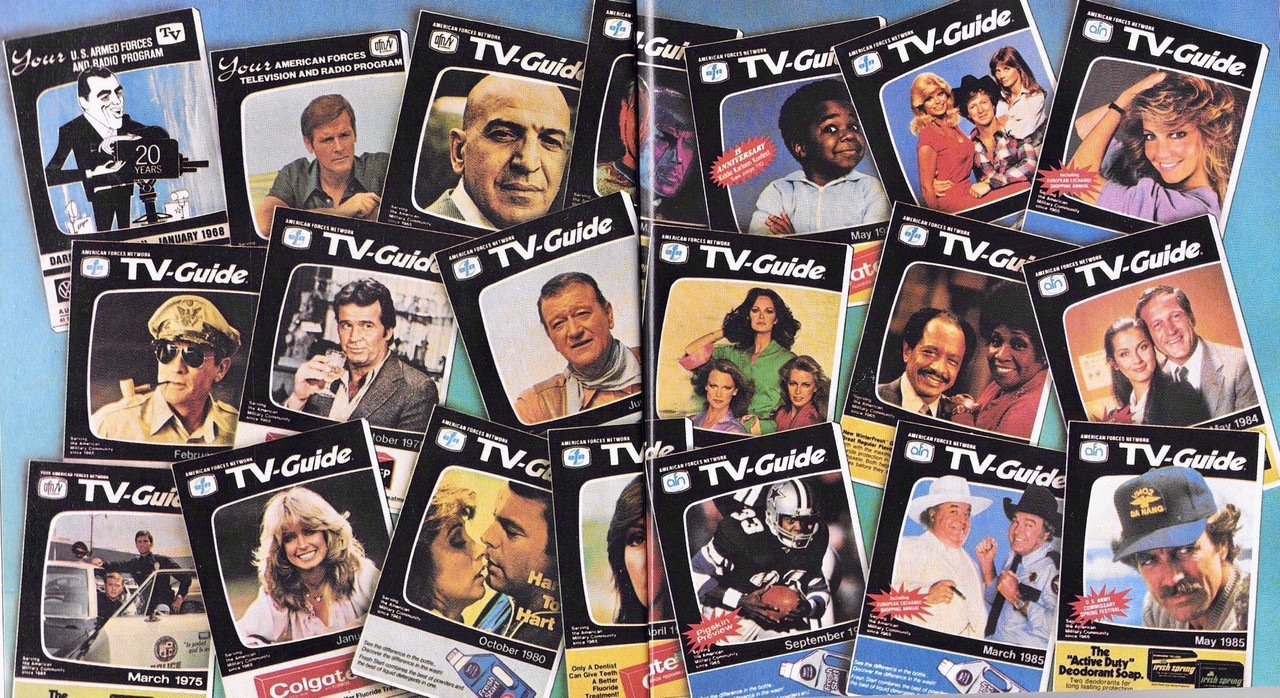
Some AFN TV-Guide covers, also courtesy of Claus Grimm:


And here, with a programming mix from all kinds of networks (broadcast and cable), is a typical day's schedule for AFN Europe from 1994:

 
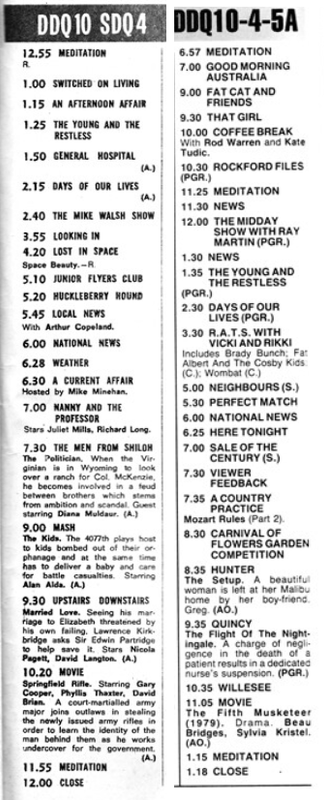
Here are 1977 and 1987 listings for DDQ-10 serving the Darling Downs region and Toowoomba, Queensland, Australia:


Source: TelevisionAU at MediaSpy (reproduced with permission)

Why bring up this station in particular? In 1982, DDQ produced an interesting behind-the-scenes video for tour groups visiting their facilities. It provides an interesting glimpse at a small-market Australian television operation of that era:

 
Here are 1977 and 1987 listings for DDQ-10 serving the Darling Downs region and Toowoomba, Queensland, Australia:


Source: TelevisionAU at MediaSpy (reproduced with permission)

Why bring up this station in particular? In 1982, DDQ produced an interesting behind-the-scenes video for tour groups visiting their facilities. It provides an interesting glimpse at a small-market Australian television operation of that era:

A lot of American programming, especially on that first channel.
 
A lot of American programming, especially on that first channel.

If I read the original post correctly, it was the same channel in 1977 and ten years later. They are both "the first channel".

Edit: Judging from the reply immediately below, I did read it correctly.
 
A lot of American programming, especially on that first channel.

Just to clarify: That's the same channel 10 years apart, in 1977 and 1987. (DDQ had acquired a new translator in the meantime, hence the addition of a channel number.)

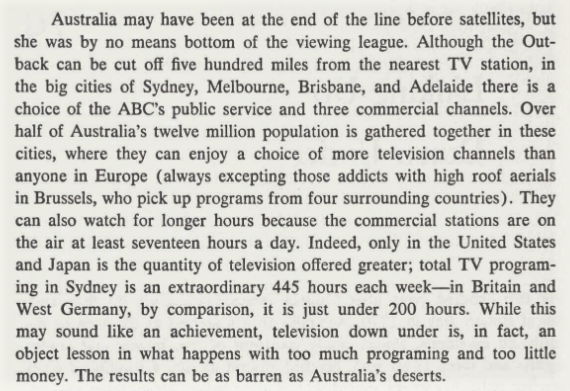
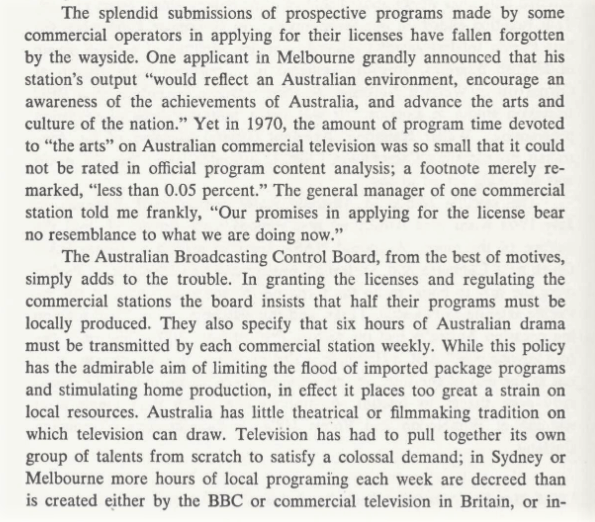
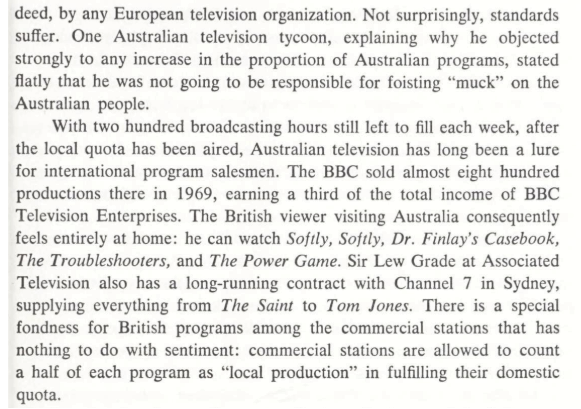
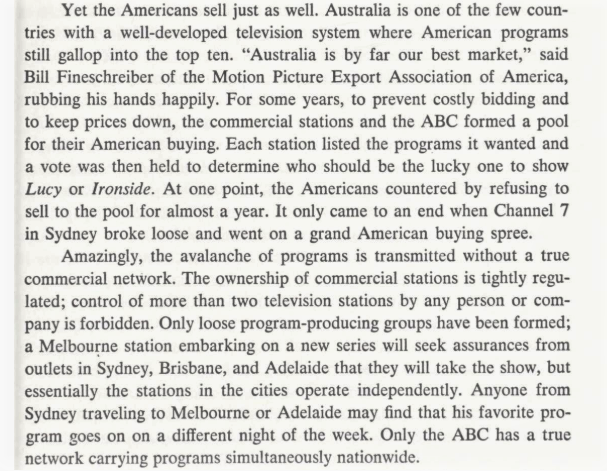
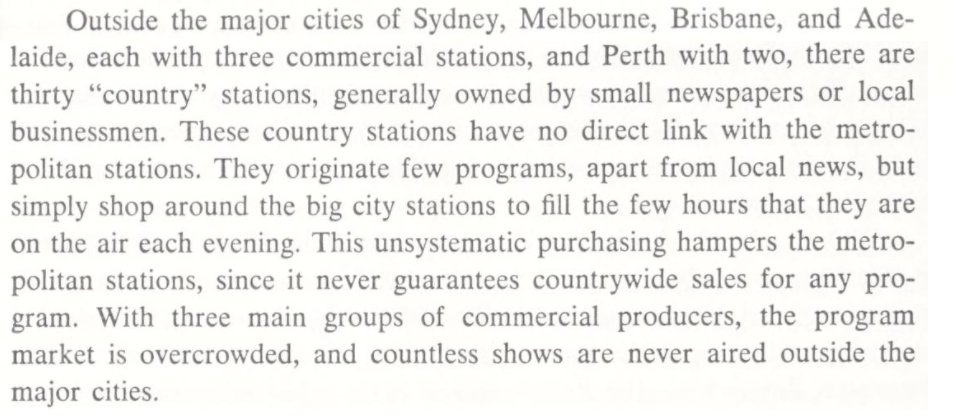
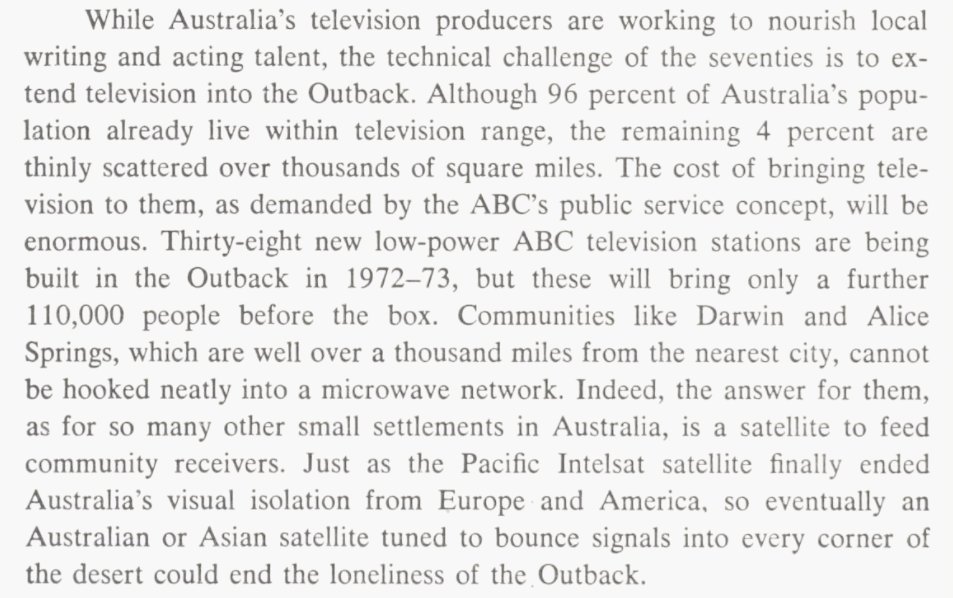
This is how Timothy Green describes the Australian television landscape in his aforementioned book from 1972:


(continued)
 
If I read the original post correctly, it was the same channel in 1977 and ten years later. They are both "the first channel".

Edit: Judging from the reply immediately below, I did read it correctly.

You're right. I didn't pay attention to the text line. I just saw the two schedules and assumed they were two channels in the same city.
 
(continued)


This part reminds me of the small stations in the Mountain Time Zone in the 1960s and 1970s that would fill their schedules with hodgepodges of two or three networks, run either in-pattern with the ETZ/CTZ feed or taped and run wherever they would fit. This was before the MTZ had its own network feeds.
 
Speaking of what was said earlier in the thread about OTA pay TV, anyone remember USDTV's brief foray into OTA subscription TV during the pre-digital transition era? This existed from 2003-2007 and only was able to serve 4 markets before going belly-up (Las Vegas, Alburquerque, DFW, and Salt Lake City). Basically it consisted of the local stations and diginets existing at that time, plus a small amount of traditional cable stations on virtual channel 99.## (e.g., Fox Sports, Disney Channel, Toon Disney, HGTV, Lifetime).

Wikipedia article about USDTV: USDTV - Wikipedia

Also a sample lineup from Dallas/Fort Worth: Dallas/Fort Worth Programming & Availability


Back
Top Bottom