• Get involved.
    We want your input!
    Apply for Membership and join the conversations about everything related to broadcasting.

    After we receive your registration, a moderator will review it. After your registration is approved, you will be permitted to post.
    If you use a disposable or false email address, your registration will be rejected.

    After your membership is approved, please take a minute to tell us a little bit about yourself.
    https://www.radiodiscussions.com/forums/introduce-yourself.1088/

    Thanks in advance and have fun!
    RadioDiscussions Administrators

Vancouver's 50,000 Watt AM Stations

Locally in a station's market area its class has nothing to do with how "good" it sounds. A 50 kw station on any channel is as good as one of a different class on an adjacent channel.

When I operated AM stations in Ecuador, I was subject to the different regulations in adjacent Colombia and Perú. Colombia called 540 to 1000 kHz as our equivalent of clear channels with up to 100 kw. Then up to 1250 had up to 10 kw, and from there to 1600 had just 1 kw. Perú had different licencing, partly dependent, it appeared, to city size. And Ecuador was at random so I could have put 10 kw or even 50 or 100 kw on any of my stations if I wanted to.

So in my case, the best frequency was always a low one where nobody else in either country had a big signal nearby. And with those Vancouver market 50 kw stations, all that matters is how restrictive the directional system is and how well it puts a signal over the metro area population.
Thanks for sharing that, David. I think the Vancouver market is pretty unique in the sense that the overall square milage of the metro is pretty small. Pretty much any use of maximum power is going to be (or at least should be) pretty effective at reaching the entire market. I’m sure there are examples of similar size markets (by area) that have far fewer 50kw AMs.

Back at home in Seattle, the big clear channel stations (710 and 1000) seem to be the most effective at covering the market. The regional stations are mostly fine (but there are certain spots that are troublesome). I would imagine that Vancouver (and the surrounding area) would be somewhat immune to these issues, but that’s proven not to be the case. Even a class A like CKWX struggles due to the directional signal. People living out east towards Abbotsford have been complaining for a long time it seems.
 
Thanks for sharing that, David.
After posting, I feared I had sounded a bit didactic in my response. I apologize if I came off that way, as you are one of my favorite posters here!
I think the Vancouver market is pretty unique in the sense that the overall square milage of the metro is pretty small. Pretty much any use of maximum power is going to be (or at least should be) pretty effective at reaching the entire market. I’m sure there are examples of similar size markets (by area) that have far fewer 50kw AMs.
One issue with land-locked markets is they can't send the high power out over the ocean. Even Toronto can't have too many 50 kw stations even if they push the power up over Hudson Bay! Those interior market station may somehow get 50 kw, but it ends up being so directional that a lot of the population is not served.

From my recollection of Vancouver, it is fairly condensed with a lot more apartments and "vertical real estate" than some spread out U.S. markets. That means less land to cover, but getting a good AM signal inside apartment buildings with all the man-made noise is a hard thing to do.
Back at home in Seattle, the big clear channel stations (710 and 1000) seem to be the most effective at covering the market. The regional stations are mostly fine (but there are certain spots that are troublesome). I would imagine that Vancouver (and the surrounding area) would be somewhat immune to these issues, but that’s proven not to be the case. Even a class A like CKWX struggles due to the directional signal. People living out east towards Abbotsford have been complaining for a long time it seems.
A classic story is the one about how Gordon McLendon long ago upgraded KLIF in Dallas to higher power. He had to use separate day and night sites, and there were stories about how driving a mile or two from Dallas to Ft Worth saw the signal literally disappearing. When Dallas and Ft Worth were made into a single radio market, KLIF, who did not cover to the West at all at night, just died.
 
After posting, I feared I had sounded a bit didactic in my response. I apologize if I came off that way, as you are one of my favorite posters here!

One issue with land-locked markets is they can't send the high power out over the ocean. Even Toronto can't have too many 50 kw stations even if they push the power up over Hudson Bay! Those interior market station may somehow get 50 kw, but it ends up being so directional that a lot of the population is not served.

From my recollection of Vancouver, it is fairly condensed with a lot more apartments and "vertical real estate" than some spread out U.S. markets. That means less land to cover, but getting a good AM signal inside apartment buildings with all the man-made noise is a hard thing to do.

A classic story is the one about how Gordon McLendon long ago upgraded KLIF in Dallas to higher power. He had to use separate day and night sites, and there were stories about how driving a mile or two from Dallas to Ft Worth saw the signal literally disappearing. When Dallas and Ft Worth were made into a single radio market, KLIF, who did not cover to the West at all at night, just died.
No worries David! It didn't come off that was as well. The only way to learn how this stuff works is to hear it from the experts themselves. I appreciate that you explain this stuff to those of us who want to increase our knowledge and awareness.

San Francisco and Los Angeles appear to be markets where a huge chunk of AM power is thrown out over the ocean. This seems to be true for Seattle as well. In every west coast market, it seems like power is pretty limited toward the east of the market (except for the clear channel stations). Back at home in Seattle, almost every AM got choppy towards the cascades, but 710 and 1000 were ever reliable.

It looks like Vancouver is no exception. The power gets thrown to the west (or northwest, since a certain member of RD consistently hears these stations in Alaska). All of the AMs seem to be fine in the western lying parts of the market, but parts of the Fraser Valley get a spotty signal. Even a class A like 1130 struggles, which is (initially) a bit surprising. However, after looking at their pattern, hardly anything gets sent to the east.

And your description of the Vancouver market is absolutely spot on. It was a rather strange metropolitan area to get used to. It takes quite a long time to drive from one end of the Seattle market to the other side. The same is absolutely true in San Francisco and Los Angeles market. The traffic in Vancouver may be awful (and give an unrealistic sense of distance), but the distance between the far end of one side of the market to the other measures to be about 40km. That seems pretty compact. Most people are living in high rise buildings (full of electrical noise), and the roads are packed with wires to power electric busses (exacerbating the interference). I'm on Lulu Island, where most of the AMs transmit from. My location is probably as good as it can possibly get.

On the topic of your KLIF story: I find it amazing that 1190 has stuck around in the Dallas market this long. The daytime pattern is great, but the night pattern is a big problem. I assume that they don't expect to garner a ton of listeners outside of the key listening hours, or else that wouldn't be workable.
 
It looks like Vancouver is no exception. The power gets thrown to the west (or northwest, since a certain member of RD consistently hears these stations in Alaska). All of the AMs seem to be fine in the western lying parts of the market, but parts of the Fraser Valley get a spotty signal. Even a class A like 1130 struggles, which is (initially) a bit surprising. However, after looking at their pattern, hardly anything gets sent to the east.

The best "Vancouver area" signal consistently is KVRI 1600. With what amounts to about 50kw ERP beamed squarely right at me from about 1500 miles away

 
CKNW on 980 had one of the worst signals in Vancouver. Period.
 
The best "Vancouver area" signal consistently is KVRI 1600. With what amounts to about 50kw ERP beamed squarely right at me from about 1500 miles away

Growing up "back East" I always found the nighttime reception on the handful of 50kw AM signals near the top of the dial tended to be stronger and steadier than for the many more clear channel stations, broadcasting at lower and mid-dial frequencies. Properties of shorter wavelengths, as I understand it. And I think they were all quite directional, which also helped aim that signal into where I was.

It was kind of a thrill wne I first discovered stations from Havana at the low end of the dial at night (590, 640, 690) coming in clearly most nights in Ohio and West Virginia. I suppose they had a lot more power than 50kw. But they also had a bit of a rumble underneath them that sounded like their transmitters working really hard. At the lowest frequencies, as you all probably know, the reception would fade a bit, strengthen a bit, and there were times every hour where you just couldn't hear them clearly for a few minutes if you were monitoring the signal from a home receiver before the skywave signal would gather strength again.

Whereas WLAC from Nashville on 1510 would bang in loud and clear, with very little of the usual fading on other clear channels, from the Gulf Coast to the Great Lakes. Even tho I lived near a local AM on 1520. Same deal with Cincinnati's WCKY on 1530 and KXEL Waterloo Iowa on 1540.
WLAC's nighttime "soul" music was a revelation. I remember the Spider Man as one of their DJs. There have been articles and perhaps a documentary or two about their influence 'back in the day' on rhythm and blues music - especially heavy with the blues part.

That's what I miss most about the AM band today. You would literally hop on board a frequency and ride it out for as long as you could, if the programming was unique and interesting.
 
The best "Vancouver area" signal consistently is KVRI 1600. With what amounts to about 50kw ERP beamed squarely right at me from about 1500 miles away

An interesting tidbit about KVRI. I regularly visit Semiamoo park, which is located right near the Canada/US border in Blaine WA. It's a pretty unique spot, as it's basically a jetty of land that extends out from the Washington State side (and provides a great view of White Rock, BC. This is where the KVRI/KARI site is located. What an interesting spot for an AM site. I don't think it's possible to get much closer to the border than that. With how much power they put out (and how close they are to the population they want to serve), I view KVRI as being just as "local" as any other Vancouver AM. It also has the added benefit of cicumventing the Canadian rules of having to air programming in other languages other than Punjabi during certain times of the day/week.
 
Growing up "back East" I always found the nighttime reception on the handful of 50kw AM signals near the top of the dial tended to be stronger and steadier than for the many more clear channel stations, broadcasting at lower and mid-dial frequencies. Properties of shorter wavelengths, as I understand it. And I think they were all quite directional, which also helped aim that signal into where I was.

It was kind of a thrill wne I first discovered stations from Havana at the low end of the dial at night (590, 640, 690) coming in clearly most nights in Ohio and West Virginia. I suppose they had a lot more power than 50kw. But they also had a bit of a rumble underneath them that sounded like their transmitters working really hard. At the lowest frequencies, as you all probably know, the reception would fade a bit, strengthen a bit, and there were times every hour where you just couldn't hear them clearly for a few minutes if you were monitoring the signal from a home receiver before the skywave signal would gather strength again.

Whereas WLAC from Nashville on 1510 would bang in loud and clear, with very little of the usual fading on other clear channels, from the Gulf Coast to the Great Lakes. Even tho I lived near a local AM on 1520. Same deal with Cincinnati's WCKY on 1530 and KXEL Waterloo Iowa on 1540.
WLAC's nighttime "soul" music was a revelation. I remember the Spider Man as one of their DJs. There have been articles and perhaps a documentary or two about their influence 'back in the day' on rhythm and blues music - especially heavy with the blues part.

That's what I miss most about the AM band today. You would literally hop on board a frequency and ride it out for as long as you could, if the programming was unique and interesting.
I wasn't alive at the time to experience it, but it probably was a cool experience to scroll across the AM dial and hear different and unique stations. As we all know, a lot of the AM band is a graveyard of 800 numbers and syndicated programs in the modern era.

I still get a lot of joy from scanning across the AM dial at night. But I always look for the big stations that tend to air unique content. I was driving tonight listening to KCBS 740 in the car. I get a kick out of that since I get to hear a traffic report for San Francisco before heading down for an extended visit in a few weeks.
 
Wow! You got that right. KAPS 660 has a really dirty signal spectrum-wise making it hard to hear 650 south of Bellingham.

Log on to one of the region's KiwiSDRs and you'll observe the 660 mess. Or you can just drive I-5 and tune in firsthand.
I drove through Mount Vernon today and listened for KAPS for a bit. It sounds fine on 660, but it sounds like a complete mess on the adjacent channels. The FM sounded okay, but it wasn't as clear as I was expecting (especially when you consider that I was within a mile of the transmitter).
 
It looks like the AM 980 loop is gone. There is now no RF signal on that channel. 980 is no more.

If you have not reset your radio push-button to AM 730 you are indeed a "clueless listener." I wonder what signals will now be heard on that open channel.
 
It looks like the AM 980 loop is gone. There is now no RF signal on that channel. 980 is no more.

If you have not reset your radio push-button to AM 730 you are indeed a "clueless listener." I wonder what signals will now be heard on that open channel.
Welp, I tried listening to 980 tonight and didn’t hear much of anything. To be fair, my location isn’t ideal for nighttime catches. I was able to get a much stronger KNWN though. I usually listen to 1000 for a few minutes before bed just to hear what’s going on at home in Seattle. 1000 has always been the easiest Seattle AM to pick up in my location, and it sounds better with 980 turned off.
 
Using some remote receivers in the area and my own local experience the two "leftover" signals on 980 are:
KFWB Los Angeles
KWSW Eureka

The KWSW logging is no surprise as 1480 KEJB Eureka blasts into Western Washington at night . Oldtimers remember 1480 as KRED.
 
The answer to my earlier comments...

I have been hearing Mandarin programming in the afternoons on KVRI 1600 AM, Blaine. An Internet search led to a YouTube off-air recording and ultimately this website:


Translated:


About Us

"Chinese Radio Vancouver is located in Richmond, a satellite city of Vancouver, British Columbia, Canada. It provides broadcasting services to Mandarin-speaking listeners in the Greater Vancouver area of British Columbia through AM1600. It is the first and only Chinese radio station in Vancouver that caters to Mandarin-speaking listeners, and it is also the only Chinese radio station in Canada that broadcasts live simultaneously in the United States and Canada."

The website has a streaming audio player but does not seem to be working (or is blocked South of the Border).
 
The answer to my earlier comments...

I have been hearing Mandarin programming in the afternoons on KVRI 1600 AM, Blaine. An Internet search led to a YouTube off-air recording and ultimately this website:


Translated:


About Us

"Chinese Radio Vancouver is located in Richmond, a satellite city of Vancouver, British Columbia, Canada. It provides broadcasting services to Mandarin-speaking listeners in the Greater Vancouver area of British Columbia through AM1600. It is the first and only Chinese radio station in Vancouver that caters to Mandarin-speaking listeners, and it is also the only Chinese radio station in Canada that broadcasts live simultaneously in the United States and Canada."

The website has a streaming audio player but does not seem to be working (or is blocked South of the Border).
You are absolutely correct, it looks like 1600 has shifted some of their airtime to mandarin language programming. I’m not sure if this is something that will increase over time, or if it will continue to be a mix of Punjabi shows and then mandarin shows.

I think there’s a business case for having another radio station in town that caters to the mandarin speaking audience. As of now, listeners are basically stuck with Fairchild radio (alternating between fm and am). Cantonese speakers also get 1320, so there’s a little more programming available. It doesn’t surprise me at all that one of the border blasters would air mandarin programming as well.
 
A classic story is the one about how Gordon McLendon long ago upgraded KLIF in Dallas to higher power. He had to use separate day and night sites, and there were stories about how driving a mile or two from Dallas to Ft Worth saw the signal literally disappearing. When Dallas and Ft Worth were made into a single radio market, KLIF, who did not cover to the West at all at night, just died.
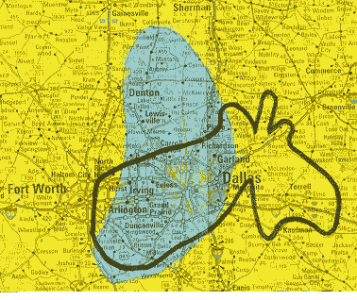
Here are the two nighttime signals for KLIF 1190.... blue is the pre-1970 coverage, the black line is the new multi-tower array based in Rockwall that went on in 1970.
The intent was to get better coverage into Fort Worth, but in hindsight (especially with the growth to the north), they may have been just as well served to have left well enough alone.
1749176454404.png
 
You are absolutely correct, it looks like 1600 has shifted some of their airtime to mandarin language programming. I’m not sure if this is something that will increase over time, or if it will continue to be a mix of Punjabi shows and then mandarin shows.

I think there’s a business case for having another radio station in town that caters to the mandarin speaking audience. As of now, listeners are basically stuck with Fairchild radio (alternating between fm and am). Cantonese speakers also get 1320, so there’s a little more programming available. It doesn’t surprise me at all that one of the border blasters would air mandarin programming as well.
Yes, let's see what happens. There are plenty of South Asian stations coming from both sides of the border. I would not be surprised if some of those vacant a Vancouver AM channels come back as South Asian formatted stations. Mandarin remains a growth market on the lower Mainland BC.


Back
Top Bottom