• Get involved.
    We want your input!
    Apply for Membership and join the conversations about everything related to broadcasting.

    After we receive your registration, a moderator will review it. After your registration is approved, you will be permitted to post.
    If you use a disposable or false email address, your registration will be rejected.

    After your membership is approved, please take a minute to tell us a little bit about yourself.
    https://www.radiodiscussions.com/forums/introduce-yourself.1088/

    Thanks in advance and have fun!
    RadioDiscussions Administrators

Which Beautiful/Easy Listening Orchestras Were Better or Worse Than Others and Why

McLendon abandoned the all-classified format on 103.5 and flipped it from KADS to beautiful music KOST in October 1967. In March 1968, when KFWB went all-news, McLendon decided to give up the all-news format on XETRA (or, since he technically didn't own XETRA, he "convinced" its management to give it up) and made it a simulcast of KOST (which lasted until into the mid 70s)
View attachment 10071
Huff---I'm not sure XTRA/KOST was a simulcast. In those days, you couldn't send a signal live from a studio in the U.S. to a transmitter in Mexico. It's why Wolfman Jack recorded his shows and had the tapes sent down to Rosarita Beach on the bus.

My mom liked both XTRA and KOST in those days, and I recall them being programmed separately (though to adolescent me, you couldn't tell them apart except for the station IDs).

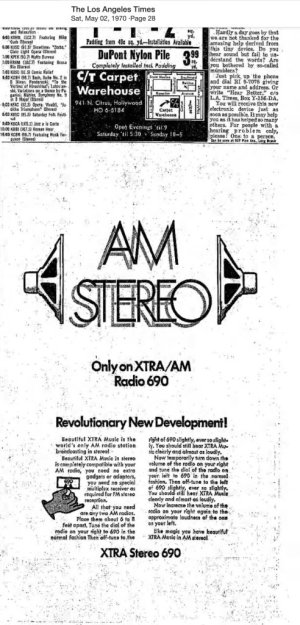
Also---beginning in 1970, XTRA broadcast in AM stereo (two receivers needed):

Screenshot 2025-08-22 at 9.06.03 AM.jpeg
 
True - it may have been more of a "Shadowcast", but they were certainly marketed in tandem.

Okay...so here's the answer. Both stations programmed by the same guy (Paul Wexler), separate automation systems (one in L.A. and one in Mexico), with at least some of the XTRA tapes being shipped down from KABL in Oakland:


That was 1968. By 1970 and the launch of the AM Stereo thing, Billboard reported that the tapes were produced at McLendon's headquarters in Dallas:


And yes, they were marketed---both to advertisers and the public---in tandem, at least until 1974, when the focus on the advertising shifted entirely to KOST.
 
McLendon abandoned the all-classified format on 103.5 and flipped it from KADS to beautiful music KOST in October 1967. In March 1968, when KFWB went all-news, McLendon decided to give up the all-news format on XETRA (or, since he technically didn't own XETRA, he "convinced" its management to give it up) and made it a simulcast of KOST (which lasted until into the mid 70s)
View attachment 10071
XTRA/KOST somehow missed the opportunity to describe it as "at no extra cost" rather than "free"...
 
McLendon abandoned the all-classified format on 103.5 and flipped it from KADS to beautiful music KOST in October 1967. In March 1968, when KFWB went all-news, McLendon decided to give up the all-news format on XETRA (or, since he technically didn't own XETRA, he "convinced" its management to give it up) and made it a simulcast of KOST (which lasted until into the mid 70s)
View attachment 10071
I have KOST switching Nov 26, XTRA (XETRA) April 5. McLendon planned the change as soon as KFWB announced they were changing to News which switch happened 3/11 as far as I have been able to determine. I have that one duplicated the other too but can that be said when they are each running tapes even though they be copies of the same? I have that Paul Wexler did the programming but on XETRA they also used KABL tapes. As I recall I figured that out by consulting the local newspapers which may well have been off. Or taken a while before they published the changes or did not report them to those papers I was able to examine. I was never able to consult anyone who worked at either. After KOST was sold XTRA AM used Rich Wood's TM Programming and in 1978 he left TM to program the AM exclusively which was syndicated for four years as Noble One. Thank you.
 
Which is why I've spent decades and more money than I care to admit accumulating archival ARB data back to 1965. Unfortunately, there was never a Hooper "repository" or archive, so most of that data is lost to history, with the exception of a few trade ads here or there or the odd pamphlet report saved by a programmer.
Which is when they started in radio is it not? At least in some markets which they kept adding to over the years. But in siting their figures for sake of comparison we must qualify by indicating how many markets they were gathering data in. But I believe they were the first service to break out the AM-owned FMs.
 
Except for a couple of stations like WPAT in the New York market and KPOL in LA, I can't see many true "Beautiful Music" stations that endured into the 70s. And those two I mention had FM simulcasts that were listed in combined form in Arbitron... generally as the AM station.

Some, like "Ocean" in Miami, left the format in the earlier 70's. And even ones like WVCG-1070 in Miami had their FM as well.

In the 1976 Duncan book, I can not find a single stand-alone AM Beautiful Music station with significan ratings.

But format radio pretty much started taking over in the early 50's when Top 40 was created. By the middle of the decade, there were few block programmed stations and those were, musically, MOR in that era.

Most of those, if they played instrumentals, used a big percentage of bands and not so much Jackie Gleason and the more modern "studio orchestra" sound.

You are missing the fact that Top 40 was created in 1951, and it played "the hits". When rock 'n' roll hits came along, the stations played both traditional sounds and the newer artists together... even as late as 1960 when many stations celebrated "Volare" as the prior year's #1 song... a definite MOR tune!

The stations that were not Top 40 were generally among just a couple of big formats by the end of the 1950's: country, "race music" (sorry, but that is how it was called), and some form of MOR, often called "Full Service". Few were all instrumental. The MORs were the most varied, as they might play some instrumentals, be more traditional or even play some of the crossover artists that had Top 40 hits, like Nat "King" Cole and even Paul Anka

I was an AM band DXer starting in 1958 and in the next 5 or so years logged about 2,500 stations. I can recall very few that played instrumentals in rated dayparts, although there were several shows, such as the Holiday Inn overnight show that played instrumentals.

There were exceptions, such as McLendon's 1960 launch of KABL 960 in San Francisco... a station that took advantage of poor FM coverage in that market. KABL got a few imitators, but the format was not that common on AM

In 1950 there were about 1000 licensed FMs in construction or on the air. By 1960 they had fallen to just over 600. The independent FM for the most part had closed. The others simulcast their AM. Then, in the ealy 60's a new set of owners filed for FMs and got them and stuck with it.

And was not into effect until the start of 1967.

Major market AM station owners, faced with non-duplication rules, looked for the formats that would least affect their cash cows, and so Beautiful Music and Album Rock seemed to be the best way to protect their AMs.

But if anything made Beautiful Music so successful, it was the duo of Shulke and Taylor who used syndication to mae doing the format cheap and easy: no cost of building a library, no PD, generally no talent, ability to automate, and even help in promotion and sales.
But - a listener getting into FM would have been usually the result of a conscious decision before most radios had FM receivers. So most listeners who had found a Beautiful AM they became used to playing would just have stuck with it rather than get an FM receiver or search for another station. Unless their fave station went off or changed format. Which makes me think of my father who I doubt ever listened to a Beautiful station in his car on AM which is when he most listened. Then he discovered in 1972 the Mt. Washington FM out of Portland ME Marlin was programming from that year - that had been WMTW and was WMMT or something like that and changed to WHOM in '76. He would listen for hours every evening and when I visited once I remember he said Dick isn't that the most beautiful music you ever heard? So many listeners I interviewed were never even aware of Beautiful Music on AM at all. Then when it became big on FM they tuned in and it was new to them.
 
I would argue that the initial Storz success in 1951 came more from the personalities he hired rather than from any of his innovations.
If you read the definitive history which can still be bought you will see that the success of KOWH was in playing the hits over and over all day with nothing else in between. The DJs created a nice mood, but the key was the consistent music format.

A brief story: KOWH Omaha: The birth of American's First Top 40 station

I met with Todd a week or so before he died in Miami. I was on a layover of over 14 hours for my flight back to Quito, and went to WQAM hoping to see how it ran. The receptionist was intrigued by the story of an 18 year old building a Top 40 station, and introduced me to the manager. He believed my story and said, "there is someone here you should meet" and took me to another office where Todd was working. He loved my story, and over the next 6 hours or so, including his treat of dinner, he taught me "Top 40 for Dummies".
Yes he was eliminating non-music programs was until Fall of 1953. The DJs he hired were pulling their own music and he must have learned a lot from them.
No, there was a playlist and rotation by category of what we call powers, new songs, and several others for the rest of the 40 or so songs. By the time I saw WQAM, the music was on carts. But each category was in sets and you played the most rested and then "put it in the back".

Storz got play info from the juke box companies, and later from singles sales. And he tabulated requests.
But in terms of the limited playlist for programs that did not come in until Bill Stewart as I understand it.
The fable goes that Bill and Todd were together often at a coffee shop and saw how the waitresses would use nickles from their tips to play the same songs over and over.
And then only part of the broadcast day. The rest of the time they were playing the same stuff as hundreds of other AMs were.
It was all day after the 1951 "relaunch" as all-hit radio. It was a daytimer. Yes, before that it was block programmed.
Possibly some of those men were lazy and only pulled a minimum of records. In those days it was mostly all singles. I have read that Storz himself never cared for 45 rpms so recorded them on to 78 rpms for station and his own use. Until 1957 or '58. Just my own conclusions and I know at variance with how history has received it.
I bought my first records in prior to "rock 'n' roll' and remember that by the earlier 50's the 45 was what you found at record stores. I remember buying a song for my mother around 1953 and, when I gave it to her, she said, "now you have to buy me a new record player".

Every picture I have of Todd Storz that has a record in it shows a 45. But I am curious as to why you believe he had a preference for 78's, particularly since their life in radio studios was much shorter due to the difference in materials.
 
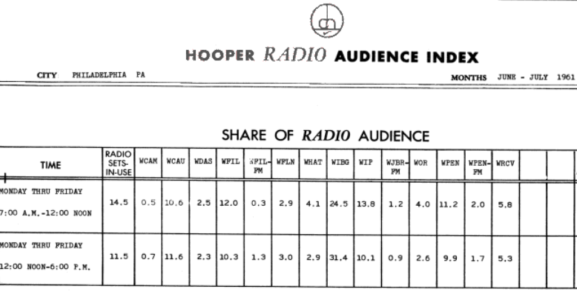
Hooper would list FMs if they had enough listening and were not simulcast
View attachment 10074
Sidedbar: In that era, I had a dog... and owned a couple of shares of Storer Broadcasting. So the dog was named "Wibbage". You can see why!
 
But - a listener getting into FM would have been usually the result of a conscious decision before most radios had FM receivers.
As more and more radios came out with FM, more people had access.

Around 1958 I had savings from part time print-shop and radio work and I bought a radio to listen to while I did my 3 to 4 hours of nightly homework. I found a very nice looking Zenith that was leather bound, portable and had great sound. It also had FM, even though I was not looking for FM.

The radio was so good that almost a decade later, it was my backup STL receiver in Ecuador for HCRM-570 AM.
 
As more and more radios came out with FM, more people had access.

Around 1958 I had savings from part time print-shop and radio work and I bought a radio to listen to while I did my 3 to 4 hours of nightly homework. I found a very nice looking Zenith that was leather bound, portable and had great sound. It also had FM, even though I was not looking for FM.

The radio was so good that almost a decade later, it was my backup STL receiver in Ecuador for HCRM-570 AM.
That year (1958) my father got a Hallicrafters set to hear the ship-to-ship and ship-to-shore and amateur broadcasts. It had an FM receiver so for the first time I could explore that band. When I was 17 or 18 I bought an Arvin receiver.
 
If you read the definitive history which can still be bought you will see that the success of KOWH was in playing the hits over and over all day with nothing else in between. The DJs created a nice mood, but the key was the consistent music format.

A brief story: KOWH Omaha: The birth of American's First Top 40 station

I met with Todd a week or so before he died in Miami. I was on a layover of over 14 hours for my flight back to Quito, and went to WQAM hoping to see how it ran. The receptionist was intrigued by the story of an 18 year old building a Top 40 station, and introduced me to the manager. He believed my story and said, "there is someone here you should meet" and took me to another office where Todd was working. He loved my story, and over the next 6 hours or so, including his treat of dinner, he taught me "Top 40 for Dummies".

No, there was a playlist and rotation by category of what we call powers, new songs, and several others for the rest of the 40 or so songs. By the time I saw WQAM, the music was on carts. But each category was in sets and you played the most rested and then "put it in the back".

Storz got play info from the juke box companies, and later from singles sales. And he tabulated requests.

The fable goes that Bill and Todd were together often at a coffee shop and saw how the waitresses would use nickles from their tips to play the same songs over and over.

It was all day after the 1951 "relaunch" as all-hit radio. It was a daytimer. Yes, before that it was block programmed.

I bought my first records in prior to "rock 'n' roll' and remember that by the earlier 50's the 45 was what you found at record stores. I remember buying a song for my mother around 1953 and, when I gave it to her, she said, "now you have to buy me a new record player".

Every picture I have of Todd Storz that has a record in it shows a 45. But I am curious as to why you believe he had a preference for 78's, particularly since their life in radio studios was much shorter due to the difference in materials.
Wasn't that in the book you cited? My variance comes from reading interviews with and sometimes chatting with men on the scene in those days or who heard KOWH. I will admit to never having had much interest in that kind of radio except as far as it affected Beautiful Music as a format. So any study of it I did was from that perspective.
 
That year (1958) my father got a Hallicrafters set to hear the ship-to-ship and ship-to-shore and amateur broadcasts. It had an FM receiver so for the first time I could explore that band. When I was 17 or 18 I bought an Arvin receiver.
That was Hallicrafters' failed effort to make a consumer radio with added features. It did not have real selectivity options like the SX series, but was actually a step above the average consumer radio in sensitivity, fidelity and features. But the brand was unknown to consumers, so it never caught on.
 
Wasn't that in the book you cited? My variance comes from reading interviews with and sometimes chatting with men on the scene in those days or who heard KOWH. I will admit to never having had much interest in that kind of radio except as far as it affected Beautiful Music as a format. So any study of it I did was from that perspective.
Yes, KOWH was a full all-day all the same format from the moment in 1961 that it debuted as the first "Top 40 station" before the format even got that name. Storz had tried to make the 500 watt daytimer work for several years, with little success, until he hit on the format that made him one of radio's saviors in years when TV was thought to have killed it forever.
 
Shulke was most demanding in the large markets where he required live announcers. In the smaller ones, he was less adamant, just "requiring" but not inspectign.

And, remember, there were precursors such as WDBN in the Cleveland / Akron market that in 1958-1959 had a fairly well assembled precursor to the very later more famous stations like KABL and, then, the syndicated formats.

I used the concept of what was "easy listening" before Shulke and Bonneville for my Teleonda 95 in Quito. When I decided to syndicated such a format, updated my own model. The core values to me were...
  • Suitable instrumental versions of Latin American standards done in contemporary styling. This meant stylized versions of genres like the tango, ranchera, vals peruano, cuecas, etc.
  • A portion of instrumental versions of non-Latin American "modern era" songs that had wide age appeal and had been hits in Latin America, such as covers of some American Top 40 songs as well as covers of many of the big French and Italian pop hits of the 60's and later.
  • Instrumental versions of Latin American pop (what would be considered Top 40 in American terms) songs that had been universal hits across the region.
  • Vocals that were either contemporary "Light Pop" that also might have been exposed on Top 40 stations in Latin America or versions of traditional songs done by contemporary singers or choral groups.

WDBN used the harp before KABL.

In the very big markets, as I said. I doubt he paid much attention to stations in markets outside the top 20 to 25 and let his staff do that.

Remember, few stations ran "overnight" in the late 60's. There were some frequencies that were totally vacant in all North America after midnight in the late 50's and early 60's. So the few that were on all night might get considerable regional listening.

The other syndicators were executing a format, not a single person's approach. Some, like KalaMusic, RPM and Peters, tried to have fewer covers of standards and more contemporary sounds and vocalists.

This is just as Bill Drake and Rick Sklar both "did Top 40" in the 60's, but each had a different "sound" to their product. They were on the same highway, but in different lanes and at different speeds.

While I had no way of checking many of the stations that did instrumental based formats that far back, the use of the harp sound was based on the interval signals of short wave stations dating back to the 60's. At some point, that became a "stinger" for "good music" stations. But it was not a McLendon original. McLendon like taking proven ideas, such as Todd Storz' Top 40 and adding his own showmanship to them. Heck, he even took credit for "inventing" all-news when he had just simply copied what was created by Goar Mestre in Cuba about 12 years prior!

Again, those were the Beautiful Music / Good Music equivalent of jingles. And they were based on shortwave interval signals dating back several more decades.

Re Latin American listening: an artist like for instance Percy Faith recorded Latin tunes using some Latin instruments - but rhythmically they were not patterned the way the performances would have been in their home countries. I learned this because when I was young I used to play piano with Latin bands and had to learn the proper patterns or I would throw off the rhythmic feeling. Different for Conjunto, Charanga, Cha Cha Cha, and so on. So I am thinking listeners in those countries could enjoy the tunes and the orchestrations but they would not feel they were properly done rhythmically and would find that leaving something to be desired and not in the right groove.


Back
Top Bottom