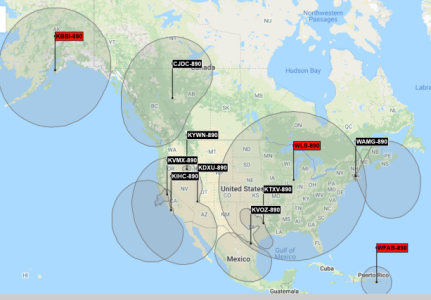
DavidEduardo said:Watt Hairston said:Much of the problem is manmade noise plus poor receiver design that is prevalent today as touched on here. The distance reception issue is related to a station in Columbia that started nighttime operation some years back.
If you are referring to Columbia, the country, I have a comment. Otherwise, I can't find a station in Columbia, MO, or even the District of Columbia on 890 or 900 or 880.
Colombia has had several 50 kw stations on 890 going back 50 years. When the channels were reassigned in the early 60's, all frequencies below 1000 kHz are the equivalents of clear channels, where as many as 2 50 kw stations can be licensed, and where some have two 50's and a 10 on them.
Colombia, and Latin America other than Puerto Rico and Mexico, have no daytimers, There are not more than a handfull of directional stations outside Mexico, either.
So there is no station in Colombia that recently began night operation. The ones on 890 have been there for three or four decades.
In southern vernacular, “some” is a varying quantity that may infer years, decades, centuries, millennia etc. To me, 30-40 years does not seem like that very long ago now. Back to the subject, as I recall in the 50’s and 60’s the clears were indeed very clear with rare interfering signals, just selective fades. Were the Columbian stations operating at full power at that time? On the other hand they could have been and solar conditions weren’t favorable. Solar cycle 19 was a record breaker in the late fifties into the sixties.


 . actually i have gotten it a lot lately.