
• Get involved.
    We want your input!
    Apply for Membership and join the conversations about everything related to broadcasting.

    After we receive your registration, a moderator will review it. After your registration is approved, you will be permitted to post.
    If you use a disposable or false email address, your registration will be rejected.

    After your membership is approved, please take a minute to tell us a little bit about yourself.
    https://www.radiodiscussions.com/forums/introduce-yourself.1088/

    Thanks in advance and have fun!
    RadioDiscussions Administrators

WLS

DavidEduardo said:
Watt Hairston said:
Much of the problem is manmade noise plus poor receiver design that is prevalent today as touched on here. The distance reception issue is related to a station in Columbia that started nighttime operation some years back.

If you are referring to Columbia, the country, I have a comment. Otherwise, I can't find a station in Columbia, MO, or even the District of Columbia on 890 or 900 or 880.

Colombia has had several 50 kw stations on 890 going back 50 years. When the channels were reassigned in the early 60's, all frequencies below 1000 kHz are the equivalents of clear channels, where as many as 2 50 kw stations can be licensed, and where some have two 50's and a 10 on them.

Colombia, and Latin America other than Puerto Rico and Mexico, have no daytimers, There are not more than a handfull of directional stations outside Mexico, either.

So there is no station in Colombia that recently began night operation. The ones on 890 have been there for three or four decades.

In southern vernacular, “some” is a varying quantity that may infer years, decades, centuries, millennia etc. To me, 30-40 years does not seem like that very long ago now. Back to the subject, as I recall in the 50’s and 60’s the clears were indeed very clear with rare interfering signals, just selective fades. Were the Columbian stations operating at full power at that time? On the other hand they could have been and solar conditions weren’t favorable. Solar cycle 19 was a record breaker in the late fifties into the sixties.
 
Well, there is WBAJ in Blythewood, SC (near Columbia), just coming on within the last few years, but that station signs off at night due to WLS.

That signal is weaker than it used to be in South Carolina, but it still comes in most every night, and often into the early daylight hours, as late as 7:30-8 am during the winter (when WBAJ doesn't interfere).

Also, being wedged between a local at 910 (which doesn't cause that much interference), and the strong clears at 870 and 880 (WWL and WCBS are usually strong here), it's sometimes tough to get WLS here at night.
 
Watt Hairston said:
Back to the subject, as I recall in the 50’s and 60’s the clears were indeed very clear with rare interfering signals, just selective fades. Were the Columbian stations operating at full power at that time? On the other hand they could have been and solar conditions weren’t favorable. Solar cycle 19 was a record breaker in the late fifties into the sixties.

The Colombian stations at high power go back to the 50's and 60's on most of the low frequencies. In the early 60's, all the high power stations were moved to 540 to 1000 kHz, so there was a major change then.

But bigger facilities such as Radio Nacional with 100 kw on 570 go back to the very early 60's, and the CARACOL major market 50 kw's (750 Medellín, 820 Cali and 850 Bogotá) were built around 1959 with those pretty blue Westinghouse transmitters.

The Bogotá 10 kw station has been there and at that power going back to the late 50's, while the newer Santa Marta 20 kw station (Santa Marta is on the coast across the river from Barranquilla) is now going on about 30 or so years on the air. Venezuela also has two 10 kw stations that have been on somewhere between a long time and forever; the one in Valencia nearly came under my management in about 1977, by coincidence.

Elsewhere, there is a move in the Caribbean to FM, and there are far fewer AMs in total except in Cuba, which is about a half-century behind the rest of the Hemisphere. And, in fact, the biggest AM in the Caribbean Basin (Northern South America, Central American and everything in and around the Gulf of Mexico and the Caribbean) is the 30 kw reputed to be in Santa Clara, Cuba. But that one has been there for nearly 50 years, too.
 
Tom Wells said:
There isn't anything wrong with WLS' daytime signal in Waukegan... perhaps you have a radio problem.

It was Waukesha, WI that I was referring to - just west of Milwaukee. On the way up, WLS was pretty much buried by the time I passed Mitchell Airport and got on 894. However, it was actually worse farther west toward Pewaukee and Waukesha - so I do not believe that the presence of a local at 920 is to blame.

Yes, it does ok in Waukegan and even in Kenosha. Even given the fact that the other Chicago 50 kw stations are 30 miles closer, WLS still underperforms....based on my little field test. There was a lot of territory where WLS was the odd man out.

Ironically, I also visit New Hampshire a lot - but rarely pull in WLS thanks to a local on 900 in the area where I hang out (Nashua). Elsewhere in the region, WLS is certainly the weakest of the Chicago clears, though WGN and WBBM get hit pretty hard by Canadian stations too. That may change with the CRTC's encouragement of migration from AM to FM.
 
Have a look at Radio Locator, ( I hear it's been down) and see that WOKY is west and bit south of Milwaukee about 6 miles out.
As I drive past the airport, then follow the 894 bypass, WLS is overrun by WOKY and really bad until I get to Menominee Falls.

I dont have a problem as far out as Pewaukee and Sussex. I think it's just the absence/presence of a pre-selector in the
AM tuner. If there are any newer car radios with these, I'd be shocked.
Maybe it's time to sell AM band RF preamps with a real tank circuit and a KNOB to hang under the dash.

I'm back to Chicago now, but did notice WCBS throwing a lot of hiss on WLS last night in NH.
Then there's that heterodyne, what is that, about 1 khz? Someone somewhere on 889 or 891?
Hafta be another continent to be on 9khz spacing, wouldn't it?
Sure enough I think someone's explained that before.
 
>>The Colombian stations at high power go back to the 50's and 60's on most of the low frequencies. In the early 60's, all the high power stations were moved to 540 to 1000 kHz, so there was a major change then>>

If the Colombian stations on 890 were broadcasting in the 60s they didn't pose any threat to WLS on many trips that I made to central & southern Mexico in the 60s & early 70s.
WLS came in loud & clear every time I tried to get it from Mexico City to Acapulco.
 
radioman148 said:
If the Colombian stations on 890 were broadcasting in the 60s they didn't pose any threat to WLS on many trips that I made to central & southern Mexico in the 60s & early 70s.
WLS came in loud & clear every time I tried to get it from Mexico City to Acapulco.

Bogotá is on Eastern Standard time, meaning is is really almost due south of New York. It is on an acceptable north/south auroral "duct" path of about 345 to 350 degrees towards Chicago, while Central Mexico is at about 285 to 290 degrees, or less that northwest, and not a good auroral path because it is so much further south.

The kind of propagation that causes very close by stations to be affected by very distant ones requires the interferred with station to be in a rather northern latitude.

In any case, in the 60's there were 890's all through Central America, including Honduras, Guatemala, Nicaragua, Panama and El Salvador.

Within the tropics, north-south propagation is not that good for some reason, so that is another reason why it would have been very tough DX to hear any Colombian at the time in Central Mexico. At the time you mention, 890 was not used in Mexico at all to preserve the national coverage of XEW on 900, so what you had was a total clear channel for WLS unless the much smaller stations in Honduras (an HRN relay at the time) and Guatemala (Escuintla, later to move to 900) were for some reason causing some interference.

I'm azmazed, though, that you would get WLS in Mexico City. XEW was one of the most broadbanded AMs I have ever heard, and they blanketed from 880 to 920 in the entire Valley of Mexico with their 250,000 watts. Of course, at that time they did not run after 1 AM, so maybe you were listening after the local station's sign off.
 
Tom Wells said:
Have a look at Radio Locator, ( I hear it's been down) and see that WOKY is west and bit south of Milwaukee about 6 miles out.
As I drive past the airport, then follow the 894 bypass, WLS is overrun by WOKY and really bad until I get to Menominee Falls.

I dont have a problem as far out as Pewaukee and Sussex. I think it's just the absence/presence of a pre-selector in the
AM tuner. If there are any newer car radios with these, I'd be shocked.
Maybe it's time to sell AM band RF preamps with a real tank circuit and a KNOB to hang under the dash.

It was the radio in my relatively new Toyota and that radio has a very good and selective AM tuner. No, WLS was just extremely weak to the point of being non-existent when I was up in that area - during the day. At night, it came in....though WCBS came in just as well. It wasn't my radio that was the problem. It works just fine, to the point where I get daytime reception of Milwaukee's WTMJ well as far SW as Aurora, IL (perhaps farther, though I haven't tried) and WISN comes in listenably well down to Downers Grove.

The problem is that WLS has a stick that seems to lack the muscle of it's competitors' transmitters. North or south, it underperforms relative to the level of signal that others crank out.
 
I live about 65 miles northwest of WLS' stick. Here's another way to look at it. "Back in the day," WCBS and CHML were difficult, even with WLS completely nulled. Today, they're regulars here....especially 'CBS. You don't even have to bother to null WLS to pick it up.

CHML is more problematic, but that's due to the lack of juice they throw in my direction and the other slop on the channel. Its not because they're getting blown away by WLS.
 
>>I'm azmazed, though, that you would get WLS in Mexico City. XEW was one of the most broadbanded AMs I have ever heard, and they blanketed from 880 to 920 in the entire Valley of Mexico with their 250,000 watts. Of course, at that time they did not run after 1 AM, so maybe you were listening after the local station's sign off.>>

I forgot to mention that XEW signed off--I thought at midnight when I was there, maybe 1AM--it's been 45 years. Anyway I could not pick up WLS in Mexico City until XEW's signoff. After that it was crystal clear.
From about 90 miles south of Mexico City all the way to the southern Mexico pacific coast WLS was loud and clear everynight.
I've also mentioned on other threads that I received WLS in Hawaii in 1978. In the 60s & 70s they were Chicago's easiest station to DX whenever I traveled far from the midwest. A totally different situation than today.
 
i have gotten wls in orlando as well :). actually i have gotten it a lot lately.
 
Having grown up in the midwest, about 400 miles west of Chicago, WLS boomed in like a local. These days, on good AM radios, it limps in over the noise.
 
In Manchester NH this week it's been alternately strong or well hissed by 880 NY iboc.
 
WLS has been solid here in Ottawa at night the past few weeks. Anything south or east of us has been non-existant some nights, but all the Chicago AM's have been very strong. WLS has been almost at local strength.
 
Something's definitely changed.
Somethin's rotten in Chicagoland.
I use to receive WLS at night from Nebraska to Texas. Really strong, like it was a local. And in stereo, in the mid-80s just before it went talk full-time.
It doesn't really come into central Texas anymore, even in its coverage circle.

WLS-.png
 
Something's definitely changed.
Somethin's rotten in Chicagoland.
I use to receive WLS at night from Nebraska to Texas. Really strong, like it was a local. And in stereo, in the mid-80s just before it went talk full-time.
It doesn't really come into central Texas anymore, even in its coverage circle.

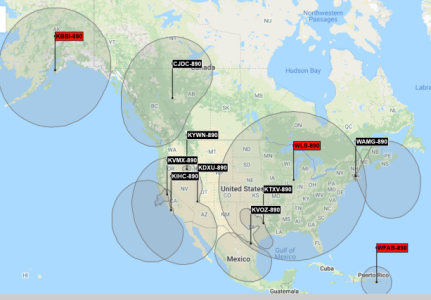
View attachment 2474

Those contours are for a very low signal area, and are used to determining legal signal protection requirements. They are not "listenable" coverage areas or "coverage circles". Protection rules show where another station could operate, not where any given station can be comfortably and reliably heard.

Use the 890 station in Puerto Rico, WFAB as a good study from your posted map. The usable day and night signal barely reaches Naguabo, Humacao and Yabucoa, the far eastern 20% or less of Puerto Rico. Yet the map shows it reaching the eastern part of the Dominican Republic, about 150 miles farther away. I have driven that signal, as when the group I was with purchased 910 in Ponce we wanted to see if there was any interference by the "new" 890. Of course, there was not as in the Ponce area you could not hear it.

The average consumer receiver, coupled with natural and man made noise, can't reliably hear stations at the distances those maps indicate.

Another example: I am in the Coachella Valley in CA. I'm about 300 miles from KDXU in Utah; daytime there is no signal at all and night time the signal can be half-decent some nights and full of noise and fading on others. Day or night, I am outside the reliable coverage area even though the map shows the signal going as far south as Los Mochis and Loreto in Mexico and as far north as Portland, OR.

I'll give you a good example: look at the map for KNX in Los Angeles. The usable coverage that is noise free and reliable day and night barely gets to Redlands, CA, to the East, to Oxnard to the North and coastal San Diego County to the South.
 
Last edited:
Status
This thread has been closed due to inactivity. You can create a new thread to discuss this topic.


Back
Top Bottom