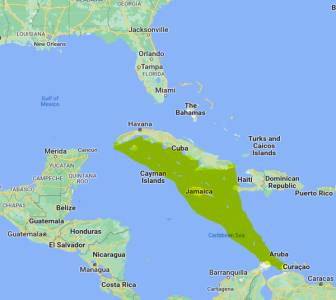
The Day Night Pattern change at CKLW had a large effect on their influence and other stations in the 1960s and early 1970s, before FM took over. Because of interference from XEROK and PJB, and their huge lobe to the East at Night, which was often heard without much interference in the rural areas and medium sized towns with Top 40 Daytimers and Class IVs, whose signals only got out several miles at Night.
Unless a town had several moderately powerful stations, often Top 40 was often relegated to lesser facilities, often one at best. In areas to the West of CKLW at Night, WLS, WCFL, WOWO, for Top 40 and WLAC for rarer R & B were better options. Areas of West and Central Michigan, especially college towns, had those limited local options for Top 40 at Night. So those powerhouse stations had more influence there, and influenced local playlists.
As close as Ann Arbor, they lost all the decent Top 40 Day signals from around Detroit. Well known radio and recording aritists, such as Award winning DJ John Landecker, radio archivist Art Vuolo, and recording artist Bob Seger, have all mentioned in interviews and books, listening to WLS, WCFL, and WLAC at Night because of the siginal limitations of stations to the East. WJR has a signal of more than 25 mV/m on 760 there, so WABC 770 wasn't usually an option. WKBW mainly only goes East from Buffalo. WBZ was sometimes an option.
If you look at the ARSA Radio Surveys collection, you can see that influence. And if you look at fccdata.org for ground waves and skywave, and Radio Locator for ground waves, including Canadian and Mexican stations, you can see the Day Night situation. The old Daytimers in many areas are usually still Class Ds, with less than 100 watts Night. The are usually limited by well protected old Class III-As, and nondirectional antennas that don't protect the old Class III-As.
Unless a town had several moderately powerful stations, often Top 40 was often relegated to lesser facilities, often one at best. In areas to the West of CKLW at Night, WLS, WCFL, WOWO, for Top 40 and WLAC for rarer R & B were better options. Areas of West and Central Michigan, especially college towns, had those limited local options for Top 40 at Night. So those powerhouse stations had more influence there, and influenced local playlists.
As close as Ann Arbor, they lost all the decent Top 40 Day signals from around Detroit. Well known radio and recording aritists, such as Award winning DJ John Landecker, radio archivist Art Vuolo, and recording artist Bob Seger, have all mentioned in interviews and books, listening to WLS, WCFL, and WLAC at Night because of the siginal limitations of stations to the East. WJR has a signal of more than 25 mV/m on 760 there, so WABC 770 wasn't usually an option. WKBW mainly only goes East from Buffalo. WBZ was sometimes an option.
If you look at the ARSA Radio Surveys collection, you can see that influence. And if you look at fccdata.org for ground waves and skywave, and Radio Locator for ground waves, including Canadian and Mexican stations, you can see the Day Night situation. The old Daytimers in many areas are usually still Class Ds, with less than 100 watts Night. The are usually limited by well protected old Class III-As, and nondirectional antennas that don't protect the old Class III-As.
Last edited: