• Get involved.
    We want your input!
    Apply for Membership and join the conversations about everything related to broadcasting.

    After we receive your registration, a moderator will review it. After your registration is approved, you will be permitted to post.
    If you use a disposable or false email address, your registration will be rejected.

    After your membership is approved, please take a minute to tell us a little bit about yourself.
    https://www.radiodiscussions.com/forums/introduce-yourself.1088/

    Thanks in advance and have fun!
    RadioDiscussions Administrators

XEROK 800 is off the air

The Day Night Pattern change at CKLW had a large effect on their influence and other stations in the 1960s and early 1970s, before FM took over. Because of interference from XEROK and PJB, and their huge lobe to the East at Night, which was often heard without much interference in the rural areas and medium sized towns with Top 40 Daytimers and Class IVs, whose signals only got out several miles at Night.

Unless a town had several moderately powerful stations, often Top 40 was often relegated to lesser facilities, often one at best. In areas to the West of CKLW at Night, WLS, WCFL, WOWO, for Top 40 and WLAC for rarer R & B were better options. Areas of West and Central Michigan, especially college towns, had those limited local options for Top 40 at Night. So those powerhouse stations had more influence there, and influenced local playlists.

As close as Ann Arbor, they lost all the decent Top 40 Day signals from around Detroit. Well known radio and recording aritists, such as Award winning DJ John Landecker, radio archivist Art Vuolo, and recording artist Bob Seger, have all mentioned in interviews and books, listening to WLS, WCFL, and WLAC at Night because of the siginal limitations of stations to the East. WJR has a signal of more than 25 mV/m on 760 there, so WABC 770 wasn't usually an option. WKBW mainly only goes East from Buffalo. WBZ was sometimes an option.

If you look at the ARSA Radio Surveys collection, you can see that influence. And if you look at fccdata.org for ground waves and skywave, and Radio Locator for ground waves, including Canadian and Mexican stations, you can see the Day Night situation. The old Daytimers in many areas are usually still Class Ds, with less than 100 watts Night. The are usually limited by well protected old Class III-As, and nondirectional antennas that don't protect the old Class III-As.
 
Last edited:
Fast forward to just last month when I was in the Pensacola area, PJB was on top there most nights, but noticeably weaker than when the "rebuilt 440 kw" version had just came on. I presumed they had tweaked the DA to focus better on Cuba.

The new "incarnation" of PJB is effectively missing at my home location. CKLW is usually on top of 800 most nights, with WVAL and WSVS semi-regular visitors.
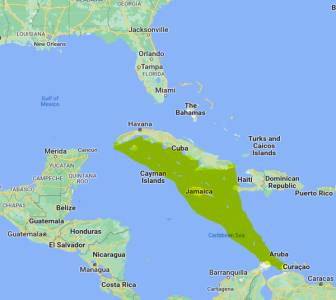
Looking at the radiation needed to totally cover Cuba, we see a really narrow angle... about 30° would be my guess. But that would put a good secondary coverage over everything from Norfolk, VA to Beaumont, TX.

A 400 kw transmitter run into such an array would generate a major lobe well in excess of 4 million watts if the pattern were precisely that sharp.

This makes me suspect that what you are experiencing is symptomatic of a lower power operation, possibly due to the very high cost of energy / fuel in the ABC Islands and the apparent loss of access to Venezuelan crude.

I was always amused by TWR's use of "440 kw" as the power. That is the output of that model when maxed out, but really not recommended for day-in-day-out use, which is rated at 400 kw, still a rather significant power in our hemisphere.

1679776645207.png

I have always been befuddled by the "Christian" operators of TWR who managed to get, back in the 60's, permission from the Netherlands to drop the hemisphere's highest power station on a channel used all over the zone. There was even an 800 kHz station in Maracaibo, one in Bucaramanga, Colombia, one in Panama City, Panama as well as station in Costa Rica, Honduras, Guatemala and Guayaquil, Ecuador. I owned one on 805 kHz in Quito, and had to clandestinely move it to 810 to avoid the horrible heterodyne right in my own market at night.

I always thought that planting that station on a well-use frequency without any international negotiation or compensation for the affected stations was rather un-Chrisitian and arrogant. As the owner of one of the affected station, I can say that I was never contacted let alone offered any compensation for the problems it caused me. I'm bitter about it till today, and that is nearly 60 years ago!
 
It's possible that the original decision to allow the use of that frequency was made locally. That would no longer be the case, since the Netherlands Antilles is no longer considered a nation within the Dutch kingdom, with three of the islands now being Dutch municipalities, including Bonaire. (If you want to give yourself a headache, you can read all about the governance structures of the Netherlands Antilles at Dissolution of the Netherlands Antilles - Wikipedia). So, now on Bonaire and two other islands, the Dutch Authority for Digital Infrastructure regulates spectrum usage, just as in the European part of the kingdom. (See Dutch Authority for Digital Infrastructure [in English], section heading " Radiocommunications in the Caribbean"). But that might not have been the case when PJB was originally authorized. The matter of Dutch control over affairs in the Netherlands Antilles has been a rather sensitive question in the Dutch government, and the tendency in the Hague had been to delegate as much as possible to the local government unless there was some sort of financial issue. Since 2010, Bonaire and two other islands have been ordinary municipalities and thus subject to more control than before.
 
It's possible that the original decision to allow the use of that frequency was made locally. T
I always thought that somehow local authorities were influenced to allow this, and since radio was hardly overdeveloped in the NA (just a couple of stations, using odd split frequencies like 1435 for the widely heard Radio Kelkboom) it's likely nobody realized that a high power station would cause damage in other nations. If I recall accurately, part of the decision was based on TWR providing generator power for street lighting in the area where it was located.

I visited the station many years later when I was no longer in Ecuador. While there, the transmitter kicked off. Instead of just hitting "Plate On" again, the two engineers bowed in a short prayer, then hit the button. It went right back on. And the building was so immaculate you would not feel bad eating off the floor!
 
I always thought that somehow local authorities were influenced to allow this, and since radio was hardly overdeveloped in the NA (just a couple of stations, using odd split frequencies like 1435 for the widely heard Radio Kelkboom) it's likely nobody realized that a high power station would cause damage in other nations. If I recall accurately, part of the decision was based on TWR providing generator power for street lighting in the area where it was located.

I visited the station many years later when I was no longer in Ecuador. While there, the transmitter kicked off. Instead of just hitting "Plate On" again, the two engineers bowed in a short prayer, then hit the button. It went right back on. And the building was so immaculate you would not feel bad eating off the floor!
I remember TWR running Carribean-focused programming from Radio Nederland on 800 in the early evening. Before RN built its Bonaire relay, TWR apparently carried RN programming on TWR's shortwave transmitters.
 
My memory is that XEROK, PJB, and CKLW each took turns "owning" 800 at night at my home location northwest of Chicago during XEROK's top 40 blaster days. Depending entirely on conditions.

Fast forward to just last month when I was in the Pensacola area, PJB was on top there most nights, but noticeably weaker than when the "rebuilt 440 kw" version had just came on. I presumed they had tweaked the DA to focus better on Cuba.

The new "incarnation" of PJB is effectively missing at my home location. CKLW is usually on top of 800 most nights, with WVAL and WSVS semi-regular visitors.
I've heard this version, or any version, of PJB only once, in January of last year. Just before 8 p.m. EST one night and it was very weak, but present. Definitely one off my bucket list, especially at that distance.
 
I always thought that somehow local authorities were influenced to allow this, and since radio was hardly overdeveloped in the NA (just a couple of stations, using odd split frequencies like 1435 for the widely heard Radio Kelkboom) it's likely nobody realized that a high power station would cause damage in other nations. If I recall accurately, part of the decision was based on TWR providing generator power for street lighting in the area where it was located.

Even if it went to the Hague, they may not have realized the full implications, since the usual European model of the time was to have a few high-powered stations allocated by country. Fun fact: Even though NOS Radio 1 (which would now be NPO Radio 1 if 747 was still active) is long gone, there are still signs on the motorways saying "Radio 1 - 747 AM".
It may also be worth noting that religious organizations have more influence in Dutch government than might be commonly realized. Some of those organizations are actually quite conservative. The democratic system there is highly consensus-oriented, with a balancing of various interests when it comes to the development and execution of policy. So there could've been a little horse-trading there, too.

I visited the station many years later when I was no longer in Ecuador. While there, the transmitter kicked off. Instead of just hitting "Plate On" again, the two engineers bowed in a short prayer, then hit the button. It went right back on. And the building was so immaculate you would not feel bad eating off the floor!
Clearly appealing to a, um, higher power.
 
I remember TWR running Carribean-focused programming from Radio Nederland on 800 in the early evening.
From 1964 until the late 1970s Radio Netherlands purchased a two hour block (2330 to 0130 UTC) on the 800 kHz Bonaire transmitter. Spanish was 2330 to 0020, English from 0020 to 0110, then Dutch from 0110 to 0130.

On some days the programming for English and Spanish was identical to what was broadcast on shortwave. However on couple of days a week (Tuesday & Thursday, IIRC) the Spanish and English broadcasts were combined into a 100 minute bilingual presentation specifically targeted at the Caribbean area. Also the “Happy Station 100” Sunday broadcast was bilingual, unlike the purely English or Spanish versions broadcast on shortwave.

The 20 minute Dutch broadcasts were newscasts and related current events, no feature programming.

I think towards the very end of the RN-TWR arrangement the broadcast block was moved 30 minutes earlier. I still have RN’s printed schedules from those days, but not immediately accessible as I type this.

During those years the 800 kHz transmitter was running 500kw; however some sources had the power as 525kw.
Before RN built its Bonaire relay, TWR apparently carried RN programming on TWR's shortwave transmitters.
From 1964 to 1969 RN purchased seven hours a day on the 250kw TWR shortwave transmitter. The “afternoon” block ran from 2000 to 2320 UTC and included Dutch to West Africa at 2000, English to West Africa at 2130, and Spanish to South America at 2230. There was also an “evening” block from 0130 to 0450 UTC which included English to North America at 0130, Dutch to North America at 0230, and Spanish to Central America and Mexico at 0400.

(TWR also had a 50kw shortwave transmitter on Bonaire which was not part of the RN time purchase.)

Radio Netherlands launched its own relay station on Bonaire in 1969, and the TWR shortwave time purchase was ended. The RN facility originally had two 300kw Philips transmitters, usually with separate programming in the early years of operation. A third (ABB) transmitter was added in 1988, and the original Philips units were replaced by 250kw Thomson/Thales units in 2007. The RN Bonaire site was closed in 2012, along with most of RN’s broadcast operations.
 
Looking at the radiation needed to totally cover Cuba, we see a really narrow angle... about 30° would be my guess. But that would put a good secondary coverage over everything from Norfolk, VA to Beaumont, TX.

A 400 kw transmitter run into such an array would generate a major lobe well in excess of 4 million watts if the pattern were precisely that sharp.

This makes me suspect that what you are experiencing is symptomatic of a lower power operation, possibly due to the very high cost of energy / fuel in the ABC Islands and the apparent loss of access to Venezuelan crude.

I was always amused by TWR's use of "440 kw" as the power. That is the output of that model when maxed out, but really not recommended for day-in-day-out use, which is rated at 400 kw, still a rather significant power in our hemisphere.
This makes perfect sense. I have to admit that my first thought wsa "reduced power", But then I was thinking "Why would theya 440kw flamethrower tx and not use it." I've also been suspicioous of paid religion or any organization claiming non-profit, when in reality, they turn out to be anything. And finally I'm shocked. SHOCKED that there might be corrupt local authorities involved in attempts to circument long-established rules and regulations.
 
This makes perfect sense. I have to admit that my first thought wsa "reduced power", But then I was thinking "Why would theya 440kw flamethrower tx and not use it." I've also been suspicioous of paid religion or any organization claiming non-profit, when in reality, they turn out to be anything. And finally I'm shocked. SHOCKED that there might be corrupt local authorities involved in attempts to circument long-established rules and regulations.
I seem to remember from the Mid-70s the Radio Nederland part running 70 minutes, and Tom Meyer's bilingual Sunday show being "Happy Station 70", which he presented in a really mellow tone of voice. Other days I though it was half Spanish, half English but starting around 6 or 6:30pm Eastern. I have slept since the 70s though.
 
I seem to remember from the Mid-70s the Radio Nederland part running 70 minutes, and Tom Meyer's bilingual Sunday show being "Happy Station 70", which he presented in a really mellow tone of voice. Other days I though it was half Spanish, half English but starting around 6 or 6:30pm Eastern. I have slept since the 70s though.
That jogged my memory, and I believe you are right. RN's program block on 800 was reduced to 90 minutes sometime in the mid-70s, and I think the start time was moved to 2300 UTC. They still had Spanish and English, which were cut to 35 minutes each (when not doing a bilingual show) while Dutch remained at 20 minutes.

I need to dig out the old RN schedules that I have for more specifics; they are stored away in a filebox with numerous other international radio items. I think the RN 800 broadcast was gone by 1980, but need to research the exact date, plus when the broadcast block was reduced from 120 to 90 minutes.

Long time ago, but fun memories.
 
That jogged my memory, and I believe you are right. RN's program block on 800 was reduced to 90 minutes sometime in the mid-70s, and I think the start time was moved to 2300 UTC. They still had Spanish and English, which were cut to 35 minutes each (when not doing a bilingual show) while Dutch remained at 20 minutes.

I need to dig out the old RN schedules that I have for more specifics; they are stored away in a filebox with numerous other international radio items. I think the RN 800 broadcast was gone by 1980, but need to research the exact date, plus when the broadcast block was reduced from 120 to 90 minutes.

Long time ago, but fun memories.
From Ohio, I could hear RN on TWR or turn the radio the other way and hear Teddy "Truckin' Bear on CKLW.
 
I seem to remember from the Mid-70s the Radio Nederland part running 70 minutes, and Tom Meyer's bilingual Sunday show being "Happy Station 70", which he presented in a really mellow tone of voice. Other days I though it was half Spanish, half English but starting around 6 or 6:30pm Eastern. I have slept since the 70s though.
PJB wasn't reliable enough at my location for me to get a feel for what was on or when. My main memory of English language programming wis serious sounding preachers. So I appreciate learning more of what was going on with them. Thanks!
 
I need to dig out the old RN schedules that I have for more specifics; they are stored away in a filebox with numerous other international radio items. I think the RN 800 broadcast was gone by 1980, but need to research the exact date, plus when the broadcast block was reduced from 120 to 90 minutes.
Updating my own post: I dug out the old Radio Netherlands schedules in my archive filebox, and now have a clearer timeline.

RN began broadcasts from TWR's 800 kHz transmitter in late 1964, a two hour block from 2330 to 0130 UTC. Initially the schedule was Spanish at 2330, Dutch at 0020, and English at 0040. By November 1966 English had been moved up to 0020 and Dutch back to 0110. As mentioned earlier, the Spanish and English broadcasts were combined into a 100 minute bilingual program a few days a week.

In May 1970 the RN program block was reduced to 90 minutes, with Spanish at 2300, English at 2335, and Dutch at 0010. This also resulted in the Spanish-English bilingual programs being cut to 70 minutes. This was earlier than my previous recollections.

It appears RN's broadcasts on 800 came to an end in November 1977. There was a note in the program schedule starting that month indicating (at press time) that due to financial reasons, the Bonaire mediumwave broadcasts might be discontinued. The 800 programs are not shown in the next program schedule issued in the spring of 1978, so obviously gone at that point. This was at the same time many of RN's shortwave programs in various languages were reduced from 80 to 50 minutes, so possible budget restraints.

Had been many years since I last looked at those schedules, as well as many others. I suppose at some point I need to find a new home for all of that old stuff...but not yet.;)
 
Updating my own post: I dug out the old Radio Netherlands schedules in my archive filebox, and now have a clearer timeline.

RN began broadcasts from TWR's 800 kHz transmitter in late 1964, a two hour block from 2330 to 0130 UTC. Initially the schedule was Spanish at 2330, Dutch at 0020, and English at 0040. By November 1966 English had been moved up to 0020 and Dutch back to 0110. As mentioned earlier, the Spanish and English broadcasts were combined into a 100 minute bilingual program a few days a week.

In May 1970 the RN program block was reduced to 90 minutes, with Spanish at 2300, English at 2335, and Dutch at 0010. This also resulted in the Spanish-English bilingual programs being cut to 70 minutes. This was earlier than my previous recollections.

It appears RN's broadcasts on 800 came to an end in November 1977. There was a note in the program schedule starting that month indicating (at press time) that due to financial reasons, the Bonaire mediumwave broadcasts might be discontinued. The 800 programs are not shown in the next program schedule issued in the spring of 1978, so obviously gone at that point. This was at the same time many of RN's shortwave programs in various languages were reduced from 80 to 50 minutes, so possible budget restraints.

Had been many years since I last looked at those schedules, as well as many others. I suppose at some point I need to find a new home for all of that old stuff...but not yet.;)
Thanks!
Maybe David's site?
 
But in the case of allocations, such as the clear channels, those frequencies "belong" to individual nations even if they are not in use.

US stations have to protect the entire Mexican border for frequencies such as 540, 730, 800, 900, 1050, 1570, 1220, 1580 and 940. Some of those are shared with Canada, which also has to be protected.
Should 690 and 1090 be included on this list ?
 
Should 690 and 1090 be included on this list ?
Not to the same degree. 1090 has a 50 kw in Seattle, as well as Baltimore and Littlr Rock and a bunch of mid-America ones. XEPRS protects them. 690 even has a primary station in Mexico City, so Tijuana protects it. And 690 is mostly Canadian, but with some US stations like Coffeyville, Jacksonville and Honolulu with decent nigh power.

Thinking of that, 940 is also well used in the US at night, but most of the ones I listed are fully dominated by Mexico
 
The XEROK-AM station was reported by the INE in May 2022, the electoral entity that regulates the official radio times in Mexico has a monitoring system and reported that the 800 AM signal went off the air on April 4 of 2022, this same person asked the IFT what was the reason for his departure and the report is as follows:

The station indicated "justified incidents" for the non-broadcast of 10 promotional. The response letter states that the station is in the process of dismantling the Tower-Antenna, so it will be off the air with no estimated resumption date. In a letter dated April 21, 2022, the station advised that the situation was notified to the IFT on the same date. Likewise, the station did not rule on 129 omissions. In total, the trades add up to a general count of 139 non-broadcast promotionals, for which no reprogramming was offered.

INE/DEPPP/DATERT/3231/2022
INE/DEPPP/DE/DATE/01608/2022


In conclusion, XEROK-AM sold the land where the station was located and so far there is no starting date.
 
Not to the same degree. 1090 has a 50 kw in Seattle, as well as Baltimore and Littlr Rock and a bunch of mid-America ones. XEPRS protects them. 690 even has a primary station in Mexico City, so Tijuana protects it. And 690 is mostly Canadian, but with some US stations like Coffeyville, Jacksonville and Honolulu with decent nigh power.

Thinking of that, 940 is also well used in the US at night, but most of the ones I listed are fully dominated by Mexico
Thanks for the info...KYNO 940 blankets much of California at night...
 
Status
This thread has been closed due to inactivity. You can create a new thread to discuss this topic.


Back
Top Bottom