• Get involved.
    We want your input!
    Apply for Membership and join the conversations about everything related to broadcasting.

    After we receive your registration, a moderator will review it. After your registration is approved, you will be permitted to post.
    If you use a disposable or false email address, your registration will be rejected.

    After your membership is approved, please take a minute to tell us a little bit about yourself.
    https://www.radiodiscussions.com/forums/introduce-yourself.1088/

    Thanks in advance and have fun!
    RadioDiscussions Administrators

XEWW (Mighty 690) Rosarito Cross Border Controversy

XEG was always listed as 100kw, and even said so themselves in a station jingle during the "English language at night" years: "One hundred thousand watts...that covers the nation! X-E-G, Ten-Fifty!"

You might be thinking of XEWA which had 150kw on 540.
The listings in MPM, the Mexican equivalent of SRDS, showed 150 kw always.
 
Yes, XELO/XEROK was 150kw, but not XEG.

BTW, there have been reports that XEROK has been completely off the air since March 2022 after having operated at greatly reduced power in recent years.
I've heard barely detectable Spanish language audio on 800 kHz since then... perhaps it's PJB in Bonaire, although probably not.
 
According to Sergio Ballesteros, the manager for Richard Eaton's interest in XERF and XESM, the daytime operation was not done in the time he was there... most of the 60's. They had no low power transmitter, and the 250 kw rig would not run at any low power level... and the generator needed the daytime to be maintained.
Wolfman Jack's autobiography would concur with that, and also mention the transmitter was cleaned and maintained during the day.
 
CKLW hung on later than WABC and many other top 40s, going Music of Your Life in 1984 or 85 and Canadian News-Talk in 1991 or so. A couple of Big 8 revivals happened on the FM. What finished CKLW off was the refusal of the CRTC to allow the top 40 format to migrate to FM. Pat Holiday had painstakingly designed a format that met all the requirements (Cancon, hit/non-hit, etc) called 94 Fox FM. Jingles cut, billboards commissioned, staff practicing the format and then at the 11th hour the CRTC only allowed the format 4 hours a day with the rest of the day remaining Big Band, it.....and the whole operation....failed with a massive layoff.

Driving to Toronto I heard CFXX while I was in Detroit, and being surprised by the switchover to Adult Standards.

The CRTC really screwed that operation over doing that.
 
The issue is whether one of the Mexican news talk networks would take it, such as the Radio Fórmula group, and add it to heir array. There is no opportunity for US focused programming .
Based on the economics and coverage of the station, why would a Mexican commercial network do that? It isn’t useful to them.

There’s always sports betting……
 
Based on the economics and coverage of the station, why would a Mexican commercial network do that? It isn’t useful to them.
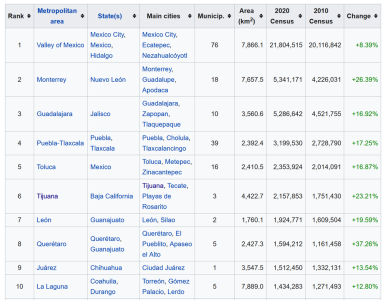
Yes it is, as Tijuana is a top 10 market in Mexico with about 3 million in the Tijuana / Ensenada / Tecate area.

1673751643612.png
There’s always sports betting……
There has to be more money in serving the Tijuana market in Spanish with that market's biggest signal.
 
Yes it is, as Tijuana is a top 10 market in Mexico with about 3 million in the Tijuana / Ensenada / Tecate area.

View attachment 4128

There has to be more money in serving the Tijuana market in Spanish with that market's biggest signal.
I'm being a bit of a devil's advocate on this. There is a lot of talk of how AM is dying, has few listeners, and is no longer economically viable. It has been said frequently by many of the programming experts on this page. Many make good points, and I don't dispute that. AM stations around the world are dropping like flies, and the future doesn't bode well for the band for all kinds of reasons.

I'm also asking, what kind of programming would be viable to make XEWW worthwhile? I was somewhat snarky about the sports betting format, as there were a lot of people here defending that format switch for KGO, and I think Cumulus could have made a better move there. But they own the thing, and therefore get to control what's on it.

If you were to program a station like this, what would you do?
 
If you were to program a station like this, what would you do?
I'd try to affiliate with the Radio Fórmula group and take one of their three national talk networks or, perhaps combine two of them. Generally, they like to own their own stations (they have over 100 of them) but it might be that the advantage of doing a "border hybrid" format that included some local content aimed at both sides of the border could be a valid option in Mexicali, Nuevo Laredo, McAllen/Brownsville, Cd. Juárez and even Nogales where a mini-border-network could be created to capitalize on the areas supported by the maquiladoras (factories on the Mexican side doing assembly and manufacturing for the US market with higher than normal Mexican wages).
 
I'd try to affiliate with the Radio Fórmula group and take one of their three national talk networks or, perhaps combine two of them. Generally, they like to own their own stations (they have over 100 of them) but it might be that the advantage of doing a "border hybrid" format that included some local content aimed at both sides of the border could be a valid option in Mexicali, Nuevo Laredo, McAllen/Brownsville, Cd. Juárez and even Nogales where a mini-border-network could be created to capitalize on the areas supported by the maquiladoras (factories on the Mexican side doing assembly and manufacturing for the US market with higher than normal Mexican wages).
That sounds worthwhile. I like the border hybrid idea too.
 
Seriously, this topic could turn into a thread all on it's own...
<...> it might be that the advantage of doing a "border hybrid" format that included some local content aimed at both sides of the border could be a valid option in Mexicali, Nuevo Laredo, McAllen/Brownsville, Cd. Juárez and even Nogales where a mini-border-network could be created to capitalize on the areas supported by the maquiladoras (factories on the Mexican side doing assembly and manufacturing for the US market with higher than normal Mexican wages).
How much of this is already happening, specifically with Mexico stations with a typically larger community south of the border, that's already serving those across the line in Estados Unidos?

I would propose it's already there to a degree.
 
How much of this is already happening, specifically with Mexico stations with a typically larger community south of the border, that's already serving those across the line in Estados Unidos?
Not at all except occasional brokered shows on the tiny high-band AMs in Tijuana. Almost all talk programming everywhere in Mexico originates in Mexico City. Unlike the US, where states have enormous local power, in Mexico the states and cities have very limited powers and the entire nation is run nationally. So radio reflects that.
I would propose it's already there to a degree.
Not really. You have to understand the totally centralized government of Mexico to realize how talk radio is almost all national in perspective.

Here is a bit about separation of state and national powers:

"Main subnational governments responsibilities. According to the Constitution, the powers that are not expressly given to the Federation
are understood as reserved to the states. In reality, it is more complex. The Constitution defines powers given to the federation, those given
in an explicit or tacit way to the states, those prohibited to the federation or to the states, coinciding powers, coexisting powers, aid powers,
etc. Overall, federal powers are extensive and also overlapping. States’ joint responsibilities with the federal government include primary
education (since 1992), healthcare (since 1996), poverty alleviation, social protection and water (since 1983). Other responsibilities include
spatial planning, regional transport, municipal affairs, etc. Municipal tasks include urban planning and development, utilities (water distribution, waste), local roads and public transport, street lighting, markets, parks, public safety. Municipalities are co-responsible for school buildings and implementation of social programmes. Municipalities can delegate some responsibilities to the state by agreement (water, urbanism, road, tax
collection)."
 
As I understand it if Mexico were an English speaking country, the Tijuana/San Diego Metro would be the 3rd or 4th largest market.
The same thing could be said on other cross border cities like Juarez, Reynosa etc.

It’s likely for another thread, but I’ve wondered why this section of Mexico could be an economic engine that drove the country and improve the lives of its people. Mexico has all the elements of being as prosperous as the USA and Canada
 
The same thing could be said on other cross border cities like Juarez, Reynosa etc.
No, while Juárez is about 1.5 million or so, El Paso is only about 860,000 and the two are not a huge market.

Reynosa and the several US cities across from that part of NE México are relatively small.
It’s likely for another thread, but I’ve wondered why this section of Mexico could be an economic engine that drove the country and improve the lives of its people. Mexico has all the elements of being as prosperous as the USA and Canada
The problem is that Tijuana / Mexicali are so far from the bulk of the population and consumers in Mexico that the economic base has involve dealing with the US dependent maquiladoras (assembly plants that add the value of labor to products then shipped for sale in the US).

Ciudad Juárez is a little closer to Mexican markets, but the other border cities are not particularly large or developed. And all are pretty much controlled by the cartels now and nobody would want to invest there.
 
I think it is time for the XEWW 690 to request a change of pattern, of a directional system and an omnidirectional system, even if it has to reduce power and focus on the Tijuana, San Rosarito and Mexicali area. I think that the US market for this project has already dried up, due to the high operating costs.
 
I'd try to affiliate with the Radio Fórmula group and take one of their three national talk networks or, perhaps combine two of them. Generally, they like to own their own stations (they have over 100 of them) but it might be that the advantage of doing a "border hybrid" format that included some local content aimed at both sides of the border could be a valid option in Mexicali, Nuevo Laredo, McAllen/Brownsville, Cd. Juárez and even Nogales where a mini-border-network could be created to capitalize on the areas supported by the maquiladoras (factories on the Mexican side doing assembly and manufacturing for the US market with higher than normal Mexican wages).
I also think the same, I think the station can coexist with different affiliations and deliver content from different channels in Mexico. until rescuing espn content that is generated for mexico.
 
Status
This thread has been closed due to inactivity. You can create a new thread to discuss this topic.


Back
Top Bottom