I have also heard KCJJ on the Norway receiver.

-
Get involved.
We want your input!
Apply for Membership and join the conversations about everything related to broadcasting.
After we receive your registration, a moderator will review it. After your registration is approved, you will be permitted to post.
If you use a disposable or false email address, your registration will be rejected.
After your membership is approved, please take a minute to tell us a little bit about yourself.
https://www.radiodiscussions.com/forums/introduce-yourself.1088/
Thanks in advance and have fun!
RadioDiscussions Administrators
You are using an out of date browser. It may not display this or other websites correctly.
You should upgrade or use an alternative browser.
You should upgrade or use an alternative browser.
Post your latest DX
- Thread starter CADXER
- Start date
Listening to WOKY 920 near Pellston, MI on the Satellit 750 right now. Dan Patrick Show.
DFW, Texas -- Sangean ATS-909X
Two new stations logged, both were stronger than their nighttime power would indicate.
910 kHz WUBR Baton Rouge, LA 1/12/2022 9:45pm CST. I had been hearing regional Mexican music in the narrow null of my local KATH (Frisco, TX), finally found matching web stream on Radio Locator. Fair with some fading. 51 watts @ 389 miles.
1540 kHz KDYN Ozark, AR 1/11/2022 9:56pm CST. Country music // web stream, fair with fading o/u KEDA (San Antonio). 10 watts at 253 miles.
Two new stations logged, both were stronger than their nighttime power would indicate.
910 kHz WUBR Baton Rouge, LA 1/12/2022 9:45pm CST. I had been hearing regional Mexican music in the narrow null of my local KATH (Frisco, TX), finally found matching web stream on Radio Locator. Fair with some fading. 51 watts @ 389 miles.
1540 kHz KDYN Ozark, AR 1/11/2022 9:56pm CST. Country music // web stream, fair with fading o/u KEDA (San Antonio). 10 watts at 253 miles.
You're absolutely sure these stations were running 51 and 10 watts?DFW, Texas -- Sangean ATS-909X
Two new stations logged, both were stronger than their nighttime power would indicate.
910 kHz WUBR Baton Rouge, LA 1/12/2022 9:45pm CST. I had been hearing regional Mexican music in the narrow null of my local KATH (Frisco, TX), finally found matching web stream on Radio Locator. Fair with some fading. 51 watts @ 389 miles.
1540 kHz KDYN Ozark, AR 1/11/2022 9:56pm CST. Country music // web stream, fair with fading o/u KEDA (San Antonio). 10 watts at 253 miles.

They were probably operating at daytime power. Even so, that's a great distance for such low power.You're absolutely sure these stations were running 51 and 10 watts?
FYI, KDYN has 1 watt at night, not 10 watts.
Not at all, only reporting their listed power. If I were betting, I would put my money on daytime power.You're absolutely sure these stations were running 51 and 10 watts?

WOKY is now even weaker at my location than they were in the early 60s when they were only running 1kw. I'd peg their day signal as about the same as WBAA, Which equates to "almost invisible".Listening to WOKY 920 near Pellston, MI on the Satellit 750 right now. Dan Patrick Show.
Sure, understood. Seems some other places on the internet DXers are crowing "I heard it with (whatever it is) with only 7 watts!" Odds are it wasn't.Not at all, only reporting their listed power. If I were betting, I would put my money on daytime power.
Do you think morning skywave?Listening to WOKY 920 near Pellston, MI on the Satellit 750 right now. Dan Patrick Show.
Definitely Critical Hours Skywave. The strange thing is the upper end of the band was just a mess of signals at the same time. I've noticed this in January before, where the CH skywave/Daytime skywaves favor signals down to about WJR 760. WWJ 950 and WFDF 910 are a couple you can hear at High Solar Noon, with their 500 kW "ERP" ground wave just about equal to the Daytime skywave, causing alternating complete cancellation and reinforcement. Of course, WJJD/WYLL is on Day pattern with that 20 kW null roughly in my direction, so it would only be around 1/SQRT(500/20)=0.2, 20 percent of the other two. They are close to the same distance, though AM Query is down due to the changing of CDBS to the new filing system, so I can't figure that out easily right now. As of yesterday, you could no longer file CDBS applications, and the APP information is unavailable. Hopefully all that will soon be available again under the new system.

The FCC really dropped the ball when it assigned that station on a powerful clear channel.If you are hearing a religious sermon under KMOX on 1120, it's KTXW, Manor, Texas. Heard with ID and matched to web stream at 10:00 pm CST.
I live close to the edge of KTXW's nighttime signal north of Austin, in the Georgetown area.
All I have to do is turn the radio and I get a strong KMOX.
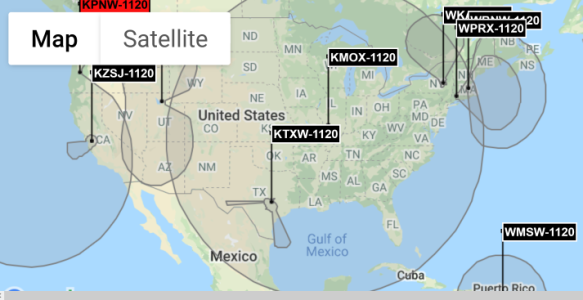
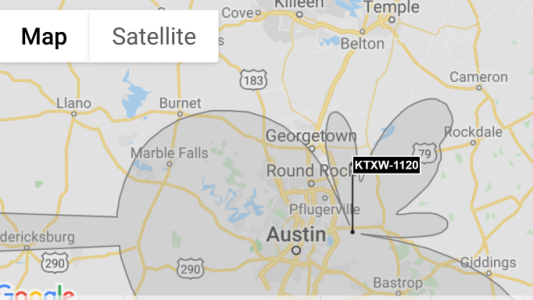

AM is not like FM. FM has a table of assignments where applicants can file for a station. AM has been, historically, an "if it fits you can file for it" situation. That is why there are so many stations that are just bad: daytimers, highly directional stations, low power ones, etc.The FCC really dropped the ball when it assigned that station on a powerful clear channel.
I live close to the edge of KTXW's nighttime signal north of Austin, in the Georgetown area.
All I have to do is turn the radio and I get a strong KMOX.
In the biggest 100 US markets, there are less than 180 stations in total that cover at least 80% of the radio metro area day and night. That means that for every reasonably good signal, there are about 6 or 7 that don't cover their own market well.
In the case of KTXW, the applicant was mostly interested in the daytime operation, as the 155 watt night power is pretty useless. The day power puts a usable signal over about 2/3 of the market, and they have a translator to fill-in the more populated areas with 85 watts at over 1000 feet HAAT.
Remember, KMOX is not protected in Austin. Its protected contour ends at some distance from the city, so an Austin area station can operate on 1120 at night as long as it does not send nearly any power towards the KMOX protected night contour.

The FCC really dropped the ball when it assigned that station on a powerful clear channel.
I live close to the edge of KTXW's nighttime signal north of Austin, in the Georgetown area.
All I have to do is turn the radio and I get a strong KMOX.
View attachment 2518
View attachment 2519
no they didnt drop the ball.... austin to st louis is 700 miles.. no one out there is listening to kmox.... no normal people
LolOf course, St. Louis Cardinals fans aren't normal people.
Similar situation near me with WSQR in Sycamore, IL. They run One watt at night on 1180. They couldn't care less that their listenable signal gets out only two or three miles at night (in an area with good ground conductivity). WHAM trashes WSQR trashes it within sight of their tower. It's all about WSQR's two translators that cover most of the population of their county.Remember, KMOX is not protected in Austin. Its protected contour ends at some distance from the city, so an Austin area station can operate on 1120 at night as long as it does not send nearly any power towards the KMOX protected night contour.
Interesting they even bother running one watt. Back in Ohio, WGNZ-1110, licensed to Fairborn and transmitting from Xenia, runs 1 watt at night, and if they actually operate, they must reach more ears of corn than ears of people.Similar situation near me with WSQR in Sycamore, IL. They run One watt at night on 1180. They couldn't care less that their listenable signal gets out only two or three miles at night (in an area with good ground conductivity). WHAM trashes WSQR trashes it within sight of their tower. It's all about WSQR's two translators that cover most of the population of their county.
KTXW is about the closest Class B I've seen to the protected Class A skywave that I've seen. The Theoretical RMS meets the legacy Class B efficiency with 155 watts. I don't think they have to run it at Night, but maybe you can only do that for Class D. They use top loading to achieve the efficiency.
Last edited: