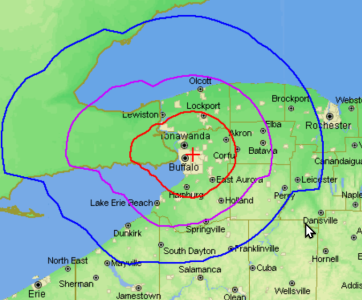
Unless the station in question has bought the extra-cost breakout of the components of a single-line reported simulcast, nobody knows what the percentage of FM vs. AM listening is.If most of the listening is still on the AM signal, then the FM translators may just be used during the sales process. You tell a client they'll get an AM/FM combo! I have no idea why anyone would be listening to music on an AM Radio in 2024. They might as well stream it, unless Buffalo really prefers rotary dial phones also...
But we do know, as a point of reference, that in places where an AM has even a single translator, 75% or so of the listening is to the FM unless the AM has a huge full Metro Survey Area coverage and the FM has limited coverage by comparison: example of such a case is KYW in Philadelphia.
In this case, the AM is a very limited effective signal (look at the 10 mV/M coverage to show what it really reaches... and maybe the 15 mV/M at night). The translators cover more people with a better signal and with better quality. Anyone with a radio that has FM (and what one does not today?) who wants to hear WECK is going to listen to the translators.
I'd bet a reasonable sum that Buddy, were the FCC to allow it, might turn the AM off if he could keep the translators running without it.