
• Get involved.
    We want your input!
    Apply for Membership and join the conversations about everything related to broadcasting.

    After we receive your registration, a moderator will review it. After your registration is approved, you will be permitted to post.
    If you use a disposable or false email address, your registration will be rejected.

    After your membership is approved, please take a minute to tell us a little bit about yourself.
    https://www.radiodiscussions.com/forums/introduce-yourself.1088/

    Thanks in advance and have fun!
    RadioDiscussions Administrators

Buffalo JP done at WECK?

Status
Not open for further replies.
If most of the listening is still on the AM signal, then the FM translators may just be used during the sales process. You tell a client they'll get an AM/FM combo! I have no idea why anyone would be listening to music on an AM Radio in 2024. They might as well stream it, unless Buffalo really prefers rotary dial phones also...
Unless the station in question has bought the extra-cost breakout of the components of a single-line reported simulcast, nobody knows what the percentage of FM vs. AM listening is.

But we do know, as a point of reference, that in places where an AM has even a single translator, 75% or so of the listening is to the FM unless the AM has a huge full Metro Survey Area coverage and the FM has limited coverage by comparison: example of such a case is KYW in Philadelphia.

In this case, the AM is a very limited effective signal (look at the 10 mV/M coverage to show what it really reaches... and maybe the 15 mV/M at night). The translators cover more people with a better signal and with better quality. Anyone with a radio that has FM (and what one does not today?) who wants to hear WECK is going to listen to the translators.

I'd bet a reasonable sum that Buddy, were the FCC to allow it, might turn the AM off if he could keep the translators running without it.
 
Unless the station in question has bought the extra-cost breakout of the components of a single-line reported simulcast, nobody knows what the percentage of FM vs. AM listening is.

But we do know, as a point of reference, that in places where an AM has even a single translator, 75% or so of the listening is to the FM unless the AM has a huge full Metro Survey Area coverage and the FM has limited coverage by comparison: example of such a case is KYW in Philadelphia.

In this case, the AM is a very limited effective signal (look at the 10 mV/M coverage to show what it really reaches... and maybe the 15 mV/M at night). The translators cover more people with a better signal and with better quality. Anyone with a radio that has FM (and what one does not today?) who wants to hear WECK is going to listen to the translators.

I'd bet a reasonable sum that Buddy, were the FCC to allow it, might turn the AM off if he could keep the translators running without it.
The user here called Radiowaves says flat out -- 70 percent of the listening is on AM. He did not provide his source that confirms that. Buffalo seems to be rooted firmly in Nostalgia, so people there may feel "Oldies must be on AM" or it's not authentic...😑
 
Last edited:
Unless the station in question has bought the extra-cost breakout of the components of a single-line reported simulcast, nobody knows what the percentage of FM vs. AM listening is.

But we do know, as a point of reference, that in places where an AM has even a single translator, 75% or so of the listening is to the FM unless the AM has a huge full Metro Survey Area coverage and the FM has limited coverage by comparison: example of such a case is KYW in Philadelphia.

In this case, the AM is a very limited effective signal (look at the 10 mV/M coverage to show what it really reaches... and maybe the 15 mV/M at night). The translators cover more people with a better signal and with better quality. Anyone with a radio that has FM (and what one does not today?) who wants to hear WECK is going to listen to the translators.

I'd bet a reasonable sum that Buddy, were the FCC to allow it, might turn the AM off if he could keep the translators running without it.
You are not correct, and you are SPECULATING. I know you hate to believe it because you are comparing Buffalo to every other market, but WECK is most listened to on the AM band. Yes, even though it has 3 FM translators . I’m not sure how else to explain this to you. It’s a Buffalo thing, David. The AM frequency of WECK has an outstanding sound and clarity in metro Buffalo. It’s not the symphony orchestra, but it is very good, also because of the target age group, listeners for some reason prefer WECK on AM.

Please stop treating Buffalo like other markets. It’s literally backwards on everything. It’s a place that does not like change

Make a market visit, spend a few days here, meet some people and you’ll know what I mean

People also have no problem with WGR or WBEN being on AM, and they do have a choice for better sound, not FM translators, but streaming
 
Probably a moot point, but my question is, what particular titles were being played that were unfamiliar? Were some songs added that skewed to a younger audience?
 
You are not correct, and you are SPECULATING.
No, you are. You show no evidence that a paid Nielsen breakout shows more listening on AM than the translators.
I know you hate to believe it because you are comparing Buffalo to every other market, but WECK is most listened to on the AM band. Yes, even though it has 3 FM translators . I’m not sure how else to explain this to you. It’s a Buffalo thing, David. The AM frequency of WECK has an outstanding sound and clarity in metro Buffalo. It’s not the symphony orchestra, but it is very good, also because of the target age group, listeners for some reason prefer WECK on AM.
WECK is high up on the band, and can't be compared with higher power stations on vastly better frequencies.
Please stop treating Buffalo like other markets. It’s literally backwards on everything. It’s a place that does not like change
In looking at all the data on AM usage, the market is not very different from many other Rust Belt and Northeastern markets that have a comparable array of AM stations.
Make a market visit, spend a few days here, meet some people and you’ll know what I mean
I'm from the same general area. I've been in Buffalo many times. It is not much different as a radio market than any other comparable market in that region.
People also have no problem with WGR or WBEN being on AM, and they do have a choice for better sound, not FM translators, but streaming
Both of those are talk stations. AM is fine for talk. A high-on-the-dial (former) Class IV limited coverage AM is not comparable.
 
If most of the listening is still on the AM signal, then the FM translators may just be used during the sales process. You tell a client they'll get an AM/FM combo! I have no idea why anyone would be listening to music on an AM Radio in 2024. They might as well stream it, unless Buffalo really prefers rotary dial phones also...

I'm a weirdo, but I like listening to WECK on the AM. Although signal processing on that band ain't what it used to be, the music still sounds pretty much like it did on KB and YSL when I was a kid. It's a bit of a time machine for me.
 
No, you are. You show no evidence that a paid Nielsen breakout shows more listening on AM than the translators.

WECK is high up on the band, and can't be compared with higher power stations on vastly better frequencies.

In looking at all the data on AM usage, the market is not very different from many other Rust Belt and Northeastern markets that have a comparable array of AM stations.

I'm from the same general area. I've been in Buffalo many times. It is not much different as a radio market than any other comparable market in that region.

Both of those are talk stations. AM is fine for talk. A high-on-the-dial (former) Class IV limited coverage AM is not comparable.
So where is your evidence of anything you are saying? What “data” are you referring to in regard to AM usage? KB is high up on the band as well. WECK AM sounds great in Buffalo metro, that’s all we need to know
 
So where is your evidence of anything you are saying? What “data” are you referring to in regard to AM usage? KB is high up on the band as well. WECK AM sounds great in Buffalo metro, that’s all we need to know

Wheres your evidence all the listening or most of it is on the AM and not WECK's fm translators?
 
For the record, Alan Pergament has a story posted on the Buffalo News' website on this whole matter. (No link hbecause...you know...paywall; however, the Southern Ontario/WNY Radio-TV board now has a post on the matter WITH the link to the story.)
 
So where is your evidence of anything you are saying?
I have had access to plenty of AM and Translator breakouts from subscribers who pay for this added service. Generally, a station with a translator will want to know only occasionally what the AM vs. FM numbers are. In all cases where the translator did nearly as well or as well at covering the population, the ratio of FM to AM is around 5 to 1.
What “data” are you referring to in regard to AM usage? KB is high up on the band as well.
And "nobody" listens to it. You know that 1 kw on 550 covers as well as 50 kw on 1520 (given identical electrical antenna height and similar transmitter site ground conductivity)? I suspect not.
WECK AM sounds great in Buffalo metro, that’s all we need to know
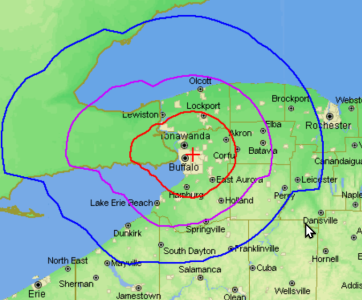
This is the calculated daytime coverage:

With today's noise levels, the usable and useful coverage is in the 10 mV/m contour (or greater) and that is well inside the red inner circle. That is less than 40% of the land area of the market. And it is worse at night on "graveyard" channels.
1720645470492.png
The "Buffalo Metro" is all of the two counties, as Nielsen does not measure cities... it measures counties.
 
I have had access to plenty of AM and Translator breakouts from subscribers who pay for this added service. Generally, a station with a translator will want to know only occasionally what the AM vs. FM numbers are. In all cases where the translator did nearly as well or as well at covering the population, the ratio of FM to AM is around 5 to 1.

And "nobody" listens to it. You know that 1 kw on 550 covers as well as 50 kw on 1520 (given identical electrical antenna height and similar transmitter site ground conductivity)? I suspect not.

This is the calculated daytime coverage:

With today's noise levels, the usable and useful coverage is in the 10 mV/m contour (or greater) and that is well inside the red inner circle. That is less than 40% of the land area of the market. And it is worse at night on "graveyard" channels.
View attachment 7332
The "Buffalo Metro" is all of the two counties, as Nielsen does not measure cities... it measures counties.
Talk to Buddy and get the facts on his station . He sorta knows
 
Talk to Buddy and get the facts on his station . He sorta knows
Buddy, like the rest of us, knows that AM is even further restricted for in-home and at-work listening due to everything from wall-warts to adjustable LED lamps and bulbs to all kinds of microprocessor controlled devices.

And, unless he pays extra for the breakouts, he does not know.

Where I live, I can't get a single one of the local AMs at home due to that kind of interference. Not even a local 5 kw station on 970 that is less than 8 km from my house.

Now you're gonna' tell me that nobody in Buffalo has LED bulbs?
 
Buddy, like the rest of us, knows that AM is even further restricted for in-home and at-work listening due to everything from wall-warts to adjustable LED lamps and bulbs to all kinds of microprocessor controlled devices.

And, unless he pays extra for the breakouts, he does not know.

Where I live, I can't get a single one of the local AMs at home due to that kind of interference. Not even a local 5 kw station on 970 that is less than 8 km from my house.

Now you're gonna' tell me that nobody in Buffalo has LED bulbs?
Dave, do you know ‘As identified by listener’ in Nielsen PDA?
 
Dave, do you know ‘As identified by listener’ in Nielsen PDA?
If you search on the Nielsen subscriber website for "PDA" nothing comes up.

Are you referring to the diary columns where one checks "Home", "Work", "Vehicle" or "Other" next to each listening entry.?
 
Are you referring to the diary columns where one checks "Home", "Work", "Vehicle" or "Other" next to each listening entry.?
What about Bathroom? AM is circling the drain. Only someone who owns an AM signal would refuse to see reality. There's no point in having FM translators if the AM is sufficient. As you mentioned, all the things causing interference make AM an Albatross...
 
If you search on the Nielsen subscriber website for "PDA" nothing comes up.

Are you referring to the diary columns where one checks "Home", "Work", "Vehicle" or "Other" next to each listening entry.?
No. I am referring to the PD Advantage software I subscribe to from Nielsen that gives the breakdown of what platform listeners are using for a station.
 
What about Bathroom? AM is circling the drain. Only someone who owns an AM signal would refuse to see reality. There's no point in having FM translators if the AM is sufficient. As you mentioned, all the things causing interference make AM an Albatross...
Tell AM owners in Buffalo that, as they make money hand over fist with the AM stations
 
No. I am referring to the PD Advantage software I subscribe to from Nielsen that gives the breakdown of what platform listeners are using for a station.
Nobody abbreviates it that way. It is "PD Advantage" and all of us who are part of a subscription have it. But last I checked, it shows listening location, not which station out of a simulcast is listened to.
 
Nobody abbreviates it that way. It is "PD Advantage" and all of us who are part of a subscription have it. But last I checked, it shows listening location, not which station out of a simulcast is listened to.
Then please tell me how you come to the conclusion that WECK has more FM listeners than AM?
 
Status
Not open for further replies.


Back
Top Bottom