• Get involved.
    We want your input!
    Apply for Membership and join the conversations about everything related to broadcasting.

    After we receive your registration, a moderator will review it. After your registration is approved, you will be permitted to post.
    If you use a disposable or false email address, your registration will be rejected.

    After your membership is approved, please take a minute to tell us a little bit about yourself.
    https://www.radiodiscussions.com/forums/introduce-yourself.1088/

    Thanks in advance and have fun!
    RadioDiscussions Administrators

1110 New Format

FCC ASR Records show a change in ownership from Lincoln Financial Media to a subsidary of Radio One, Charlotte Broadcasting Inc. on April 1, 2021. LFM as a whole was acquired by Greater Media and then absorbed into Beasley which explains why Beasley's address was on the other record, but NO it does not own the land anymore...

@CLTRadio I don't care about you're claiming to be correct based on one record, but attacking other posters when questioned will not be accepted here.
ASR records are for the equipment ”Antenna Structure”. Doesn’t have anything to do with the land.

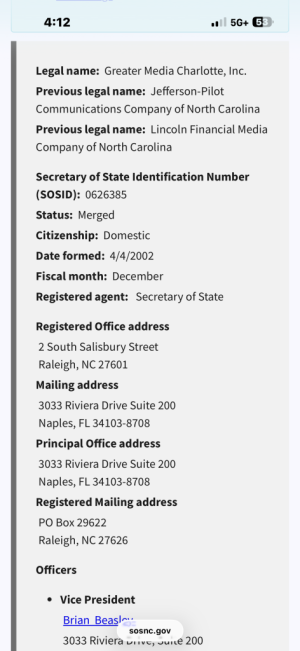
I checked with the Secretary of State website, and Lincoln Financial Media was acquired by Greater Media which is a subsidiary of Beasley. So Beasley owns the land. Again, you’ve presented nothing to contradict that.

For the record, I never “attacked” anyone. I corrected them, and I stand by everything I said. I really don’t care if some fragile egos can’t take being wrong.

IMG_3755.png
 
You win a year's supply of peanut butter and jelly for life!*

*void wherever the integration of peanut butter and jelly is prohibited by law.
*not available in new jersey, oklahoma, south dakota, or anywhere else.
*invalid in months that contain the letter R, summer months, or may.


Roger on that, I'll keep the legalese in mind. :D)
 
ASR records are for the equipment ”Antenna Structure”. Doesn’t have anything to do with the land.

I checked with the Secretary of State website, and Lincoln Financial Media was acquired by Greater Media which is a subsidiary of Beasley. So Beasley owns the land. Again, you’ve presented nothing to contradict that.
And the full answer is we are BOTH right...

From the 2016 sale contract of 610, 1110, 99.3, and 107.9 from Beasley to Entercom (with rights later transferred to Radio One), Radio One owns the land under the towers and transmission building, with Beasley retaining the remainder. Should Radio One decide to sell the land, Beasley gets 60% of the proceeds and Radio One 40%.

WBT-AM Transmitter Site.

(a) Buyer will be granted a perpetual interest in the WBZ Land for $1 per year
pursuant to a lease agreement with respect to the use of the land (“WBT Lease”) and a
deed of trust with respect to Buyer’s interest in the event of a sale of the WBT Land
(“WBT Deed of Trust”). The form of the WBT Lease and the WBT Deed of Trust will
be mutually agreed to by the parties, in good faith, prior to Closing and the forms thereof
shall be consistent with customary industry AM land leases and real estate provisions,
provided that Buyer’s use of the WBT Land shall not be exclusive but shall be subject to
the requirements set forth herein and in the WBT Lease and WBT Deed of Trust. Buyer
will own all improvements on the WBT Land.

(b) If Seller or its successors decide to sell the WBT Land (which sale shall be
subject to Buyer’s (and its successor’s) continuing right to use the property pursuant to
the WBT Lease and the WBT Deed of Trust), then proceeds will be used to first
reimburse Buyer for the estimated cost, as mutually agreed upon by Seller and Buyer, (or
actual cost if Buyer elects to relocate) of relocating WBT-AM (including new land,
towers, etc.) and Buyer and Seller (or their respective successors) shall split the
remaining profits as follows: with 60% to Seller and 40% to Buyer.

(c) If Seller or its successors desire to develop the WBT Land (by allowing its
use by any third party in any manner), then Seller (or its successors) shall not do so
without the prior written consent of Buyer or its successor, such consent not to be
unreasonably withheld; provided that Buyer’s failure to consent to develop the WBT
Land shall not be deemed to be unreasonable if such development would impair or
interfere with Buyer’s use of the site consistent with its past practices. If the parties
consent to development of the WBT Land (which shall be subject to Buyer’s (and its
successor’s) continuing right to use the property pursuant to the WBT Lease and the
WBT Deed of Trust), proceeds will be used to first reimburse Buyer (or its successor) for
the estimated cost, as mutually agreed upon by Seller and Buyer (or their respective
successors), (or actual cost if Buyer elects to relocate) of relocating WBT-AM (including
new land, towers, legal fees, lease costs, etc.) and Buyer and Seller (or their respective
successors) shall split the remaining profits as follows: with 60% to Seller and 40% to
Buyer.

 
You can bet whatever programming they place on 1110 it will be low rated after weeks of blowing off their audience with the endless loop promoting 107.9.

I hope Josh, you will admit that WBT leans even more conservative than WFAE leans liberal. Not wishing to get into a political discussion here..
Here's another idea, making the best of a bad situation, perhaps. Whatever the plan was for 1110 did not happen, and the opportunity to hand off an active signal to a new format or program has passed. So, walk the cat backwards - the audience that listens to WBT can and did tolerate the AM signal. It has been shown in several instances that simply moving an AM talk station to FM doesn't necessarily guarantee significantly higher ratings. So, for several ratings books go back to doing a simulcast, maybe even returning the branding to NewsTalk 1110 (and 107.9).

After 1110 is back in the consciousness of Charlotte as a radio address again, development of something new WITH A FUTURE can be added to 107.9. For a point of consideration, I am betting that the morning show has broad appeal with news-weather-traffic and generates the most money. That would continue to be simulcast. After 10, separate programming would eventually be introduced. Traditional talk as is being done currently on the AM, and new non-political talk on the FM that will be intended for younger generations. I have for several years been impressed with the apparent good ratings a station in Orlando, WTKS, gets. Whenever I have listened to it, they seem to get advertising unlike what a typical AM talker does. The topics they talk about must have interest for the younger demographics, because they don't really appeal to this boomer. But I am impressed with what that station is able to do and am puzzled as to why it isn't being attempted in every market.

At the end of the day, after 6PM, the simulcast can be resumed. This way Radio One doesn't have to come up with two new stations, but can keep the best of both serving the intended audiences where they are likely to tune in for most of the day.
 
Here's another idea, making the best of a bad situation, perhaps. Whatever the plan was for 1110 did not happen, and the opportunity to hand off an active signal to a new format or program has passed. So, walk the cat backwards - the audience that listens to WBT can and did tolerate the AM signal. It has been shown in several instances that simply moving an AM talk station to FM doesn't necessarily guarantee significantly higher ratings. So, for several ratings books go back to doing a simulcast, maybe even returning the branding to NewsTalk 1110 (and 107.9).

After 1110 is back in the consciousness of Charlotte as a radio address again, development of something new WITH A FUTURE can be added to 107.9. For a point of consideration, I am betting that the morning show has broad appeal with news-weather-traffic and generates the most money. That would continue to be simulcast. After 10, separate programming would eventually be introduced. Traditional talk as is being done currently on the AM, and new non-political talk on the FM that will be intended for younger generations. I have for several years been impressed with the apparent good ratings a station in Orlando, WTKS, gets. Whenever I have listened to it, they seem to get advertising unlike what a typical AM talker does. The topics they talk about must have interest for the younger demographics, because they don't really appeal to this boomer. But I am impressed with what that station is able to do and am puzzled as to why it isn't being attempted in every market.

At the end of the day, after 6PM, the simulcast can be resumed. This way Radio One doesn't have to come up with two new stations, but can keep the best of both serving the intended audiences where they are likely to tune in for most of the day.


That is a plan, but all due respect, my view from this particular armchair, I can't see them doing it.
 
I remember WBT on 1110 having a liberal host. John Hancock maybe?
I think you may be thinking of the late Jerry Klein.
John Hancock replaced midday host H.A. Thompson in a controversial move in the early 90's. Then moved to afternoon drive before retiring a few years back. Still does the Christmas bike drive and appears on the morning show every Friday at 9am. His show was not all politics and more middle of the road or center right, if I recall. He is known as "Charlotte's most beloved."
 
That is a plan, but all due respect, my view from this particular armchair, I can't see them doing it.

Urban One has got bigger problems than WBT right now.

To be fair, setting up a simulcast while working on a long-term solution for WBT is probably their safest bet since they clearly have no other plan.
 
I have a question about AM and also about FM licenses. It's not actually related to WBT, but the situation here has me wondering.
What actually happens when a station turns in an AM license? How about an FM license? I've read something about the table of allotments for FM, and maybe an FM station can be re-applied for. Is that right? Is it different for AM, and if so, why? WLWI in Montgomery was cancelled, the license turned in. If somebody wanted 1440, could they apply for a license? Or does turning it in exclude it from future broadcasting, and therefore assure no competitor can buy it?
If R1 just wants out of 1110, would they be better to try to sell it, or just to cancel it? Yes, I know they said they planned on operating with a new, yet unnamed, format. But what if?
 
I have a question about AM and also about FM licenses. It's not actually related to WBT, but the situation here has me wondering.
What actually happens when a station turns in an AM license? How about an FM license? I've read something about the table of allotments for FM, and maybe an FM station can be re-applied for. Is that right? Is it different for AM, and if so, why? WLWI in Montgomery was cancelled, the license turned in. If somebody wanted 1440, could they apply for a license? Or does turning it in exclude it from future broadcasting, and therefore assure no competitor can buy it?
If R1 just wants out of 1110, would they be better to try to sell it, or just to cancel it? Yes, I know they said they planned on operating with a new, yet unnamed, format. But what if?
Don't quote me on this because I could be wrong, but I wanna say that AM works differently from FM in this regard. With AM, once the license is surrendered, the frequency is open for anyone else to apply for when the next application window opens. However, with FM, I believe it depends on the specific frequency. If I'm wrong about anything I've said, please feel free to correct me of course.
 
Don't quote me on this because I could be wrong, but I wanna say that AM works differently from FM in this regard. With AM, once the license is surrendered, the frequency is open for anyone else to apply for when the next application window opens. However, with FM, I believe it depends on the specific frequency. If I'm wrong about anything I've said, please feel free to correct me of course.

You are mostly correct, and closest to a full answer regarding FM. Any vacated FM allocation, be it from the licensee surrendering or the FCC cancelling, pretty much gets included in the next auction. There is no "application window" anymore ... instead, the winning bidder for a specific allocation has a window of time after the auction to formally apply. (Their incentive to do so is that they have to ante up their win with the Commission even if they fail to follow through.)

Auctions are conducted only for FMs. AMs that go silent with the license cancelled are not considered to be vacant allocations. The FCC tried to include several AMs in the St. Louis market in a recent auction; they didn't even get one bid for any of them, so now it's "once silent, permanently silent".

Non-commercial FM auctions are conducted separately from commercial FM ones.

As I said, you got it mostly right.
 
Auctions are conducted only for FMs. AMs that go silent with the license cancelled are not considered to be vacant allocations. The FCC tried to include several AMs in the St. Louis market in a recent auction; they didn't even get one bid for any of them, so now it's "once silent, permanently silent".
I want to be surprised by this, but somehow I can't? I guess the cost of building a new station outweights the potential profitability for AM radio these days? Oh well, that just clears up the band for hobbyists like me...
 
Auctions are conducted only for FMs. AMs that go silent with the license cancelled are not considered to be vacant allocations. The FCC tried to include several AMs in the St. Louis market in a recent auction; they didn't even get one bid for any of them, so now it's "once silent, permanently silent".
I'm confused. If auctions are only conducted for FMs, how/why did the FCC (try to?) include several AMs in the St. Louis market in an auction?
And, more directly, what would be better for an AM operator to do if he wanted to cancel the license but also wanted to make sure nobody could end up on it and compete.
I can see that filing for silent, but once a year run something on the carrier and ask for an extension. And I suppose you could keep that dance up for years. But what if you just wanted to turn in the license "without prejudice."
I'm not suggesting R1 would do that. I just was wondering.
 
I'm confused. If auctions are only conducted for FMs, how/why did the FCC (try to?) include several AMs in the St. Louis market in an auction?

It was a circumstance where the FCC cancelled all of the licenses of a single owner without giving them a chance to sell out, so I presume that called for an exception and those AM allocations were included. But since that failed, I doubt such an exception will ever be made again.

And, more directly, what would be better for an AM operator to do if he wanted to cancel the license but also wanted to make sure nobody could end up on it and compete.

I think, given the above circumstance, there is little chance anyone is going to be interested in resurrecting a dead AM. Note that the frequency -- and I don't mean the one measured in kiloHertz -- of stations going permanently silent has been increasing steadily over the past couple of years.

I can see that filing for silent, but once a year run something on the carrier and ask for an extension. And I suppose you could keep that dance up for years. But what if you just wanted to turn in the license "without prejudice."
I'm not suggesting R1 would do that. I just was wondering.

Any licensee has those options available to it. But sooner or later, either you get tired of playing the game or the FCC starts asking whether or not you seriously intend to resume operations on a regular basis. And remember, even if you keep the facilities in place but silent, you still have to comply with the regulations for tower painting and lighting, etc. So ya gotta ask if it's worth it.
 
I wonder what R1 had in mind back in January. I wonder how many listeners tuned to 1110 today to get a weather update, if they were in Belmont, Ballentine, Lake Norman or Lake Wylie. Do they not care about Indian Land or Indian Trail, Fort Mill or Fort Lawn, Rock Hill or Mount Holly, Harrisonburg or Huntersville, Steele Creek or Sugar Creek?
 
I wonder what R1 had in mind back in January. I wonder how many listeners tuned to 1110 today to get a weather update, if they were in Belmont, Ballentine, Lake Norman or Lake Wylie. Do they not care about Indian Land or Indian Trail, Fort Mill or Fort Lawn, Rock Hill or Mount Holly, Harrisonburg or Huntersville, Steele Creek or Sugar Creek?
Well 107.9 reaches all these areas, unless they were off the air due to the storm. But I still say 1110 serves a purpose and reaches areas 107.9 may not. I wish they had continued the AM simulcast like WSB in Atlanta. But I guess they are pursuing a different business model or revenue generator, although it does seem as if the original plan may have fallen through.
 
Well 107.9 reaches all these areas, unless they were off the air due to the storm. But I still say 1110 serves a purpose and reaches areas 107.9 may not. I wish they had continued the AM simulcast like WSB in Atlanta. But I guess they are pursuing a different business model or revenue generator, although it does seem as if the original plan may have fallen through.

107.9 covers everything that matters monetarily to the advertising department at WBT and to advertisers. This has been said at least once before in this thread. what do people not understand?


Back
Top Bottom