• Get involved.
    We want your input!
    Apply for Membership and join the conversations about everything related to broadcasting.

    After we receive your registration, a moderator will review it. After your registration is approved, you will be permitted to post.
    If you use a disposable or false email address, your registration will be rejected.

    After your membership is approved, please take a minute to tell us a little bit about yourself.
    https://www.radiodiscussions.com/forums/introduce-yourself.1088/

    Thanks in advance and have fun!
    RadioDiscussions Administrators

560

An experienced radio programmer here has stated that he is in the advertising business, not the entertainment business. But if the audience goes away to the internet, isn't he losing the opportunity to advertise to them? Are the revenues on I-Heart and Audacy apps smaller than broadcast radio? Isn't the big money on OTA? Don't give up the ship - alter the course.

That would be me. I say that all the time.

And KRKE does also stream its programming, and we include the same local advertisers' spots on the stream. It's called multi-platform.

And it positions us to continue operating even as terrestrial radio fades away.

Nice try at discrediting me, but I have to point out that many more have tried to do so, and I am still here, I am not "resting on my laurels" and I still get paid for what I do. In fact, I am programming KRKE because the station owner -- who I had worked with before -- asked me to program that station. He has since added a retainer to my monthly compensation to consult all of his stations in the state of New Mexico.

You will not win an argument here if I am on the opposite side of it, and I politely suggest you drop your pipe dream of an idea and start working to understand the reality of today's radio business.
 
I am not focused on AM. I am suggesting using it as a testing ground to try something new for broadcast radio overall

How do you test whether a format will work on a band that has an audience (FM) by trying it on one that really doesn't anymore (AM)?

I was listening to radio in 1987 - a long time ago - and yeah, ya got me - it was Ed McLaughlin who put Rush on the national scene. Forgive me for a hazy memory. But ABC Talkradio had 56 stations when Rush started, I think. From a radio exec's perspective, I'll bet they thought it was not successful. WABC certainly had their misgivings, as I recall they had some kind of deal that Rush did a 'free' two hour local show before his national one, and initially, I am not sure they even carried that.

Rush did two hours replacing Owen Spann on ABC Talkradio, preceded by two hours local on WABC that WABC did carry. That was part of McLaughlin's original deal, giving Rush immediate clearance in market #1.

The point is/was somebody took risks to see if a new DAYTIME national talk could be viable. And I would wager that what Rush did/said was unlike anything previous. Smart money back in 1988 would have said no.

And again, you're ignoring the AM radio landscape in 1988. The trouble with Talkradio was that it essentially erased an affiliate's identity--it took over the station for most if not all of the day, and that Michael Jackson was entirely too urbane for the vast majority of the country (hell, he was too urbane for anything outside of L.A.'s Westside).

There was a huge market for allowing stations trying to morph out of Adult Contemporary or Full Service formats to choose their talk programs a la carte. A friend of mine worked with Ed on the Rush project and I got briefed on it months before it launched. The potential was obvious.

Three months before Rush launched, this was in R&R:


I think too many people are focusing on AM or 560 as the reason to try something like this. I am thinking bigger picture, for broadcast radio - FM radio - and the future.

Here's what you said---in this thread about 560---20 days ago:

While a lot of this programming is dated, many shows I see at the Internet Archive could be considered timeless. Science Fiction, Radio Plays of Famous Books, Radio Plays of Classic Movies are some of them. Then there are dated shows that are classics in themselves - The Jack Benny and Your Money or Your Life episode (I'm Thinking It Over). This would appeal to older audiences, but that is who is listening to AM radio anyway, so play to your audience. It might be inexpensive to try, and for stations that are left being the third or fourth sports talker in town, it might get better ratings.

The idea of old time radio is that it would be available cheap - money is something radio does not have to experiment with.

Right, and we keep explaining the costs beyond programming that are baked into broadcasting on a real honest-to-God radio station.

560 is/was a decently powered station. Antioch Radio is on a 100 watt signal - it is essentially internet radio. While I would think it is decently successful for the size it is, it is not a real test of something on a real broadcast platform. You wouldn't (at least I wouldn't) blow up an FM music station that is performing well to experiment. Entertainment 560 wouldn't be expected to be in the top 10. But would it do better than .1? More important, would experienced radio people be able to see the results and determine if investing money in this new format with modern programming would be worth it?

With the goal of doing better than an 0.1? And then what? Moving a format that (let's be generous) gets an 0.3 on AM to FM so it can get....what? Double that would be a 0.6. And it's not going to do that because it's completely out of sync with the audience that's on FM.

The only thing less viable than OTR on AM in San Francisco in 2026 is OTR on FM in San Francisco in 2026.

Unless you had let Rush try his schtick, you would have never known

You make it sound as though Rush was untested. He blew the roof off KFBK in Sacramento for four years before Ed cooked up the syndication deal.
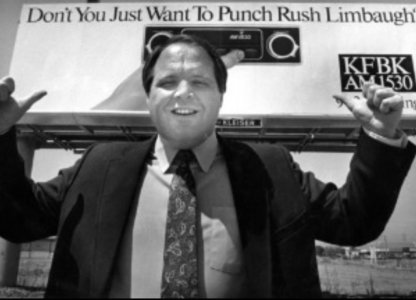
541742076_1073989738276885_7221424523122482851_n.jpg

Dude was all about attention-getting and self-promotion. He was a natural.

People keep focusing on 65+ year old programs. For today's average 40 year old, I bet they have never heard them - for that audience they would be new.

Didn't we cover this with the TCM analogy?

Come to think of it, there are in some of the OTR radio catalogues I have lying around, new radio mystery type programs. For me, those would be new. Can I go buy the CD's for them? I sure could. But the ability to hear them on the radio would be easier as I am driving around.

You already can:

And the producers of those shows would probably be agreeable to the exposure broadcast could give them.

The producers of those shows would probably be dead.

I would bet there are a lot of people for who the current offerings on radio don't grab them, and even if they do like the music, the over commercial'd broadcast hours are shoving them to the internet.

So lemme see if I follow...music lovers alienated by commercials who have left FM radio for the infinite variety and choice of streaming can be lured back to AM radio by playing spoken word programming from 1932 to 1962.

I am suggesting try something new, and with the idea I have for 560, it could be tested for not too much money.

Again, shows that were on the radio between 64 and 94 years ago aren't "something new", and there are fixed costs to broadcasting that don't square with "not too much money".

An experienced radio programmer here has stated that he is in the advertising business, not the entertainment business. But if the audience goes away to the internet, isn't he losing the opportunity to advertise to them?

Not if he goes where the ears are.

Are the revenues on I-Heart and Audacy apps smaller than broadcast radio?

Presently, yes.

Isn't the big money on OTA?

The once-big and rapidly declining money.

Don't give up the ship - alter the course.

The ship is FM. The listening levels on AM are too low to be a meaningful indicator of whether a format might work if transplanted to FM.

 
I am not focused on AM. I am suggesting using it as a testing ground to try something new for broadcast radio overall

As we've discussed before, the place to try something new isn't a technology the target audience has already left behind. Think about it. What do companies do when they test a new product? They go where the type of consumers they target are. When I was a junior in high school, Pepsi decided to try a product that didn't have the artificial coloring called Crystal Pepsi. They tried it Dallas because it had a large and diverse sample population in the demographics it wanted to reach. It didn't go to Wichita to see how many people would drive cross country to try it. Crystal Pepsi, by the way, was successful in Dallas and the three or four other markets where it was tried, but it failed and only lasted a couple years after it went national. New concepts in radio often have similar results.

The point is/was somebody took risks to see if a new DAYTIME national talk could be viable. And I would wager that what Rush did/said was unlike anything previous. Smart money back in 1988 would have said no.

Again, Rush was a risk, but he was a calculated one. If smart money had said "no," he wouldn't have been tried. He had already been successful in Kansas City and was doing well in Sacramento. ABC knew he had at least as good of a chance to succeed as he had to fail.

People keep focusing on 65+ year old programs. For today's average 40 year old, I bet they have never heard them - for that audience they would be new.

That's not how that works. As I mentioned before, I could play songs from Martha Reeves and the Vandellas for my about-to-turn 22 year-old niece. She would never have heard them before, but she would know they're not new.

An experienced radio programmer here has stated that he is in the advertising business, not the entertainment business. But if the audience goes away to the internet, isn't he losing the opportunity to advertise to them? Are the revenues on I-Heart and Audacy apps smaller than broadcast radio? Isn't the big money on OTA? Don't give up the ship - alter the course.

While I can agree with you that broadcasting companies sometimes seem to be less focused on their over-the-air properties than they probably should be, you have to ride in the direction the horse is going. If the audience is going to go to the internet regardless, you might as well try to reach them as opposed to letting Spotify or Pandora have those listeners. Broadcast radio simply can't offer some of the product the internet can, and one of the big problems with reaching younger listeners is that they want a medium that gives them more control than what radio could ever hope to offer. The lack of consensus current hits is also a problem for radio.

Broadcasting companies are frequently researching and testing new ideas, formats and sounds.
If they are, I sure haven't heard them OTA. Since the debut of Sportstalk radio, I would be interested to see a listing of what has been tried to improve the offerings. Music DJ's have been cut back and commercial loads increased. All Comedy Radio, Business Radio, Podcast Radio I have heard and they all leave a lot to be desired. Sports as a format seems to be the last new idea tried that has stuck.

Don't forget Jack and Bob FM. Those concepts came out in the last 20 years and are still around. The retooling of oldies to classic hits is another. Current-based formats are always adjusting their music mixes. And, yes, comedy, business, and podcast radio were more-or-less new formats, too (though I can remember comedy being tried in the late-80's on a few stations). Children's radio was also tried. You may think those ideas were bad, but they were, in fact, new ideas when they were tried. Like most new concepts, they fail at a much greater rate than they ever succeed.

Last I'd heard, Cumulus still has research and digital departments. It's still testing new concepts.
I thought Cumulus (and I-Heart and Audacy) are very much in debt and don't have money to invest in much of anything, Cutbacks on staff seem to be the norm.

And their research and digital departments make them money. So, they continue to operate. Large staffs, on the other hand, don't make much, if any, money. That's why they're getting cut.

I am the amateur here. There is a lot I don't know about share/cume/rating points. From a business perspective I am pretty sure a 1.6 on a Sports Talk station is much better than a 3.0 on a talk station. But I have not heard anybody on any of these boards think highly of anybody getting a .5. For the 6+ would it be correct that anything under 1.0 is a cause for concern?

Rating is the percentage of the total population that is listening while share is the percentage of the listening population. Radio, in total, gets about a 5 to 6 rating at any point in time. That means between 5 and 6% of the available audience is listening. A 0.5 rating would be about a 10 share because that would mean 10% of the listening audience is listening to that station. A 0.5 share, on the other hand (which is what I think you were actually talking about), is roughly what KSFO 810 has now. Share is how you're doing relative to everyone else. Rating is how you're doing relative to everything else.
 
It seems that talk radio works for life groups that enjoy provocative and some would argue support confirm their own biases. I remember when I worked on San Francisco, I had a conversation with Barbara Simpson who called me at K101 asking me about weekend talk show opportunities. I mentioned that I remember her anchoring the news on KTVU and she told me news was boring and that she preferred commentary. I heard the same thing in Sacramento from a KFBK reporter who said, KCBS was boring and talk radio was interesting. Of course KFBK's interesting talk was and is all conservative.

Fast forward to 2004, I returned to Sacramento radio as the OM of the local Air America Affiliate, where we had Christine Craft locally. I remember listeners telling me that they thought that people like Randi Rhodes and perhaps Christine sounded like liberal versions of Rush Limbaugh and that they preferred discussion akin to NPR.

So to David's point, people like Rush Limbaugh were liked due to their great personalities. I say, it's more due to their provocative nature.
 
So to David's point, people like Rush Limbaugh were liked due to their great personalities. I say, it's more due to their provocative nature.

It's both. Rush replaced Morton Downey, Jr. at KFBK. Mort was a guy you loved to hate. Actually, that was his shtick. He worked for me three years before doing weekends as an AC jock at KOLO in Reno and he was a sweetheart---used to write his own poetry and recite it over the intros to love songs once an hour or so. But when he landed the talk gig at 'BK, he turned himself inside out to be provocative.

Rush certainly had people who didn't like him---but he wasn't universally abrasive the way Mort was.
 
It's both. Rush replaced Morton Downey, Jr. at KFBK. Mort was a guy you loved to hate. Actually, that was his shtick. He worked for me three years before doing weekends as an AC jock at KOLO in Reno and he was a sweetheart---used to write his own poetry and recite it over the intros to love songs once an hour or so. But when he landed the talk gig at 'BK, he turned himself inside out to be provocative.

Rush certainly had people who didn't like him---but he wasn't universally abrasive the way Mort was.
I remember Mort's downfall well in 1984. He used an ethnic slur used to label an individual of Chinese decent. Local council member, Tom Chin called him out and Mort justified it by saying it's no different from calling someone of Irish decent an "Irishman". He was later dismissed and Rush was hired. Mort would later go on to falsely claim that he was attacked by skin heads in 1989.

Interesting little tidbit:

Morton Downy Jr and Rush Limbaugh were both brought in to KFBK when it was owned McClatchy's. Back then, the Sacramento Bee was widely accused of having a strong liberal bias. So it could be said that if Rush Limbaugh saved AM radio, then it started by the 'liberal' McClatchy family of Sacramento. Let me also make it clear that Eleanore McClatchy had passed away years before their hiring. I always wondered what her thoughts would have been about it.

But, this is the SF forum, so back to Bay Area radio. I do miss the old KGO and I also miss what radio was, but now we have everything that we want at our fingertips.
 
I remember Mort's downfall well in 1984. He used an ethnic slur used to label an individual of Chinese decent. Local council member, Tom Chin called him out and Mort justified it by saying it's no different from calling someone of Irish decent an "Irishman". He was later dismissed and Rush was hired. Mort would later go on to falsely claim that he was attacked by skin heads in 1989.

Looking back, Mort worked for me in '78-'79. A year and a half at most. In his mid-late 40s at that point, and with a healthy list of call letters on his resume--WPOP, KRIZ, WFUN, KUDL, KJR. But I didn't really know him and there was no obvious way to check out how things went at those places ten to 15 years after the fact at that time. He got fired a lot and rightfully so.

I guess I'm lucky he behaved himself when he was with us. Not all of our weekenders (especially those who went on to make a name for themselves) did.

Interesting little tidbit:

Morton Downy Jr and Rush Limbaugh were both brought in to KFBK when it was owned McClatchy's. Back then, the Sacramento Bee was widely accused of having a strong liberal bias.


The Sacramento Union was so far to the right that I'm sure the Bee appeared liberal even when it was being neutral. You know as well as anyone---this is a really schizophrenic area politically. A liberal downtown core and blood-red suburbs and exurbs---especially north of I-80.


So it could be said that if Rush Limbaugh saved AM radio, then it started by the 'liberal' McClatchy family of Sacramento. Let me also make it clear that Eleanore McClatchy had passed away years before their hiring. I always wondered what her thoughts would have been about it.

The family had one foot out the door by the time that happened. They sold to Group W in '87, the year before Rush went national.
 
The Sacramento Union was so far to the right that I'm sure the Bee appeared liberal even when it was being neutral. You know as well as anyone---this is a really schizophrenic area politically. A liberal downtown core and blood-red suburbs and exurbs---especially north of I-80.


The family had one foot out the door by the time that happened. They sold to Group W in '87, the year before Rush went national.
I was there before he left and they treated him like gold back then. Group W felt they needed a liberal counterweight and hired Lee Nichols followed by Christine Craft.
 
I remember Mort's downfall well in 1984. He used an ethnic slur used to label an individual of Chinese decent. Local council member, Tom Chin called him out and Mort justified it by saying it's no different from calling someone of Irish decent an "Irishman". He was later dismissed and Rush was hired. Mort would later go on to falsely claim that he was attacked by skin heads in 1989.

Interesting little tidbit:

Morton Downy Jr and Rush Limbaugh were both brought in to KFBK when it was owned McClatchy's. Back then, the Sacramento Bee was widely accused of having a strong liberal bias. So it could be said that if Rush Limbaugh saved AM radio, then it started by the 'liberal' McClatchy family of Sacramento. Let me also make it clear that Eleanore McClatchy had passed away years before their hiring. I always wondered what her thoughts would have been about it.

But, this is the SF forum, so back to Bay Area radio. I do miss the old KGO and I also miss what radio was, but now we have everything that we want at our fingertips.
I miss the old KGO too!
 
It's both. Rush replaced Morton Downey, Jr. at KFBK. Mort was a guy you loved to hate. Actually, that was his shtick. He worked for me three years before doing weekends as an AC jock at KOLO in Reno and he was a sweetheart---used to write his own poetry and recite it over the intros to love songs once an hour or so. But when he landed the talk gig at 'BK, he turned himself inside out to be provocative.

Rush certainly had people who didn't like him---but he wasn't universally abrasive the way Mort was.

I met Morton Downey, Jr. my freshman year of college when he and Dave Palone were debating gay rights. He was quite nice and personable off stage when he and Palone hung around for a meet-and-greet. He also refrained from attacks on Palone most of the time. He seemed a far cry from the loudmouth on the TV show who had almost seemed scary a few years earlier. I couldn't figure out which persona was an act, the one on TV or the one shaking my hand. One of my friends even told him he thought it was a lackluster debate, and Mort's response was, "If I can come this far, maybe everyone else can, too."
 
I must say and I'm only half or maybe 1/4 serious: about the only thing I can think of that that might make 560 useful would be to either carry BBC World service 24/7 or NOAA Weather Radio 24/7 but then again I said I wasn't really serious...
 
I must say and I'm only half or maybe 1/4 serious: about the only thing I can think of that that might make 560 useful would be to either carry BBC World service 24/7 or NOAA Weather Radio 24/7 but then again I said I wasn't really serious...

I can't say that I would expect either to generate enough listenership for ad sales to even pay the 560 electric bill, let alone even one staffer to supervise it.
 
I must say and I'm only half or maybe 1/4 serious: about the only thing I can think of that that might make 560 useful would be to either carry BBC World service 24/7 or NOAA Weather Radio 24/7 but then again I said I wasn't really serious...
Actually, KQED carries the Beeb 24-7 on their HD2 channel. NOAA Weather? I think they'd have more success by looping the most recent weather reports of the various local stations' meteorologists. Capture their audio, run it for the 2-3 minute length it aired on 2 or 4 or 5/7/11, then run a couple of spots. 90 seconds max. Then back to the next report in the sequence. At least the audience -- whatever of it is willing to listen -- has a chance of being familiar with those weather people.
 
Actually, KQED carries the Beeb 24-7 on their HD2 channel. NOAA Weather? I think they'd have more success by looping the most recent weather reports of the various local stations' meteorologists. Capture their audio, run it for the 2-3 minute length it aired on 2 or 4 or 5/7/11, then run a couple of spots. 90 seconds max. Then back to the next report in the sequence. At least the audience -- whatever of it is willing to listen -- has a chance of being familiar with those weather people.
And then you have the problem of the shortest TSL in all of radio.
 
And then you have the problem of the shortest TSL in all of radio.

IIRC, that was one of the many problems with KHJ's "Car Radio" format in 1984-86. If you were listening (and that was another problem) you were likely to tune out after the traffic report, especially if the music between them -- ten minutes' worth at a time -- were getting stale.

Saul Levine discovered the same problem when he converted 1650 to all-Traffic as KKTR for several months in 1998-99.
 
Turn 810 into a classic hits station. Now guys don't go throwing any rocks at me. Its just a thought that crossed my mind. Put Sue Hall on 9 to 1PM and Celeste Perry or perhaps Sylvia Chacon on 1 to 5 PM Simulcast SiriusXM'S Phlash Phelps 5 to 9am and Shotgun Tom Kelly on in the evenings. Music pow pow power 810 KSFO. I'm ducking and all the rocks missed me but you did break my kitchen window and scared my German Shepherd. Lol lol. Cumulus ha ha never going to happen. Classic hits well maybe in another world. I can certainly dream with the best of you other dreamers. Lol.
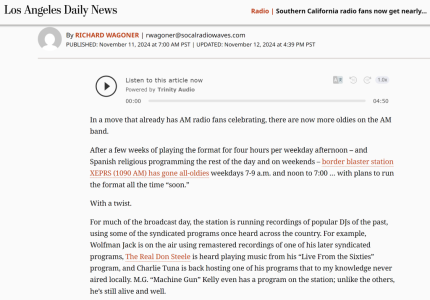
This was actually tried very recently (2024/2025) in a California major market, on a powerful AM signal... and the results were bubkis (even though I myself did tune in). XEPRS 1090 AM (with a signal that covers San Diego and reaches Orange County and parts of Los Angeles County) aired an oldies approach and could not amass an audience... or an advertiser base. While I would have liked to see it flourish, the market and demographic factors referenced in this thread proved that such a revitalization effort on a powerful AM signal is not destined to succeed. Sad but true.
1769633132963.png
 
All weather, all the time might work in Hurricane country. But not in San Francisco. "Fog burning off to sun with high around 75..."
Ah, but you could do microclimates!

Imagine what you'd hear in the summer: "It's 58 in the Avenues...68 in the Mission...78 at the Oakland Museum...88 in San José...and 108 in Pleasanton"
 
Actually, KQED carries the Beeb 24-7 on their HD2 channel. NOAA Weather? I think they'd have more success by looping the most recent weather reports of the various local stations' meteorologists. Capture their audio, run it for the 2-3 minute length it aired on 2 or 4 or 5/7/11, then run a couple of spots. 90 seconds max. Then back to the next report in the sequence. At least the audience -- whatever of it is willing to listen -- has a chance of being familiar with those weather people.
Give a big boost to the Berkeley emergency TIS.


Back
Top Bottom