• Get involved.
    We want your input!
    Apply for Membership and join the conversations about everything related to broadcasting.

    After we receive your registration, a moderator will review it. After your registration is approved, you will be permitted to post.
    If you use a disposable or false email address, your registration will be rejected.

    After your membership is approved, please take a minute to tell us a little bit about yourself.
    https://www.radiodiscussions.com/forums/introduce-yourself.1088/

    Thanks in advance and have fun!
    RadioDiscussions Administrators

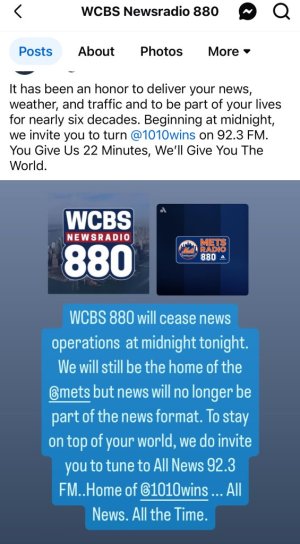
Good Karma To Lease 880; WCBS News Programming To End

Status
Not open for further replies.
Paul and Wayne indicated they’ll be “okay, not set, but okay” based on the severance negotiated by SAG-AFTRA.

Someone like Anita Bonita who has only been there a few years and wasn’t even full time (any more - she was also doing work under the Writer’s Guild) may not be.

The OP said he hoped the severance was fair. IMO it is fair for longer-term employees to receive higher severance pay than those who have been employed for shorter periods of time. It is also fair for full-time employees to receive more than part-time ones.

So long as the inequities are based on logical and reasonable conditions, they are fair even if unequal among all when no one's individual employment status is ignored.

I expect Anita to get the same severance as anyone whose status is similar. I also expect her to be unemployed for a relatively short period of time.
 
This was upboard two pages back, but for the record (or tape or mp3 file) I wanted to respond. I'm doing this mostly from memory, so feel free to correct anything I'm misremembering.


Easy listening, back in the 60's and 70's, was 93.1/WPAT, 103.5/WTFM and 105.1/WRFM. Plus a handful of suburban signals like WKJY in Nassau County or WCTO in Suffolk. WPAT and WRFM were full-market signals off ESB, WTFM was on the Chrysler Bldg with a directional antenna pointing mostly east towards Queens and Long Island. TFM transitioned to "mellow" rock in the latter '70s, RFM did the same in the mid '80s, and PAT was the 'last man standing' in the format, so to speak.

Classical was 96.3/WQXR and 104.3/WNCN. WNCN got sold in the 90s from GAF to one of the iHeart predecessors and converted into a modern rock station, and later to classic rock. WQXR was acquired by Univision(?) and became WXNY. As part of that deal, the 105.9 signal was acquired by NY Public Radio (WNYC) and rebranded as WQXR, and the "old" WQXR's music library was donated to NYPR to launch classical on 105.9.

The foreign language station Kent referred to was WEVD, named in memory of the socialist Eugene V. Debs. It was on 1330AM and 97.9FM. Owned by the Forward Association, which also published the Yiddish-language Forward newspaper. Around 1987 or '88, they were offered a truckload of money to sell the 97.9 signal in a 3-way exchange with one of the Spanish-language broadcasters (HBC? SBS? Can't recall...) and Emmis, the then-owner of 1050/WFAN (previously WHN). Emmis was buying 660/WNBC from GE/NBC, which was going dark after 60-odd years. So the deal was:

660/WNBC --> ashbin of history
1050/WFAN --> 660/WFAN
1330/WEVD --> 1050/WEVD
Other owner (Multicultural?) --> 1330
97.9/WEVD --> SBS or HBC
Cash --> Forward Assoc. (to subsidize The Forward for a couple of decades)

At a certain point, mid-late '00s, Disney offered the Forward Assoc. another infusion of cash in exchange for 1050/WEVD. Believing that their primary mission was keeping the Yiddish-language Forward alive as well as a newer English edition, they took the money and never looked back. Disney put ESPN on 1050 and eventually leased 98.7 from Emmis. I don't remember all the machinations. 1050 got converted to ESPN Desportes for a few years, then sold to Craig Karmazin's Good Karma Brands, and currently is the repeater for the ESPN national feed.

(Edited @ 18:05 EDT. Accidentally posted this before it was ready.)

The Spanish-language broadcaster is SBS. Actually, the exchange went as follows.

660 = WNBC to WFAN
1050 = WFAN to WUKQ (temporary AM station)

1050 = WUKQ to WEVD
97.9 = WEVD to WSKQ-FM (which was WUKQ)

WEVD had already ceased broadcasting on 1330 in 1984.
 
I expect Anita to get the same severance as anyone whose status is similar. I also expect her to be unemployed for a relatively short period of time.
Anita is a very "much in demand" voiceover and dubbing talent. While I'm sure she loves being "on the radio" I think her main occupation is elsewhere.
 
Sort of wonder, in the back of my mind, that when they got the new contract, combining WINS & WCBS news staff, that Audacy was thinking ahead and saying "Screw it, we know one of them will be going away within 10 years so it really doesn't matter what we give them as long as it doesn't cost us too much"
 
"More Conversational approach to news" if one is asking the answers are going to circle around public radio like WNYC, Connecticut Public Media, New Jersey Public Radio or WLIW-FM. In the past we mentioned how WCBS-AM aimed for a suburban audience/median demo. How much of this has changed not just because Audacy added WINS-FM as part of them promoting their flagship station but also the suburban audiences listen to public radio stations like WNYC and the others mentioned here.
Listening to Thursday's farewell, Wayne Cabot mentioned multiple times that the "resources to cover news were getting thinner at 880."

Both WCBS and WINS have far fewer reporters on the street than three years ago and despite sharing the reporters, combined headcount has continued to decline.

I took a look at an archived version of the WCBS website from ~2016. At that time, they had two dedicated reporters covering New Jersey, one covering Long Island (Sophia Hall - who was there until the end), and Fran Schneidau was still working in CT.

With a larger reporting team, assigned to suburban beats in areas they were able to produce both robust core NYC coverage as well as report stories in the suburban regions of the Metro area.

As their reporting headcount shrank, they were down to only Sophia Hall working from Long Island. No one dedicated to New Jersey, no one in CT. While they were still rip and reading stories from those areas, its not the same as having a reporter out there filing a couple packages a day.

How much did their pullback from reporting in areas that had long been their listener base accelerate their ratings decline?
 
Yeah...it seemed like Sophia Hall covered LI and Sean Adams covered the rest of the suburbs. One day he'd be in Norwalk, CT, another day in Newburgh, NY, and another day somewhere in North Jersey. Probably put a heck of a lot of miles on his car!! Many of the other stories outside of the five boros were anchor vo's or audio from WCBS-TV.
 
Yeah...it seemed like Sophia Hall covered LI and Sean Adams covered the rest of the suburbs. One day he'd be in Norwalk, CT, another day in Newburgh, NY, and another day somewhere in North Jersey. Probably put a heck of a lot of miles on his car!! Many of the other stories outside of the five boros were anchor vo's or audio from WCBS-TV.
And lets not forget that a lot of "site reporting" can be done online now. Nearly everything of importance can be covered from a reporter's home studio if they want. And nearly everything of major importance will come from their paid outside news suppliers.

"Feet on the ground" may be needed for TV coverage of what J-Low is wearing today, but for most news now that just is not needed. In fact, breaking news can be covered better using the old fashioned telephone than getting in a car and driving to the location.

I did a Top 15 market all news station decades ago with no street reporters. We would track stories through police and emergency scanners and then use a reverse directory and call a store or office or even a residence nearby to get a "street report". We even had food truck employees near government offices provide reports sometimes; we have them a fee and a recorder and they got recorded responses to our questions. We'd often beat the other traditional news station by as much as an hour in coverage.
 
Sort of wonder, in the back of my mind, that when they got the new contract, combining WINS & WCBS news staff, that Audacy was thinking ahead and saying "Screw it, we know one of them will be going away within 10 years so it really doesn't matter what we give them as long as it doesn't cost us too much"

Nobody forced the union to agree to the contract. All the members voted. You think they didn't know listenership for news radio is dropping?

The union could have held out, gone on strike, done what the actors did in Hollywood. But they didn't.
 
"Feet on the ground" may be needed for TV coverage of what J-Low is wearing today, but for most news now that just is not needed.
There is a notable difference between a package relying on info passed along from stringers and one from a reporter dedicated to a beat who is able to ask questions - of politicians, people on the street, eyewitness, whatever.

With an extra 10 minutes in the newswheel WCBS' reports historically were a bit longer and more detailed than the headline type stories from 1010WINS.
 
There is a notable difference between a package relying on info passed along from stringers and one from a reporter dedicated to a beat who is able to ask questions - of politicians, people on the street, eyewitness, whatever.
That is a degree of depth that "give us 20 minutes and we'll give you the news". In today's limited attention span world, deeper reporting is not favored by people only interested in headlines.
With an extra 10 minutes in the newswheel WCBS' reports historically were a bit longer and more detailed than the headline type stories from 1010WINS.
And that is 10 to 15 minutes longer than the average listening time of users per the PPM data.
 
I did a Top 15 market all news station decades ago with no street reporters. We would track stories through police and emergency scanners
Something that's impossible to do in many cities now as police and fire departments have gone to encrypted digital transmissions. Turn on a scanner today and about all you'll hear "in the clear" are hams and GMRS users, who might be useful to monitor during weather emergencies but won't give you leads on crime and accidents.
 
In other words, they were more like a typical report you'd hear on NPR.
Yes, except a typical NPR station will only clear 1, maybe 2 stories as part of the local block between the NPR newscast and the start of ME or ATC, and maybe one more at the bottom of the hour.

The only place I've lived with really, really robust local reporting on NPR was in Alaska, where they pre-empted the last 10 minutes of ME for a full local Alaska newsblock.

WCBS, at its peak, was running many more local news stories per 30 minute wheel than a local NPR affiliate.
 
Something that's impossible to do in many cities now as police and fire departments have gone to encrypted digital transmissions.

Sometimes agencies can't even talk to each other on digital systems, something Oakland discovered several years ago when it bought a system that couldn't communicate with other Alameda County (California) systems.
 
WCBS, at its peak, was running many more local news stories per 30 minute wheel than a local NPR affiliate.

My post was about the "longer and more detailed" aspect. What we find in PPM is that brevity is the key for holding attention and preventing tuneout with audiences in demo. The longer and more detailed the reporting, the less likely someone under 55 will stick with it. This is why WINS did better than WCBS, and ultimately made it vulnerable.
 
In other words, they were more like a typical report you'd hear on NPR.
No, not really. NPR reports on ATC and ME mostly covers the news with unscripted conversations with their correspondents, which leads to meandering conversations about the news. For example, on Friday, all coverage of VP Harris's speech from Chicago on NPR was via conversations with correspondents or guests. The only packaged politics story all day was about RFK leaving the race.

WCBS is/was tightly scripted. The script lets the anchor tell more of a story with fewer words and less time. It's much more respectful of the listener's time, which is good when your real goal is to sell advertising.
 
No, not really. NPR reports on ATC and ME mostly covers the news with unscripted conversations with their correspondents, which leads to meandering conversations about the news. For example, on Friday, all coverage of VP Harris's speech from Chicago on NPR was via conversations with correspondents or guests. The only packaged politics story all day was about RFK leaving the race.

WCBS is/was tightly scripted. The script lets the anchor tell more of a story with fewer words and less time. It's much more respectful of the listener's time, which is good when your real goal is to sell advertising.
The use of extensive two ways on NPR is rather new, and I find it jarring.
 
Status
Not open for further replies.


Back
Top Bottom