• Get involved.
    We want your input!
    Apply for Membership and join the conversations about everything related to broadcasting.

    After we receive your registration, a moderator will review it. After your registration is approved, you will be permitted to post.
    If you use a disposable or false email address, your registration will be rejected.

    After your membership is approved, please take a minute to tell us a little bit about yourself.
    https://www.radiodiscussions.com/forums/introduce-yourself.1088/

    Thanks in advance and have fun!
    RadioDiscussions Administrators

KSL Daytime Signal

The late Glen Clark told me that Chicago was one of the few places where M-3 is fairly accurate. Probably because WMAQ, WGN, WBBM, WLS, WCFL, and WIND all ran measured contours early on, and it was part of the data used for M-3. Glen agreed that the 15 mS/m region between Chicago and St. Louis was very likely from measured WLS contour data.

It would be interesting to measure KSL at the Northwest corner of Great Salt Lake. There is no 15000 mS/m curve on the groundwave graphs, but it would be between the 5000 mS/m and inverse field. On Long Island, I have seen recent measurements completely below the 0.1 mS/m curve, in an area that says 0.5 mS/m on M-3.

Some of the amateurs in Salt Lake City should measure their 160 and 80 meter signals on an FIM-41 across the Lake. For a Horizontal dipole, you would theoretically put the meter on its side and turn it to maximize the signal. I guess someone would have tried this across Ocean paths. It goes up to 5 MHz to measure 2nd, 3rd, and higher harmonics of AM BC signals depending on frequency.
 
Thanks for the replies. I found a site called "AM Broadcast Pattern Maps." These maps agree with the poster that said that WYLL and KSL cover about the same area. Question: Are these maps based upon theoretical calculations, or by actual measurements taken in the field? I could be wrong, but it seems like KSL performs better than WYLL during the day. KSL blasts into Eastern Nevada and Southern Idaho. Another question: Do AM signals benefit based on the ground conductivity where the tower is located, or by the conductivity of the land the signal passes over? Thanks.

Please see the link below:
 
r fry and I found that conductivity around the transmitter site had more influence, but all the maps are based on M-3.

In Michigan, there are many areas which have been demonstrated to be way below M-3. I was always observing this empirically when traveling around the state from the time I was very young. A couple of comparisons, such as WWJ 950 when it was 5000 watts nondirectional, vs. WHAK 960 with 5000 watts nondirectional, and WXYZ 1270 when it was 5000 watts nondirectional, vs. WHGR 1290 with 5000 watts nondirectional, were noted. The limited signals from Grand Rapids, MI were noticed early on, even though all of Kent County shows as 8 mS/m on M-3, where measured data on recent applications shows 1-3 mS/m. WTCM 580 was able to go from 2500 watts based on M-3, to 5000, 15000, 35000, and finally 50000 watts Day, from subsequent measurements from DA Proofs. They went to the 5000 watt Regional Channel limit then, very quickly after the first set of Proofs. All used the same 4 tower parallelogram. Because of the TL, and direction from Traverse City, selected because of the now vacant CKPR 580 in Thunder Bay, ON and phantom allotment required protection, it has only been able to go from 500 to 800 to 1100 watts Night. All the proofs in the area done for four stations that had 50000 watt Daytime CPs that were never built except for WTCM, show radials from 0.1 to rarely 3-4 mS/m, well below 8 and even below 2 in the respective M-3 Map Areas.

In answer to your question, the whole path determines the signal. Physicists and Electrical Engineers talk about path reversibility, but it always seemed like signals originating in SE Michigan soon overtook signals in Northern Michigan, even going past first adjacent stations and going beyond them. Near Lake Michigan, stations from Illinois and Wisconsin and even the UP were stronger than stations in Western Michigan 20 miles away. WMAQ, WGN, WBBM, WTMJ, WOKY, WDOR, and WDBC along the shore along Lake Michigan, are examples.
 
Last edited:
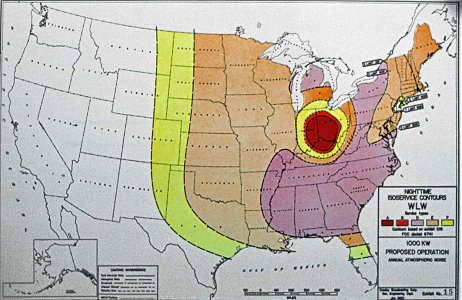
Anybody have the legend and Document which explains the different colors for the WLW Map?
It was explained in FCC docket 6741, exhibit 109, if you can find it. But note that map was with winter atmospheric noise, which is lower than in summer (lightning storms). The map based on annual atmospheric noise wasn't quite as generous:

WLW_1000kWNITECONTOURS.jpg
 
How far can KSL be receieved in the Daytime on a Good Radio?
Based on my experiences, daytime reception on a good car radio going west on I-80 is about 130-150 miles. Drops off fairly rapidly after that.

As has already been pointed out, the distance for a groundwave signal is a function of the conductivity along the entire path. For example, where my wife and I spend part of the winter near Pensacola, Florida. The salt water ends at a coast where the land has some of the worst conductivity in north America. So if you stay on directly on the waterfront where we do, you wind up with 5kw stations acros the water from Tampa or New Orleans (300 and 130 miles away, respectively) with stronger signals than 10 kw signals from the Mobile area 40-50 miles distant via land path. Another example can be found if you look at the coverage maps of the stations from Fargo, North Dakota area. KFGO and WDAY, to name just two, get out very well to the west, but come to an abrupt stop going east. Due to a sudden change in ground conductivity. No directional antenna transmitter needed.
 
Thanks

I'm looking at Google Earth to see how far West 150 miles from SLC, Only half of Nevada
SLC is about 125 miles east of the Utah Nevada border on I-80. 150 miles west of SLC would barely scratch the surface into Nevada. Cyberdad's comment about their signal dropping off rapidly makes sense, since I-80 west of the Utah Nevada border starts going through mountainous areas and away from the Salt Flats. I know KSL blasts into Wendover, Nevada. Going east, KSL is weak but listenable in Rock Springs, Wyoming at about 185 miles. Keep in mind that there are large mountains between SLC and Rock Springs.

The FM stations from SLC are easily receivable at the Utah Nevada border since the towers are located on mountain tops that are line of sight across the Salt Flats. FM is spotty east of SLC because of Wasatch Mountains.

Another question: Would the lack of trees and vegetation enhance AM and FM signals?

Thanks.
 
Last edited:
I know KSL blasts into Wendover, Nevada. Going east, KSL is weak but listenable in Rock Springs, Wyoming at about 185 miles. Keep in mind that there are large mountains between SLC and Rock Springs.
Pretty much in line with my experience exactly. For those unfamiliar, Wendover is a casino resort town exactly on the Utah-Nevada state line.

I doubt that there's much correlation between trees or lack of trees affecting how far AM signals get out over terrain. But maybe someone here more knowledgeable than me knows something that I don't.

In the meantime, welcome to the board.
 
Vegetation affects AM to some degree. That's why AM signals are better when the grass and brush is trimmed near the transmitter. And mountainous terrain is rocky and has poor conductivity. Gently rolling terrain has little effect.
 
I've read rumors (observations?) that after the harvest, AM signals travel better. So not exactly vegetation, but crops. My experience is distant AM stations come in better in the winter even without snow, but I can't say an absence of crops is why.
 
I've read rumors (observations?) that after the harvest, AM signals travel better. So not exactly vegetation, but crops. My experience is distant AM stations come in better in the winter even without snow, but I can't say an absence of crops is why.
That's all the ionosphere, and the D-Layer going away. That even goes for winter daytime skip, the sun angle is so low that there are days, the D-layer doesn't go completely away.
 
In the meantime, welcome to the board.
Thank you cyberdad. I have been a lurker on this board but seldom post. I think my last post was years ago. I love reading the posts from you and many other posters here. I'm not in the radio business, but was always interested in radio. My initial interest began when I heard "WLS The Big 89" from my childhood home in the northeast US. Later on, I discovered WABC, WCFL, WSM, WLW and many others on my big Zenith radio. I remember being puzzled on why those station couldn't be received during the day. I remember listening to a graveyard station and thought the interference from co-channel stations at night was a studio audience at the station. Anyways, thanks for the good posts on this forum.
 
... For example, where my wife and I spend part of the winter near Pensacola, Florida. The salt water ends at a coast where the land has some of the worst conductivity in north America. ...
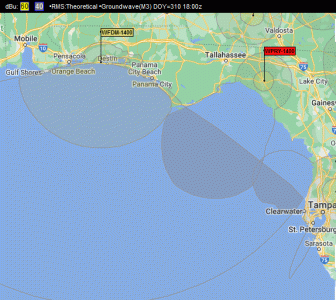
The graphic below shows how greatly the daytime field strengths of AM broadcast stations arriving at the seacoast over sea water paths are reduced by their travel over the inland terrain.

1400 kHz Field Contours Along Gulf Coast.gif
 
That's all the ionosphere, and the D-Layer going away. That even goes for winter daytime skip, the sun angle is so low that there are days, the D-layer doesn't go completely away.

I've noticed it with stations that come in via groundwave as well, but yes daytime DX is a thing I've heard many times over. Getting closer to that season for sure. I do remember reading somewhere that an Iowan said WHO's cancellation zone goes out 40 miles once the corn is harvested. I don't know if that was an exaggeration or actual observation, or possibly some of both.
 
I've noticed it with stations that come in via groundwave as well, but yes daytime DX is a thing I've heard many times over. Getting closer to that season for sure. I do remember reading somewhere that an Iowan said WHO's cancellation zone goes out 40 miles once the corn is harvested. I don't know if that was an exaggeration or actual observation, or possibly some of both.
We really need some actual analysis and data to back these claims up.
 
When the corn is harvested, lots of things are going on. The days are shorter, it starts to get colder, the leaves start falling, the skywave propagation changes, etc.

One thing I noticed, which seems odd, last night, was that WWV was blastitng in on 15000 kHz, but the other frequencies were weak or absent, at Local Sunset. AM BC skywave was pretty good though. Normally, 5000 kHz and 10000 kHz are strong at that time.
 
Last edited:
We really need some actual analysis and data to back these claims up.

I'm sure there was some truth and some hyperbole involved there. The groundwave observations from my own ears in my region have come from repeated instances over the years. I will say that on my old car radio that created a lot of AM interference, I could hear the likes of WLW, WKNR and WTAM much better in the fall and winter than in the summer. My current radio is far superior for AM so I don't expect to detect a lot of those differences, except maybe on a very distant AM signal.
 
The graphic below shows how greatly the daytime field strengths of AM broadcast stations arriving at the seacoast over sea water paths are reduced by their travel over the inland terrain.
That map is a perfect illustration of what I was talking about. And there are multiple other examples as well. 1340 is one of my favorites. WTAN from Clearwater is more than 300 miles away from where we stay on the beach at the Alabama-Florida state line, and there are probably at least a half dozen other stations operating on 1340 that are closer to me. Yet WTAN turns up all alone on a crowded daytime chnnel during the daytime hours in listenable form. Of course, WTAN vanishes completely less than a half-mile inland on the mainland.
 
Status
This thread has been closed due to inactivity. You can create a new thread to discuss this topic.


Back
Top Bottom