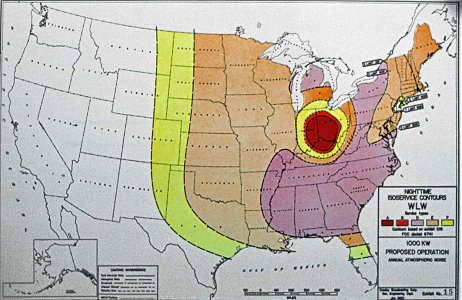
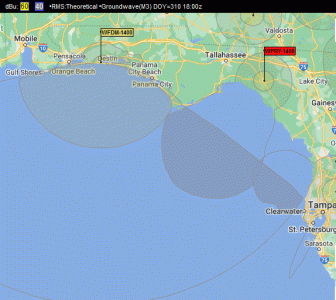
The late Glen Clark told me that Chicago was one of the few places where M-3 is fairly accurate. Probably because WMAQ, WGN, WBBM, WLS, WCFL, and WIND all ran measured contours early on, and it was part of the data used for M-3. Glen agreed that the 15 mS/m region between Chicago and St. Louis was very likely from measured WLS contour data.
It would be interesting to measure KSL at the Northwest corner of Great Salt Lake. There is no 15000 mS/m curve on the groundwave graphs, but it would be between the 5000 mS/m and inverse field. On Long Island, I have seen recent measurements completely below the 0.1 mS/m curve, in an area that says 0.5 mS/m on M-3.
Some of the amateurs in Salt Lake City should measure their 160 and 80 meter signals on an FIM-41 across the Lake. For a Horizontal dipole, you would theoretically put the meter on its side and turn it to maximize the signal. I guess someone would have tried this across Ocean paths. It goes up to 5 MHz to measure 2nd, 3rd, and higher harmonics of AM BC signals depending on frequency.
It would be interesting to measure KSL at the Northwest corner of Great Salt Lake. There is no 15000 mS/m curve on the groundwave graphs, but it would be between the 5000 mS/m and inverse field. On Long Island, I have seen recent measurements completely below the 0.1 mS/m curve, in an area that says 0.5 mS/m on M-3.
Some of the amateurs in Salt Lake City should measure their 160 and 80 meter signals on an FIM-41 across the Lake. For a Horizontal dipole, you would theoretically put the meter on its side and turn it to maximize the signal. I guess someone would have tried this across Ocean paths. It goes up to 5 MHz to measure 2nd, 3rd, and higher harmonics of AM BC signals depending on frequency.