• Get involved.
    We want your input!
    Apply for Membership and join the conversations about everything related to broadcasting.

    After we receive your registration, a moderator will review it. After your registration is approved, you will be permitted to post.
    If you use a disposable or false email address, your registration will be rejected.

    After your membership is approved, please take a minute to tell us a little bit about yourself.
    https://www.radiodiscussions.com/forums/introduce-yourself.1088/

    Thanks in advance and have fun!
    RadioDiscussions Administrators

Lexington, KY (December 7, 1981)

I meant to say "enforce" must-carry, not "endorse", and the time for editing has passed. Don't know why I wrote that, I wasn't using speech-to-text. It was late 🌛

I'm not clear whether cable carriers now can add an out-of-market station de novo, not carried up to this point, but I do know that there have been many such situations where OOM carriage was "grandfathered in", either officially (in the eyes of the FCC) or unofficially, due to long-time viewing habits and preferences. If a station is on the significantly viewed list, that would seem to lay matters to rest, but that list is ancient and bears little relation to actual viewing patterns in 2025. (The SV list seems to have been revised in 2016, but it's still archaic, for instance, it shows WLOS as significantly viewed in Harlan County, but doesn't show WYMT at all, indeed, it shows Perry County with only WCYB and WJHL being SV. For Owen County, it only lists Cincinnati 5/9/12 and Louisville 3/11, no WXIX --- but curiously, WSTR ---and no Lexington stations at all.)

Does anybody else have any better knowledge or information on what kind of rules govern OOM cable carriage, and to what extent in-market stations can invoke must-carry throughout the length and breadth of the market? WOWK has been historically very protective of its market, and I have to think they'd go after the cable system in Floyd County and say "oh, yes, you will carry us!". Or maybe not.
 
I meant to say "enforce" must-carry, not "endorse", and the time for editing has passed. Don't know why I wrote that, I wasn't using speech-to-text. It was late 🌛

I'm not clear whether cable carriers now can add an out-of-market station de novo, not carried up to this point, but I do know that there have been many such situations where OOM carriage was "grandfathered in", either officially (in the eyes of the FCC) or unofficially, due to long-time viewing habits and preferences. If a station is on the significantly viewed list, that would seem to lay matters to rest, but that list is ancient and bears little relation to actual viewing patterns in 2025. (The SV list seems to have been revised in 2016, but it's still archaic, for instance, it shows WLOS as significantly viewed in Harlan County, but doesn't show WYMT at all, indeed, it shows Perry County with only WCYB and WJHL being SV. For Owen County, it only lists Cincinnati 5/9/12 and Louisville 3/11, no WXIX --- but curiously, WSTR ---and no Lexington stations at all.)

Does anybody else have any better knowledge or information on what kind of rules govern OOM cable carriage, and to what extent in-market stations can invoke must-carry throughout the length and breadth of the market? WOWK has been historically very protective of its market, and I have to think they'd go after the cable system in Floyd County and say "oh, yes, you will carry us!". Or maybe not.
I did my Master’s degree thesis on the must carry rules and its impact on small market independent stations — but that was in 1986 when the FCC was considering dropping must carry. Must carry now bears a little resemblance to the must carry of back then.

It’s also my understanding that networks can enforce market exclusivity regarding cable carriage of its affiliates in those locales in which the signal coverage overlap — such as Frankfort where WDRB and WDKY signals overlap. I know that Fox has been aggressive in this regard, hence the reason Frankfort CATV dropped WDRB and now only carries WDKY.
 
I did my Master’s degree thesis on the must carry rules and its impact on small market independent stations — but that was in 1986 when the FCC was considering dropping must carry. Must carry now bears a little resemblance to the must carry of back then.

It’s also my understanding that networks can enforce market exclusivity regarding cable carriage of its affiliates in those locales in which the signal coverage overlap — such as Frankfort where WDRB and WDKY signals overlap. I know that Fox has been aggressive in this regard, hence the reason Frankfort CATV dropped WDRB and now only carries WDKY.

I'd be interested in reading your thesis.

I wasn't aware of the signal overlap issue. I can easily foresee a situation where an OOM station could get its signal into a portion of the market that the in-market station can't reach.
 
Just realized today that I have an extra of the WKYT 50th anniversary book. It's yours if you'd like to have it; just need to know how to get it to you (via UPS, as I no longer trust the USPS).
May I make a suggestion? Since there are lots of us who'd like to see it, perhaps you could first send it to @DavidEduardo so he can scan it for his website, and then pass it along to whoever gets it in the end?
 
There are quite a few 30 ft towers here as well.
Judging from the antennas I still see here, people were watching 3,11,32 and 41 with a VHF yagi and a corner reflector bowtie aimed at Louisville and a corner reflector bowtie aimed at Lexington.

Most of these are fixed positions without a rotor.

I haven't seen any aimed at Cincinnati which leads me to believe that Lexington and Louisville stations were plenty for Anderson county.

You're right about "one station per network" in most cases.
It seems I read that FOX would only allow cable companies to carry that DMAs FOX affiliate.
That was the case here.
WDKY and WDRB were both carried full time, then sometime around 2000, the cable company here would "sim-sub" WDKY over WDRB during network hours, and eventually WDRB was dropped altogether. Then WLKY was dropped leaving WAVE and WHAS as the sole remaining Louisville channels on cable here.

Up the road in Frankfort, the viewers decided to pay the extra transmission fees to keep WAVE, WLKY, and WHAS. WDRB was dropped due to WDKY flexing their muscle. WLJC is carried on cable there, as well.

A little farther north in Owen county (Cincinnati DMA) the cable there, has a network from each market:
WLEX (NBC), WLKY (CBS), WCPO (ABC) and WXIX (FOX).
Owenton is equal distance from all 3 markets.

I had family that lived in Frankfort in 1974, and I remember WXIX as well as WDRB were in cable there. I can't remember if the other Cincy stations were there but as a teenager, WXIX and WDRB were more of an interest to me.

Back when I ran service I kept a 5" yard sale find black and white TV in my work truck, that I would watch when I stopped to eat lunch. (But not while I was driving!)
I traveled all over the eastern part of the state, so I would turn it on to see what I could, the farther out I was. Glad I'm not the only TV and antenna geek.

I have a good friend that's into model trains, and his layout is massive, however he thinks my TV and radio DXing hobby is " weird". To each his own, I guess.
The 1972-1973 TV Factbook shows all three Cincinnati affiliates carried on both of the Frankfort CATV systems, along with Louisville and Lexington affiliates (even though it doesn't show WBLG and WDRB being carried on the "Consolidated TV Cable Service Inc." system, but it did carry WXIX).
 
The 1972-1973 TV Factbook shows all three Cincinnati affiliates carried on both of the Frankfort CATV systems, along with Louisville and Lexington affiliates (even though it doesn't show WBLG and WDRB being carried on the "Consolidated TV Cable Service Inc." system, but it did carry WXIX).
A lot of that TVFB cable information was out of date, and their most recent information for Consolidated may not have reflected these two stations going on the air. Or Consolidated might have thought with being in the Louisville market at the time, and already having two other ABC affiliates, it wasn't worth it to add a third one. Don't know about WDRB.
 
A lot of that TVFB cable information was out of date, and their most recent information for Consolidated may not have reflected these two stations going on the air. Or Consolidated might have thought with being in the Louisville market at the time, and already having two other ABC affiliates, it wasn't worth it to add a third one. Don't know about WDRB.
Yes, I’ve found TVFB to generally be out of date, but more of an indicator of what was once carried on CATV systems at some point.
 
Yes, I’ve found TVFB to generally be out of date, but more of an indicator of what was once carried on CATV systems at some point.

I'm still scratching my head as to how KSBY-6 San Luis Obispo CA got carried on cable in Tonopah NV. It appeared in their TVFB data in 1967 and 1968. That would have taken many knife-edges lined up just right --- you do have mountains between SLO and Tonopah --- but it's still hard to believe. I've even wondered if TVFB could have "seeded" fake information here and there to trip up copyright violators, the way mapmakers will put "ghost streets" on maps, or (apparently) deliberately misspell the names of cities. The TVG editions map listed "Binghampton" NY and "Harrisonville" VA.
 
I'm still scratching my head as to how KSBY-6 San Luis Obispo CA got carried on cable in Tonopah NV. It appeared in their TVFB data in 1967 and 1968. That would have taken many knife-edges lined up just right --- you do have mountains between SLO and Tonopah --- but it's still hard to believe. I've even wondered if TVFB could have "seeded" fake information here and there to trip up copyright violators, the way mapmakers will put "ghost streets" on maps, or (apparently) deliberately misspell the names of cities. The TVG editions map listed "Binghampton" NY and "Harrisonville" VA.
In 1988-89, when I lived east of Bishop near the Nevada border, the dials were nearly empty and with a rooftop antenna, knife-edge propagation through the Sierra Nevadas and White Mountains actually did bring in signals from SLO on a daily basis.

So I don't think it's impossible at all that the operator of the Tonopah system could have put up a mountaintop antenna and had adequate reception of KSBY.
 
In 1988-89, when I lived east of Bishop near the Nevada border, the dials were nearly empty and with a rooftop antenna, knife-edge propagation through the Sierra Nevadas and White Mountains actually did bring in signals from SLO on a daily basis.

So I don't think it's impossible at all that the operator of the Tonopah system could have put up a mountaintop antenna and had adequate reception of KSBY.

That's pretty incredible, 270 miles, but with those kinds of knife-edges, I guess anything's possible. North Palisade sits almost directly between SLO and Tonopah.
 
I did my Master’s degree thesis on the must carry rules and its impact on small market independent stations — but that was in 1986 when the FCC was considering dropping must carry. Must carry now bears a little resemblance to the must carry of back then.

It’s also my understanding that networks can enforce market exclusivity regarding cable carriage of its affiliates in those locales in which the signal coverage overlap — such as Frankfort where WDRB and WDKY signals overlap. I know that Fox has been aggressive in this regard, hence the reason Frankfort CATV dropped WDRB and now only carries WDKY.
Well, this has been a quite interesting, and fun discussion!

But since I'm not a "pro", I have to ask, how does a network like FOX "enforce" market exclusivity?
Unless it's a FOX O&O station (WDRB and WDKY are not) what can the network do?

Strip the station of it's affiliation? (Networks should not be able to dictate where an affiliate can be carried, unless they are an O&O)

The affiliate can't dictate wether a cable company carries their channel or not unless, of course they are accepting retrans fees from the OOM cable provider.
And maybe by the affiliate accepting retrans fees, from the OOM cable provider ( such as Frankfort and Anderson county) FOX could pull their affiliation?
Am I somewhat close to correct?

In another note, I feel DMAs are too large. The DMA should only extend to the reach of the OTA signal. Beyond that cable and satellite should be able to carry whatever affiliates they like.

I can tell you that you cannot get the Lexington stations OTA in Somerset, Lake Cumberland or all the way down to Monticello. Not can you get them in the mountain counties. Yet these are all in the Lexington DMA. You seldom see ads for businesses that far away.

Conversely, Adair county (Columbia) is in the Louisville DMA. 100 miles out. You cannot get Louisville OTA there (but possibly Bowling Green) and I never see ads on Louisville TV for businesses down there.
 
Well, this has been a quite interesting, and fun discussion!

But since I'm not a "pro", I have to ask, how does a network like FOX "enforce" market exclusivity?
Unless it's a FOX O&O station (WDRB and WDKY are not) what can the network do?

Strip the station of it's affiliation? (Networks should not be able to dictate where an affiliate can be carried, unless they are an O&O)

The affiliate can't dictate wether a cable company carries their channel or not unless, of course they are accepting retrans fees from the OOM cable provider.
And maybe by the affiliate accepting retrans fees, from the OOM cable provider ( such as Frankfort and Anderson county) FOX could pull their affiliation?
Am I somewhat close to correct?

In another note, I feel DMAs are too large. The DMA should only extend to the reach of the OTA signal. Beyond that cable and satellite should be able to carry whatever affiliates they like.

I can tell you that you cannot get the Lexington stations OTA in Somerset, Lake Cumberland or all the way down to Monticello. Not can you get them in the mountain counties. Yet these are all in the Lexington DMA. You seldom see ads for businesses that far away.

Conversely, Adair county (Columbia) is in the Louisville DMA. 100 miles out. You cannot get Louisville OTA there (but possibly Bowling Green) and I never see ads on Louisville TV for businesses down there.
As I understand it, Fox keeps its affiliates on a very short leash. I'm pretty sure that they enforce 100% clearance of their programs, and various FCC regulations ensure the right of the in-market station both to insist upon must-carry, and to block out OOM affiliates of the same network, at least up to a point. As I indicated above, I'm not entirely clear how must-carry applies when you get to the outer fringes of the market, and would look to those more expert than me to shed some light on this. Just guessing, I'd say that Fox wants each and every one of its affiliates to be as strong as they can be within their respective DMAs. Somewhat of the same dynamic existed in the 1980s when local business leaders wanted to set up an ABC affiliate in Pikeville, WEKT-51. ABC refused to grant the affiliation, as they maintained that this would cannibalize their affiliates in Charleston and Kingsport, and WEKT never got on the air.

Every county or county-equivalent in the US is within one and only one DMA. Stations within the DMA often jealously guard the borders, to keep from losing counties to another DMA. Markets that have lost counties over the years aren't keen to lose any more, the example I always use is Lewis County KY, which has little if any economic or cultural connection to the Charleston-Huntington market, and would probably fall into the Lexington market if C-H didn't block those stations off the local cable. (Fringe OTA reception of Lexington stations is possible in parts of the county, it's on the edge of the Pottsville Escarpment, difficult terrain for any OTA reception at all.) The C-H market has been a hurtin' puppy over the years, it has lost several counties in southern Ohio and eastern Kentucky to Columbus and Lexington respectively, this coupled with the population drain in these areas (and my family and I were part of that drain), and the declining economy (the southernmost reaches of the Rust Belt) has shrunk the market drastically. Every county matters.

As I noted upthread, in the 1970s, the Lexington stations staged a very aggressive campaign, including joint promotion, to nibble away as many counties as they could from adjoining markets, and fast-forward to 2025, and their market extends far outside of their OTA reception range. Cable and satellite have enabled this, and satellite providers are very strict about providing in-market, and only in-market stations, in their local packages. A county has to jump through all kinds of hoops to be classed as an "orphan county", viz. a county that cannot otherwise receive in-state TV stations, and as I understand it, the provider can dictate which stations will be allowed. This is why eastern Kentucky counties outside of the Lexington market cannot get WYMT via satellite, the providers say "okay, fine, you want an in-state station, you can have WKYT", which isn't what the viewers want, WYMT is the de facto local news station for everything between Louisa and Middlesboro. It's a mess.
 
As I understand it, Fox keeps its affiliates on a very short leash. I'm pretty sure that they enforce 100% clearance of their programs, and various FCC regulations ensure the right of the in-market station both to insist upon must-carry, and to block out OOM affiliates of the same network, at least up to a point. As I indicated above, I'm not entirely clear how must-carry applies when you get to the outer fringes of the market, and would look to those more expert than me to shed some light on this. Just guessing, I'd say that Fox wants each and every one of its affiliates to be as strong as they can be within their respective DMAs. Somewhat of the same dynamic existed in the 1980s when local business leaders wanted to set up an ABC affiliate in Pikeville, WEKT-51. ABC refused to grant the affiliation, as they maintained that this would cannibalize their affiliates in Charleston and Kingsport, and WEKT never got on the air.

Every county or county-equivalent in the US is within one and only one DMA. Stations within the DMA often jealously guard the borders, to keep from losing counties to another DMA. Markets that have lost counties over the years aren't keen to lose any more, the example I always use is Lewis County KY, which has little if any economic or cultural connection to the Charleston-Huntington market, and would probably fall into the Lexington market if C-H didn't block those stations off the local cable. (Fringe OTA reception of Lexington stations is possible in parts of the county, it's on the edge of the Pottsville Escarpment, difficult terrain for any OTA reception at all.) The C-H market has been a hurtin' puppy over the years, it has lost several counties in southern Ohio and eastern Kentucky to Columbus and Lexington respectively, this coupled with the population drain in these areas (and my family and I were part of that drain), and the declining economy (the southernmost reaches of the Rust Belt) has shrunk the market drastically. Every county matters.

As I noted upthread, in the 1970s, the Lexington stations staged a very aggressive campaign, including joint promotion, to nibble away as many counties as they could from adjoining markets, and fast-forward to 2025, and their market extends far outside of their OTA reception range. Cable and satellite have enabled this, and satellite providers are very strict about providing in-market, and only in-market stations, in their local packages. A county has to jump through all kinds of hoops to be classed as an "orphan county", viz. a county that cannot otherwise receive in-state TV stations, and as I understand it, the provider can dictate which stations will be allowed. This is why eastern Kentucky counties outside of the Lexington market cannot get WYMT via satellite, the providers say "okay, fine, you want an in-state station, you can have WKYT", which isn't what the viewers want, WYMT is the de facto local news station for everything between Louisa and Middlesboro. It's a mess.
Yes, Fox is very aggressive in having their affiliates not cannibalize each other across DMA lines.

Yes, I agree about DMAs being ridiculously large when stations can’t even be received OTA. Look at the Lexington market for example. NO WAY can a Lexington signal penetrate those deep south and southeast Kentucky counties.

We used to have a farm in Marion county, which is on the fringe of the Louisville DMA. RabbitEars.com shows that the Lexington stations actually provide a better signal into Marion County than the Louisville stations, but the county is designated as a Louisville DMA county — probably because of the legacy of the Louisville VHFs, dating back to when they signed on in 1948 and 1950. Also, the early years of the Lexington UHFs were hampered by lower power signals, lousy UHF tuners in sets, etc. Plus, the plethora of pre-1964 VHF-only sets.

(Our farm in Marion County sat in a valley, with the hills blocking the Lexington stations, but we had a clearer shot to the west/Louisville. This resulted in WAVE and WHAS being adequate via a Channel Master Crossfire, but WLKY and WDRB via a Hooverman antenna were viewable but rough. This was pretty much the standard antenna package for Marion County for the Louisville stations in the 1970s.)


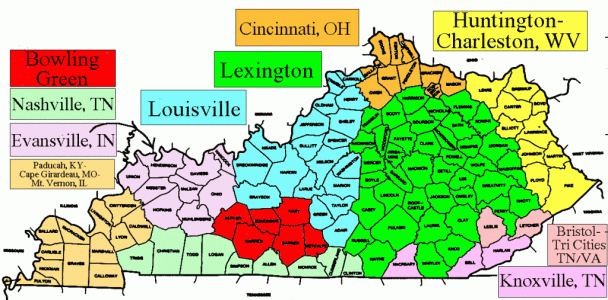
1739629080305.gif
 
Last edited:
As I understand it, Fox keeps its affiliates on a very short leash. I'm pretty sure that they enforce 100% clearance of their programs, and various FCC regulations ensure the right of the in-market station both to insist upon must-carry, and to block out OOM affiliates of the same network, at least up to a point. As I indicated above, I'm not entirely clear how must-carry applies when you get to the outer fringes of the market, and would look to those more expert than me to shed some light on this. Just guessing, I'd say that Fox wants each and every one of its affiliates to be as strong as they can be within their respective DMAs. Somewhat of the same dynamic existed in the 1980s when local business leaders wanted to set up an ABC affiliate in Pikeville, WEKT-51. ABC refused to grant the affiliation, as they maintained that this would cannibalize their affiliates in Charleston and Kingsport, and WEKT never got on the air.

Every county or county-equivalent in the US is within one and only one DMA. Stations within the DMA often jealously guard the borders, to keep from losing counties to another DMA. Markets that have lost counties over the years aren't keen to lose any more, the example I always use is Lewis County KY, which has little if any economic or cultural connection to the Charleston-Huntington market, and would probably fall into the Lexington market if C-H didn't block those stations off the local cable. (Fringe OTA reception of Lexington stations is possible in parts of the county, it's on the edge of the Pottsville Escarpment, difficult terrain for any OTA reception at all.) The C-H market has been a hurtin' puppy over the years, it has lost several counties in southern Ohio and eastern Kentucky to Columbus and Lexington respectively, this coupled with the population drain in these areas (and my family and I were part of that drain), and the declining economy (the southernmost reaches of the Rust Belt) has shrunk the market drastically. Every county matters.

As I noted upthread, in the 1970s, the Lexington stations staged a very aggressive campaign, including joint promotion, to nibble away as many counties as they could from adjoining markets, and fast-forward to 2025, and their market extends far outside of their OTA reception range. Cable and satellite have enabled this, and satellite providers are very strict about providing in-market, and only in-market stations, in their local packages. A county has to jump through all kinds of hoops to be classed as an "orphan county", viz. a county that cannot otherwise receive in-state TV stations, and as I understand it, the provider can dictate which stations will be allowed. This is why eastern Kentucky counties outside of the Lexington market cannot get WYMT via satellite, the providers say "okay, fine, you want an in-state station, you can have WKYT", which isn't what the viewers want, WYMT is the de facto local news station for everything between Louisa and Middlesboro. It's a mess.
If FOX is in fact looking out for and protecting, it's in market affiliates, that's actually a good thing. Not too many businesses do that today.

However, how do you explain WXIX being carried in Georgetown Paris, and Mt. Sterling?

SV status?

I recently stopped in a convenience store at I-75 and US 460 in Georgetown. The TV on the wall was playing one of those trash talk shows and the WXIX watermark was in the right corner of the screen.
BTW, you can see the downtown Lexington skyline from that exit.

I stopped in McDs in Mt Sterling for coffee one morning. WXIX was playing on the dining room TV.
All these systems also carry WDKY.

There was an extensive discussion on getting WYMT on satellite. Even with the FCC getting involved. Gray, which owns both WYMT and WKYT even said they were fine with having both. Nothing like owning your competition...

It's the dish providers that said it's not technically feasible.
Both dish providers receive locals OTA then uplink them to their hub, rather than utilizing fiber.

(Both dish providers used to publish the OTA uplink address on their website. I don't think they list them anymore.)

Direct TVs receiving station is located about 100 ft up on the WLEX tower on Russell Cave Rd

Dish Networks is ground level on Forbes Rd at Lisle Rd near what was the old Bluegrass Stockyards.

( I'll take pics this week and post them)

So, maybe the dish providers "can't" get a useable WYMT signal to those sites.
When WYMT switches to UHF 20, they are going to lose some of their OTA viewers as VHF does better in mountainous terrain. They have a very loyal following there, as stated before.
 
Yes, as you correctly note, the Lexington market extends far beyond the range at which it could be received OTA (unless you were on a mountaintop), moreover, even if the distances aren't extreme, you have all of those valleys that block out signals. To be fair, though, other markets might be blocked out as well, though they didn't suffer from the handicap of being UHF back in a time when that made a huge difference. Very often, OTA reception came down to what side of the mountain you were on, and whether you fell in a reception sweet spot or not.

Taking a look at the 1975 Broadcasting Yearbook, the following counties, now in the Lexington DMA, were in these markets:

Tri-Cities - Perry
Knoxville - Jackson, Clay, Laurel, Knox, Wayne, Russell, Whitley (Leslie County was also in that DMA, it's now Tri-Cities)
Charleston-Huntington - Knott, Magoffin, Morgan, Wolfe, Rowan (also Letcher County, now Tri-Cities as well)
Cincinnati - Fleming

There was at least one year (I'd have to page through several years of BCYB and TVFB to find it, that will be a research project for another time) when Robertson and Harlan counties were in the Lexington market, and IIRC, so was Leslie County. Leslie County has bounced back and forth between Knoxville, Tri-Cities, and Lexington, but as of now, it's this odd exclave of the Tri-Cities market. Long story short, the Lexington stations aggressively pursued viewers, got on cable (though not translators, that would have helped immensely), secured their loyalty, and in the 1980s, one of them, WKYT, took advantage of a situation and snapped up WKYH, which was struggling (to put it mildly). Lexington is one of the great urban success stories of the 1970s and beyond, it just keeps growing and growing, robust economies with many drivers (education being among them), easy access via the interstates and the Mountain Parkway, and from a pleasant little town known for horses, became (after a fashion) the largest city in eastern Kentucky, while being just on the edge of it. People wanted to get their TV from there.
 
If FOX is in fact looking out for and protecting, it's in market affiliates, that's actually a good thing. Not too many businesses do that today.

However, how do you explain WXIX being carried in Georgetown Paris, and Mt. Sterling?

SV status?

I recently stopped in a convenience store at I-75 and US 460 in Georgetown. The TV on the wall was playing one of those trash talk shows and the WXIX watermark was in the right corner of the screen.
BTW, you can see the downtown Lexington skyline from that exit.

I stopped in McDs in Mt Sterling for coffee one morning. WXIX was playing on the dining room TV.
All these systems also carry WDKY.

There was an extensive discussion on getting WYMT on satellite. Even with the FCC getting involved. Gray, which owns both WYMT and WKYT even said they were fine with having both. Nothing like owning your competition...

It's the dish providers that said it's not technically feasible.
Both dish providers receive locals OTA then uplink them to their hub, rather than utilizing fiber.

(Both dish providers used to publish the OTA uplink address on their website. I don't think they list them anymore.)

Direct TVs receiving station is located about 100 ft up on the WLEX tower on Russell Cave Rd

Dish Networks is ground level on Forbes Rd at Lisle Rd near what was the old Bluegrass Stockyards.

( I'll take pics this week and post them)

So, maybe the dish providers "can't" get a useable WYMT signal to those sites.
When WYMT switches to UHF 20, they are going to lose some of their OTA viewers as VHF does better in mountainous terrain. They have a very loyal following there, as stated before.
Totally agree with the inconsistency regarding Fox's "enforcement" and some of its signal-overlapping affiliates (in this case, WXIX) -- maybe it's because Frankfort/Franklin County was so strongly fought over by the Louisville and Lexington markets over the years for that county to be in either designated DMA?

Very interesting to hear that DirecTv and Dish still receive locals via OTA -- I assumed it would've been via fiber by now.


Back
Top Bottom