• Get involved.
    We want your input!
    Apply for Membership and join the conversations about everything related to broadcasting.

    After we receive your registration, a moderator will review it. After your registration is approved, you will be permitted to post.
    If you use a disposable or false email address, your registration will be rejected.

    After your membership is approved, please take a minute to tell us a little bit about yourself.
    https://www.radiodiscussions.com/forums/introduce-yourself.1088/

    Thanks in advance and have fun!
    RadioDiscussions Administrators

So Cal Hits

This is for everybody here who worked as an on-air talent. If you had a 5 day a week air part, how did you decide what your content would be? How did you decide what to say on the air?

Five-day weeks were vanishingly rare in radio, even in the major markets. All the guys at KFWB, KRLA and KHJ worked six days, usually longer shifts on the weekend, because you had to cover two days (Saturday and Sunday) with a weekday staff plus one weekender.

As far as content, that varied by jocks. Some were all about knowledge of the music, some were more topical, riffing on current events, and some leaned more toward jokes. I aimed for a bit of all three, and so I'd set aside interviews or news items about artists that I'd be playing on the air, and I'd read as many newspapers as were available in whatever town I was working in, looking for topical material---even better, topical material that you could make the first words of a hit song into a punch line for.

Example---(over the intro to Lynn Anderson) "President Nixon announced another round of wage and price freezes today. Responding to critics he said..."

(Lynn) "I beg your pardon. I never promised you a rose garden." (and the record plays on from there normally).


Obviously, when Casey did Am. Top 40, he looked up different facts or chart positions on the songs he played, so he knew a lot about artists, songwriters, producers, etc. He was prepared in advance to do patter on the air, so his show flowed smoothly.

Casey had a producer, a researcher and at least two writers. Not saying Casey didn't do some of that (he certainly did before AT 40), but it was a very tightly scripted show with a staff for much of that.

If you have a daily 3 hour show of music,

Three-hour shifts were largely a major market thing. Most medium and smaller markets did four, five and six hour shifts. Most common was a 6-10 a.m. morning show, 10 a.m.-2 p.m. midday, 2 p.m.-6 p.m. afternoon, a 6 p.m.-12 Midnight evening show and a 12 Midnight-6 a.m. overnight.

Even in the majors, that six-hour overnight was pretty much a given.


how do you prepare for the gig each day? Before you go in a studio, do you write out a list of ideas or topics that you want to mention on the air? Do you think about in advance any comedy shtick that you want to do? Do you decide in advance what your material will be for your shift?

Most jocks I knew would jot down or record on a micro cassette recorder ideas as they came to them and then flesh them out. The rule of thumb I was taught, and what was recommended by Chuck Blore (the genius behind KFWB's Color Radio format) was that you should prepare half an hour for every hour you're on the air. So a four hour shift should have two hours of prep.

Gary Owens did a one-to-one ratio---preparing an hour for each hour on the air. And honestly, Gary was always in prep---looking for a turn of phrase that he could use on the air.

As a high school teacher, I was required to do a lot of preparation and always write a lesson plan. I had to write out a lecture and know the material I was going to present. I had to decide what the topic was going to be, how long the discussion would be, whether or not I would lecture each day, or whether we would break up into small group discussion, whether or not students would present their own material, etc.

But when I listen to air talent these days, some people appear to be good at "winging it", just ad libbing; and some people have the script prepared in advance. Charlemagne, for example, knows who the on-air guest will be, so he has an idea of questions to ask.
Bobby Bones has an idea of news topics, so when he does a discussion with his team, he knows what questions to ask.

How do you prepare, and what determines a successful air talent with one who is just mediocre? Thanks in advance for your feedback. -- Daryl

A lot of it depends on the station. When I was jocking (1971-81), we were expected to say something over the intro to every record and going into every commercial break. That tightened up severely over the years, to the point that even 30 years ago, The Real Don Steele on KRTH was only opening the mic four times an hour. There's not a lot of prep required for that sort of thing, apart from knowing what's happening during those four occasions and figuring out if there's something you can say or do there that will make it special.
 
Also -- if the only requirements needed to be an overnight DJ were to: show up on time and not be a criminal or a druggie, then wouldn't there be many applicants for the job? Wouldn't there be many people who thought that was the easiest job in the world? Just show up, play songs, play commercials, and say as little as possible?

Those were not the only requirements. You needed to be at least decent on the air. You needed to be able to do commercial production. While it's true that I was one of very few overnighters to move up into morning drive once, much less three times, jocks didn't stay in overnights forever. If they couldn't get promoted to a better time slot at their station, they'd move on to a station that would hire them for evenings, middays or afternoons.

It's a punishing shift in terms of sleep deprivation and lifestyle changes and I always marveled that Johnny Williams at KHJ (who was excellent, by the way) was able to do it for nine years.
 
Casey had a producer, a researcher and at least two writers. Not saying Casey didn't do some of that (he certainly did before AT 40), but it was a very tightly scripted show with a staff for much of that.
I talked a lot with TR about this when we were prepping to do the World Chart Show. The idea was that the host(s) would arrive and review the script for anything with hard pronunciation, and then lay down the tracks. Totally scripted, with occasional improvisation if one of the lines did not come naturally.
A lot of it depends on the station. When I was jocking (1971-81), we were expected to say something over the intro to every record and going into every commercial break. That tightened up severely over the years, to the point that even 30 years ago, The Real Don Steele on KRTH was only opening the mic four times an hour. There's not a lot of prep required for that sort of thing, apart from knowing what's happening during those four occasions and figuring out if there's something you can say or do there that will make it special.
I worked with three different talents who were #1 in LA over the years. None did any prep other than the talent telling his crew what to have ready for the next day. Most of the ideas were generated in "today's show" and implemented "tomorrow".

In Puerto Rico, where we had about a 30 share in mornings, the team arrived at 5:30 and ran the last half hour from the day before while they had a BS session about where to start that day. at 6 AM they rolled, using a bunch of "every day" or "every Friday" or whatever subject. They did that for 2 hours. From 8 to 10, they ran the first two hours over. With that kind of numbers, we never told them to do anything different.
 
Those were not the only requirements. You needed to be at least decent on the air. You needed to be able to do commercial production. While it's true that I was one of very few overnighters to move up into morning drive once, much less three times, jocks didn't stay in overnights forever. If they couldn't get promoted to a better time slot at their station, they'd move on to a station that would hire them for evenings, middays or afternoons.

It's a punishing shift in terms of sleep deprivation and lifestyle changes and I always marveled that Johnny Williams at KHJ (who was excellent, by the way) was able to do it for nine years.

Thank you. Now, I'm intrigued. What is meant by commercial production? Would that be like writing the one minute spot ads and recording them? So, you had to have writing and editing skills, plus ability to correctly operate the recording equipment?

Johnny Williams did a terrific job overnights at KHJ. I always enjoyed listening to him.

Bob Eubanks at KRLA did overnights from about 1960 to spring of '62, when the listeners voted him to replace Wink Martindale in morning drive time. Bob had a very upbeat high energy patter which lent itself well to being a cheerful wake-up morning host. JMO.

Grry Owens was hilarious and creative, with his plays on words and puns. I could tell that he put some thought into his jokes.
Bill Ballance was kind of the same when he was at KFWB. Both funny guys, with sophisticated shtick and fun vocabulary jokes.
 
Last edited:
Also -- if the only requirements needed to be an overnight DJ were to: show up on time and not be a criminal or a druggie, then wouldn't there be many applicants for the job? Wouldn't there be many people who thought that was the easiest job in the world? Just show up, play songs, play commercials, and say as little as possible?
American Top 40 had writers and researchers.....Casey didn't do the writing or research
 
Thank you. Now, I'm intrigued. What is meant by commercial production? Would that be like writing the one minute spot ads and recording them? So, you had to have writing and editing skills, plus ability to correctly operate the recording equipment?

Yes. In small markets, you’d have to write copy. In larger towns (50,000 or more) most of the copy was written by sales or the client.
Johnny Williams did a terrific job overnights at KHJ. I always enjoyed listening to him.

Bob Eubanks at KRLA did overnights from about 1960 to spring of '62, when the listeners voted him to replace Wink Martindale in morning drive time. Bob had a very upbeat high energy patter which lent itself well to being a cheerful wake-up morning host. JMO.

Grry Owens was hilarious and creative, with his plays on words and puns. I could tell that he put some thought into his jokes.
Bill Ballance was kind of the same when he was at KFWB. Both funny guys, with sophisticated shtick and fun vocabulary jokes.
 
Thank you. Now, I'm intrigued. What is meant by commercial production? Would that be like writing the one minute spot ads and recording them? So, you had to have writing and editing skills, plus ability to correctly operate the recording equipment?
Mostly voicing them. In a smaller station, might include the production, too.
 
Commercial production: dubbing spots from reels to carts, putting the color coded dot stickers on the carts, typing cart labels & copy, doing the tags at the end of spots, downloading the spots from the satellite server, editing out the breaths if needed to get the spot to :30 or :60, bringing/emailing the finished cart or MP3 spots to the AM or FM studios, making sure the run and kill dates were right, talking to sales and playing the spots over the phone if a client wanted to hear them first (this was rare when I did commercial production but it occasionally happened), etc.
 
Last edited:
Those were not the only requirements. You needed to be at least decent on the air. You needed to be able to do commercial production. While it's true that I was one of very few overnighters to move up into morning drive once, much less three times, jocks didn't stay in overnights forever. If they couldn't get promoted to a better time slot at their station, they'd move on to a station that would hire them foThervenings, middays or afternoons.

It's a punishing shift in terms of sleep deprivation and lifestyle changes and I always marveled that Johnny Williams at KHJ (who was excellent, by the way) was able to do it for nine years.
There were those rare individuals that always wanted to do overnights, because of no management or office staff hassles. WLW news personality Charles Van Sant did overnights on WLW the entire time he was there. I know a guy on Fort Wayne like that.

Dick Purtan, longtime Detroit morning host, was said to have prepped for the next day after getting off the air. He had a complete show ready by early afternoon, with space to riff on anything that happened after that/
 
Commercial production: dubbing spots from reels to carts, putting the color coded dot stickers on the carts, typing cart labels & copy, doing the tags at the end of spots, downloading the spots from the satellite server, editing out the breaths if needed to get the spot to :30 or :60, bringing/emailing the finished cart or MP3 spots to the AM or FM studios, making sure the kill dates were right, talking to sales and playing the spots over the phone if a client wanted to hear them first (this was rare when I did commercial production but it occasionally happened), etc.
That is smaller market production. In a larger market, there is a production director who does the mechanics and just calls the jocks and announcers in to voice the audio.

Sometimes the production guy was also on an airshift. In that case, he'd (I never knew a woman production person, but hope there are some now) leave copy for the other jocks and assemble them when he got off the air.

I don't know of any station in my experience where a production person talked to a client unless the seller was present.
 
That is smaller market production. In a larger market, there is a production director who does the mechanics and just calls the jocks and announcers in to voice the audio.

Sometimes the production guy was also on an airshift. In that case, he'd (I never knew a woman production person, but hope there are some now) leave copy for the other jocks and assemble them when he got off the air.

I don't know of any station in my experience where a production person talked to a client unless the seller was present.
That’s what I meant - the only time we ever contacted clients was when the salesperson came into the production studio and said the client wanted to hear the spot, and I can only remember that happening once. We didn’t even talk to the client at that time, just played the spot on her voicemail.
 
There were those rare individuals that always wanted to do overnights, because of no management or office staff hassles. WLW news personality Charles Van Sant did overnights on WLW the entire time he was there. I know a guy on Fort Wayne like that.

Dick Purtan, longtime Detroit morning host, was said to have prepped for the next day after getting off the air. He had a complete show ready by early afternoon, with space to riff on anything that happened after that/
I did a partial overnight shift in college (10PM-whenever I felt like getting off air, because mine was the last staffed airshift and afterwards I’d switch back to automation). It was more just because I’m a night owl. My cohost, who was going to another college, would call in for an hour or sometimes the whole show, and then we’d talk more after the show when I was walking back to my apartment. It was fun, but unfortunately the station turned in its license a few years ago.

My dad did nights at his college’s FM station in the 60’s, he got paid though. At that station it was sometimes student shows and other nights they played music off reels and he just had to switch them out and run the board. To this day he hates hearing The Platters “Red Sails In The Sunset”….
 
Last edited:
Grry Owens was hilarious and creative, with his plays on words and puns. I could tell that he put some thought into his jokes.
Bill Ballance was kind of the same when he was at KFWB. Both funny guys, with sophisticated shtick and fun vocabulary jokes.

The genius in guys like Gary and Bill was in making it sound easy and spontaneous. Both put a lot of work into what they did, as did most jocks at that level.

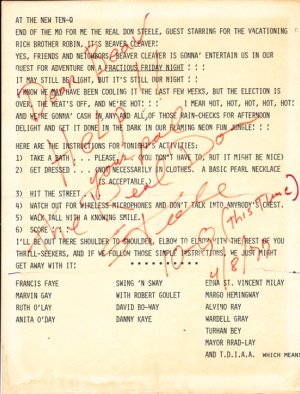
Five and a half years ago, Ken Levine (TV writer/producer, M*A*S*H, CHEERS, FRASIER and others), who worked with The Real Don Steele at K-100 and KTNQ (Ken was "Beaver Cleaver") wrote in his now (tragically) dormant blog about Don's "Fractious Friday" signoffs, which he did every Friday at KHJ, K-100 and KTNQ:

For the uninitiated:


Now that may sound like Don stream of consciousness ad-libbing his heart (and several other organs) out, but no. Ken also posted his autographed copy of one of the "Fractious Friday" signoffs Don did leading into Beaver on TenQ.

IMG.jpg

Don used to say he was "working without a net", but very little was left to chance because---he was a pro.
 
Those were not the only requirements. You needed to be at least decent on the air. You needed to be able to do commercial production. While it's true that I was one of very few overnighters to move up into morning drive once, much less three times, jocks didn't stay in overnights forever. If they couldn't get promoted to a better time slot at their station, they'd move on to a station that would hire them for evenings, middays or afternoons.

Didn't a DJ need an FCC license back in those days, as well?

I used to hear stories about DJ's who got into the business by hanging around the local, small-town station when they were kids. Not even officially hired, but used as gofers, etc. Perhaps when they got old enough they were hired as the station janitor, or maybe a file clerk, etc.

Then one night, it happened. The overnight guy couldn't make it to the studio for some reason, so the PD offers the late night shift to the kid, who, so far as no on-air experience. Just spin the records and announce the song titles....how hard is that to mess up, and if you do mess up, nobody is listening at that time anyway....

This happens once, twice, three times....soon the "kid" ends up with the overnight shift. In a few years he's promoted to weekends, and, after a few years, midday or even drive time....

My guess is that this didn't happen a whole lot, though....
 
Didn't a DJ need an FCC license back in those days, as well?
Only if they did transmitter readings. If the station had a union board op or the like, those folks would do the readings. If you did them, a 3rd Class license was needed for many stations, including most FMs

If your station was directional you'd have to have a 1st Class FCC license. That required a set of exams on rules and technical basics.
I used to hear stories about DJ's who got into the business by hanging around the local, small-town station when they were kids. Not even officially hired, but used as gofers, etc. Perhaps when they got old enough they were hired as the station janitor, or maybe a file clerk, etc.
I began at age 13 as a go-fer for an AM-FM in Cleveland, Ohio. R&B on AM, jazz on FM. Within a few months, I got some part-time board work, and then some actual shifts.
Then one night, it happened. The overnight guy couldn't make it to the studio for some reason, so the PD offers the late night shift to the kid, who, so far as no on-air experience. Just spin the records and announce the song titles....how hard is that to mess up, and if you do mess up, nobody is listening at that time anyway....
In my case, the FM ran 5 PM too 11 PM, Monday to Saturday. The FCC started requiring a full schedule, and they had to fill 7 AM to 11 PM on Sunday, and I got the whole long shift. 8 hours were overtime, so I made about $30 for the day, plus other stuff during the week. I could make about $160 to $200 in a month, which I invested in penny stocks.
This happens once, twice, three times....soon the "kid" ends up with the overnight shift. In a few years he's promoted to weekends, and, after a few years, midday or even drive time....
I never got anything better. So I took my investments and built my own radio station elsewhere.
My guess is that this didn't happen a whole lot, though....
In that era, when there were not so many legalities about kids hanging around stations, it was not uncommon. Particularly, in smaller markets you had young guys even riding their bike to work... that is how I started.
 
I used to hear stories about DJ's who got into the business by hanging around the local, small-town station when they were kids. Not even officially hired, but used as gofers, etc. Perhaps when they got old enough they were hired as the station janitor, or maybe a file clerk, etc.

The station I listened to as a kid was the one that hired me once I was old enough to drive. Full circle moment.
 
Didn't a DJ need an FCC license back in those days, as well?

I used to hear stories about DJ's who got into the business by hanging around the local, small-town station when they were kids. Not even officially hired, but used as gofers, etc. Perhaps when they got old enough they were hired as the station janitor, or maybe a file clerk, etc.

Then one night, it happened. The overnight guy couldn't make it to the studio for some reason, so the PD offers the late night shift to the kid, who, so far as no on-air experience. Just spin the records and announce the song titles....how hard is that to mess up, and if you do mess up, nobody is listening at that time anyway....

This happens once, twice, three times....soon the "kid" ends up with the overnight shift. In a few years he's promoted to weekends, and, after a few years, midday or even drive time....

My guess is that this didn't happen a whole lot, though....

So, I honestly have no idea whether I've told this story on this board or not in the past 20-something years, but if I have it's been forever, so...

I wanted to be on the radio starting at age 8. Heard Gary Owens on KMPC and that was it. But I thought you had to go to school, finish college and then God knows what.

Flash forward six years. My dad died the year I heard Gary Owens and we've moved 270 miles north of L.A. to Bishop, California, where my mom's side of the family had been for the past 45 years.

There's one radio station, KIBS. 1,000 watts daytime, 250 nighttime at 1230 on the dial. They hire high school kids for cheap talent.

One day, at age 14, I'm shooting hoops with some friends when Virginia Holmes, a substitute teacher and host of KIBS' daily "Coffee With Virginia" (light pop music, household hints and recipes) is visiting her sister, our next-door neighbor.

She recognizes me from school and remembers I read well. So she comes out to ask if I'd like a job at the radio station. I'd like a job at the gas station---are you kidding me? She clears it with mom, takes me down to KIBS, pulls a newscast off the wire machine and has me read it into a tape recorder.

She gives the tape to the General Manager, John Hemler, whose kids I go to school with. He calls and says if I can pass the FCC third-class (with endorsement) test, he'll give me a job. He loans me the books to study, mom takes a day off work, drives 270 miles to Los Angeles, waits in the hallway of the federal building while I take the exam, buys me a Big Mac (we didn't have McDonald's in Bishop yet), and drives 270 miles back to Bishop.

Three weeks later (during which I had turned 15), an official-looking envelope arrives from the FCC and inside is my license. I'm hired.

I start with the 6:00 a.m.-Noon shift on Sundays. Duties: Unlock the building, turn on the transmitter, hit the sign-on at 6:00 a.m. and play religious tapes and public affairs shows back-to-back for six hours. I can turn on the microphone (in fact, I have to) every half-hour to say "KIBS, Bishop." No more, no less.

After about six weeks of that, someone leaves, they hire a new kid, give him that shift and I move into Noon to 6 on Sundays, where I can actually play records and talk. Granted, they're not the records I'd want to play (those are only played at night), but it's something.

Six months in, I get the weekday evenings, and as David said, I rode my bike from school to the radio station. When I signed off at 10 p.m., Mom would be waiting in the parking lot, we'd put the bike in the trunk of her Mercury and go home.

Six months after that, I had a driver's license and 90 days after that I'd bought a used car, so I got myself to and from work.

At that station, in just under three years, I went from that "only the ID" Sunday morning shift to Sunday afternoons, weekday evenings, Music Director, Program Director and midday jock.

So, yeah....you could do it. In 1971, in a town of 3,500. Everyone's mileage absolutely varied.
 
So. Cal hits.....well if you go back to 1964, "Gloria" by Them [which Van Morrison was a member of] was a hit on the west coast but in rest of the country, not so much. Here and there around the midwest/Eastern part of the country it did OK. Then The Shadows of Knight covered it and pretty much had the hit with it in the Midwest/Eastern Part of the country becoming a Top 10 hit. Them only reached # 93 on the charts but did better when it was re-released in 1966 making it up to #71.
And by the way...Happy 78th Birthday to Sir George Ivan "Van" Morrison, born August 31, 1945.
 
So. Cal hits.....well if you go back to 1964, "Gloria" by Them [which Van Morrison was a member of] was a hit on the west coast but in rest of the country, not so much..

Thanks primarily to KRLA that played the song in 1965. That led to the band doing a multi-week residency at the Whiskey A Go-Go, along with The Doors. So you had the pairing of Van Morrison and Jim Morrison. That alone is a long story. Somehow the Shadows of Knight heard the song and did it at a club in Chicago. It got them a record deal with Dunwich, and it got airplay on WLS. The WLS airplay was heard regionally throughout the midwest, and other stations picked it up. I guess more parts of the country could hear WLS than KRLA.
 
Status
This thread has been closed due to inactivity. You can create a new thread to discuss this topic.


Back
Top Bottom