This is for everybody here who worked as an on-air talent. If you had a 5 day a week air part, how did you decide what your content would be? How did you decide what to say on the air?
Five-day weeks were vanishingly rare in radio, even in the major markets. All the guys at KFWB, KRLA and KHJ worked six days, usually longer shifts on the weekend, because you had to cover two days (Saturday and Sunday) with a weekday staff plus one weekender.
As far as content, that varied by jocks. Some were all about knowledge of the music, some were more topical, riffing on current events, and some leaned more toward jokes. I aimed for a bit of all three, and so I'd set aside interviews or news items about artists that I'd be playing on the air, and I'd read as many newspapers as were available in whatever town I was working in, looking for topical material---even better, topical material that you could make the first words of a hit song into a punch line for.
Example---(over the intro to Lynn Anderson) "President Nixon announced another round of wage and price freezes today. Responding to critics he said..."
(Lynn) "I beg your pardon. I never promised you a rose garden." (and the record plays on from there normally).
Obviously, when Casey did Am. Top 40, he looked up different facts or chart positions on the songs he played, so he knew a lot about artists, songwriters, producers, etc. He was prepared in advance to do patter on the air, so his show flowed smoothly.
Casey had a producer, a researcher and at least two writers. Not saying Casey didn't do some of that (he certainly did before AT 40), but it was a very tightly scripted show with a staff for much of that.
If you have a daily 3 hour show of music,
Three-hour shifts were largely a major market thing. Most medium and smaller markets did four, five and six hour shifts. Most common was a 6-10 a.m. morning show, 10 a.m.-2 p.m. midday, 2 p.m.-6 p.m. afternoon, a 6 p.m.-12 Midnight evening show and a 12 Midnight-6 a.m. overnight.
Even in the majors, that six-hour overnight was pretty much a given.
how do you prepare for the gig each day? Before you go in a studio, do you write out a list of ideas or topics that you want to mention on the air? Do you think about in advance any comedy shtick that you want to do? Do you decide in advance what your material will be for your shift?
Most jocks I knew would jot down or record on a micro cassette recorder ideas as they came to them and then flesh them out. The rule of thumb I was taught, and what was recommended by Chuck Blore (the genius behind KFWB's Color Radio format) was that you should prepare half an hour for every hour you're on the air. So a four hour shift should have two hours of prep.
Gary Owens did a one-to-one ratio---preparing an hour for each hour on the air. And honestly, Gary was always in prep---looking for a turn of phrase that he could use on the air.
As a high school teacher, I was required to do a lot of preparation and always write a lesson plan. I had to write out a lecture and know the material I was going to present. I had to decide what the topic was going to be, how long the discussion would be, whether or not I would lecture each day, or whether we would break up into small group discussion, whether or not students would present their own material, etc.
But when I listen to air talent these days, some people appear to be good at "winging it", just ad libbing; and some people have the script prepared in advance. Charlemagne, for example, knows who the on-air guest will be, so he has an idea of questions to ask.
Bobby Bones has an idea of news topics, so when he does a discussion with his team, he knows what questions to ask.
How do you prepare, and what determines a successful air talent with one who is just mediocre? Thanks in advance for your feedback. -- Daryl
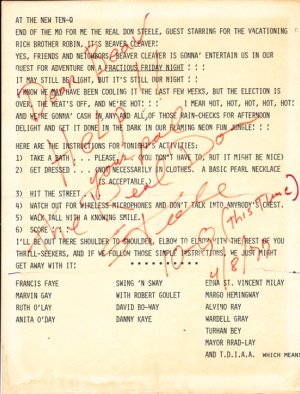
A lot of it depends on the station. When I was jocking (1971-81), we were expected to say something over the intro to every record and going into every commercial break. That tightened up severely over the years, to the point that even 30 years ago, The Real Don Steele on KRTH was only opening the mic four times an hour. There's not a lot of prep required for that sort of thing, apart from knowing what's happening during those four occasions and figuring out if there's something you can say or do there that will make it special.