
-
Get involved.
We want your input!
Apply for Membership and join the conversations about everything related to broadcasting.
After we receive your registration, a moderator will review it. After your registration is approved, you will be permitted to post.
If you use a disposable or false email address, your registration will be rejected.
After your membership is approved, please take a minute to tell us a little bit about yourself.
https://www.radiodiscussions.com/forums/introduce-yourself.1088/
Thanks in advance and have fun!
RadioDiscussions Administrators
You are using an out of date browser. It may not display this or other websites correctly.
You should upgrade or use an alternative browser.
You should upgrade or use an alternative browser.
TV Guide editions and online resources
- Thread starter IM42A
- Start date
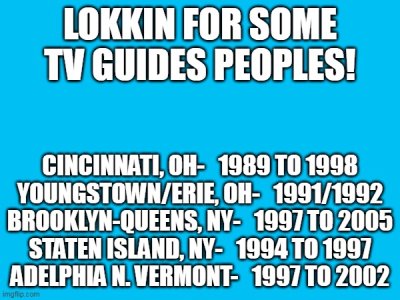
Check out eBay. They have a fairly wide assortment of TV Guides, and many of them tell what edition it is. For the ones who don't, you can contact the seller (hard to understand why they'd leave that out of the description).Hi all, this may be a long shot but i collect TV GUIDES and im lookin for some from certain regions/editions if anyone has any:
yea ive checked on there (and a few FB tv guide pages). i got many from both those, but still need alot on my list that i havent found yet in those editions.Check out eBay. They have a fairly wide assortment of TV Guides, and many of them tell what edition it is. For the ones who don't, you can contact the seller (hard to understand why they'd leave that out of the description).

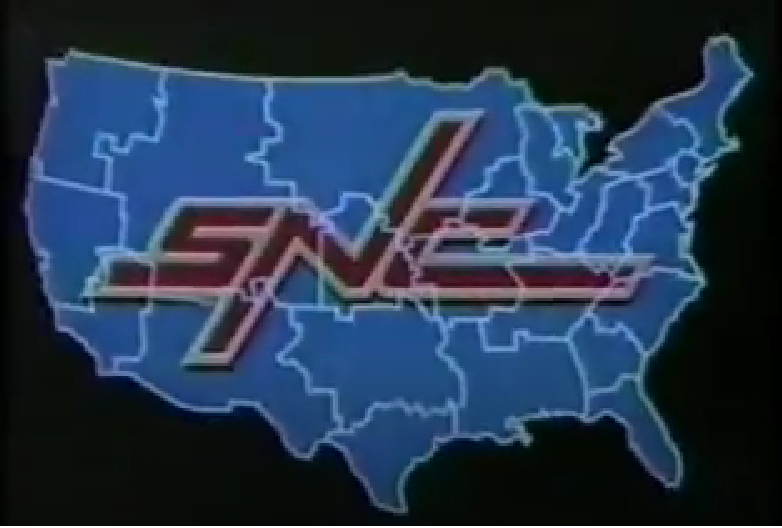
By the way, here's a map of SNC regions from a 1983 promo (with a bizarre absence of the Great Lakes, which makes it pretty hard to make out how the regions were split in that part of the country):
Twin Cities-based tcmedianow has just uploaded an entire edition of SNC's Midwest Report, produced by WCCO:
I didn't know that SNC did any sort of long-form regional newscasts. I thought they were all just a few minutes long, sharing one transponder among the different regions in tandem, such that there was always one such newscast being relayed, transmitted back-to-back.Twin Cities-based tcmedianow has just uploaded an entire edition of SNC's Midwest Report, produced by WCCO:
I didn't know that SNC did any sort of long-form regional newscasts. I thought they were all just a few minutes long, sharing one transponder among the different regions in tandem, such that there was always one such newscast being relayed, transmitted back-to-back.
These were also just five minutes long; note that there are two separate editions, one after the other, in the YT clip (along with some random WCCO material at the end).
I flipped through the video to see if I could discern any such break, and I couldn't find it. Maybe it was in a part I didn't watch.These were also just five minutes long; note that there are two separate editions, one after the other, in the YT clip (along with some random WCCO material at the end).
I flipped through the video to see if I could discern any such break, and I couldn't find it. Maybe it was in a part I didn't watch.
The break is at the five-minute mark.
One thing I found kind of annoying as a TV Guide editions collector (when such a thing existed) were the single-market editions that could have easily been appended to neighboring editions, but for some reasons those markets got their own TVG. Examples would be St Louis, Tucson, Las Vegas, and Nashville (which also carried WBKO Bowling Green). Towards the end (2004-2005) some of these editions actually did get folded into larger state editions (Arizona and Nevada). Yet even with the 2004-2005 realignment, for some reason, some relatively small areas still got their own editions, such as Southeastern Pennsylvania and Springfield-Chicopee-Holyoke. The Virginia State edition, while a sensible concept, for some reason didn't even include WVVA-6 Bluefield, even though its circulation area actually included Mercer County WV and adjacent parts of Virginia where WVVA was the "local" station.
With the rebirth of OTA viewing (accompanied by streaming video), regional editions of TVG (and similar magazines) could actually make a comeback, if it made economic sense, of course. To this day, I find it awkward to have to go online to search up TV listings, and I'd welcome a TVG-like magazine with channel numbers. They could easily do the diginets separately, as their programming rarely varies from market to market, and network affiliate subchannels could appear as, for instance, "10-1" and "10-2" for WIS-NBC and WIS-CW respectively.
I have been geeking out on TV Guide editions for over 50 years now, and I see no reason to stop, even though here in 2024 it's solely an exercise in nostalgia. Viewers still watch basically the same OTA stations that they did back then, and again, a resurrection of TVG editions might find enough readers to justify it, though probably without the excellent (and sometimes very intellectual) articles that set TVG apart back in the Annenberg days.
Hi! I am the new brand steward of a classic 1980s show and I'm on a mission to research every station and timeslot from its original run -- so I'm new to TV Guide collecting and actively using my findings for valuable research. (although as a late Gen Xer who loved Saturday morning cartoons I was always a fan of TV Guide, highlighting and looking forward to each weeks new issue. I actually had one or two TV guides that I had saved over the years before starting my current project.
Anyway - I'm now finding that I have all these nerdy questions about the history of TV Guide and how to account for various idiosyncrasies. For the show I'm researching I've found editions with no listing at all (often likely due to PBS material being unlisted 'throughout the day' - which is a whole topic on its own), show listing with no description, listing with partial description, and listing with longer full description. I'm super happy to pick long time collectors brains and try to learn more about how all the various moving parts of TV Guide worked

Hi! I am the new brand steward of a classic 1980s show and I'm on a mission to research every station and timeslot from its original run -- so I'm new to TV Guide collecting and actively using my findings for valuable research. (although as a late Gen Xer who loved Saturday morning cartoons I was always a fan of TV Guide, highlighting and looking forward to each weeks new issue. I actually had one or two TV guides that I had saved over the years before starting my current project.
Anyway - I'm now finding that I have all these nerdy questions about the history of TV Guide and how to account for various idiosyncrasies. For the show I'm researching I've found editions with no listing at all (often likely due to PBS material being unlisted 'throughout the day' - which is a whole topic on its own), show listing with no description, listing with partial description, and listing with longer full description. I'm super happy to pick long time collectors brains and try to learn more about how all the various moving parts of TV Guide worked
That's a huge task, but if you can take it on, more power to you. Compiling complete listings from every TV station in the US probably isn't possible. There are various TV Guide online collections here and there, but they are pretty much random editions and time frames. Offerings of old TVGs on eBay are similarly random, and some of the books are not in the best condition and/or are quite pricey --- obviously they're not making any more of them.
A very useful resources for tracking down individual editions of TVG is Matt Sittel's website:
TV Guide Channels Listed Scans
This site only lists channel lineups, and does not feature program listings.
Another resource, again, hit-or-miss by its very nature, is newspapers.com . You have to have a subscription (about $79 every six months) to take full advantage of its resources, but many newspapers have program listings (or even TV magazine inserts) and often channel lineups and even cable conversion charts.
Some regional TVG channel listings were very idiosyncratic, while others served only a single market and were boring as toast. Some of the more "interesting" editions of TVG were South Georgia, Montana (channel bullets for various cities just "slapped together" with no rhyme or reason), Northern Colorado, Southern Oregon State (a virtual acid trip of shared-time cable channels!), and Northern Ohio, just to name a few. Some of the single-market editions (or near enough so) were Tucson, St Louis, Nashville (which also listed Bowling Green KY stations), Salt Lake, and New Orleans. In the final years of TVG regional editions (2003-2005) they shuffled around and combined many of the editions, and towards the end, even omitted channels lineup pages entirely --- the reader was "just supposed to know" what channels referred to what stations. Never figured out what was up with that.
And then there were the editions custom-made for groups of cable systems. In some places, that was the only edition available in stores. They could be quite interesting, and they filled in gaps in coverage that the regional editions couldn't.
Very often there would be two regional editions sold side-by-side, one would usually be marked with an overstamp on the logo indicating that it was a secondary edition, and once I saw a stack of them with a big red mark on the edge that was supposed to indicate that it wasn't the local edition.
Very often there would be two regional editions sold side-by-side, one would usually be marked with an overstamp on the logo indicating that it was a secondary edition, and once I saw a stack of them with a big red mark on the edge that was supposed to indicate that it wasn't the local edition.
Unless it eventually did but I'm unaware, I'm surprised one of those "boring as toast" TVG editions you indicated, the St. Louis edition, didn't evolve into a cable-oriented guide by the 2000s.And then there were the editions custom-made for groups of cable systems. In some places, that was the only edition available in stores. They could be quite interesting, and they filled in gaps in coverage that the regional editions couldn't.
Very often there would be two regional editions sold side-by-side, one would usually be marked with an overstamp on the logo indicating that it was a secondary edition, and once I saw a stack of them with a big red mark on the edge that was supposed to indicate that it wasn't the local edition.
Although it would have easily went from bland to super unweildy if this had happened, I have never understood while the STL edition at least didn't carry some of the outlying out-of-market stations that could also be received in much of the market (e.g., Springfield IL-Decatur-Champaign, Quincy/Hannibal, and at least Carbondale's PBS WSIU-8). Or it wouldn't have hurt to put all STL stations with black on white bullets in the outlying editions (e.g., Eastern and Western Illinois, the so-called "Missouri" edition that ignored anything that wasn't in central or SW Missouri, and Evansville-Paducah--the latter of which wouldn't have hurt to have also included Terre Haute in addition to STL).
Wikipedia editors such as myself get free access. There are requirements, but if you're as active as I am and use the newspapers there as sources, and make the articles available for free to all so they can see the sources for themselves, that qualifies.Another resource, again, hit-or-miss by its very nature, is newspapers.com . You have to have a subscription (about $79 every six months) to take full advantage of its resources, but many newspapers have program listings (or even TV magazine inserts) and often channel lineups and even cable conversion charts.
Unless it eventually did but I'm unaware, I'm surprised one of those "boring as toast" TVG editions you indicated, the St. Louis edition, didn't evolve into a cable-oriented guide by the 2000s.
Although it would have easily went from bland to super unweildy if this had happened, I have never understood while the STL edition at least didn't carry some of the outlying out-of-market stations that could also be received in much of the market (e.g., Springfield IL-Decatur-Champaign, Quincy/Hannibal, and at least Carbondale's PBS WSIU-8). Or it wouldn't have hurt to put all STL stations with black on white bullets in the outlying editions (e.g., Eastern and Western Illinois, the so-called "Missouri" edition that ignored anything that wasn't in central or SW Missouri, and Evansville-Paducah--the latter of which wouldn't have hurt to have also included Terre Haute in addition to STL).
The Missouri edition was an odd duck indeed. It didn't list St Louis or Kansas City stations (not even KPLR or KSHB), but it carried Tulsa stations and even had this weird appendage that snaked down into Oklahoma between Fort Smith and Tulsa, evidently to provide listings for both cities to that area that got these markets' stations. There were three channel 6s in it and they had to resort to that disturbing bullet scheme of a white channel number on a black bar with horizontal stripes on either side for KEMV Mountain View AR. The circulation area was several hundred miles from its furthest northern to southern tips, and it was very sprawling and messy.
Sadly, I no longer have the map, but there was one area in the mid-1970s, IIRC in the western Dakotas and possibly spilling over into Nebraska and/or Wyoming, that didn't have a TVG edition. It was just cross-hatched with the words "No TV Guide Edition" or something like that. I could be having a false memory, but I want to say that anyone who lived in that area, and wanted to subscribe, got the New York Metropolitan edition, which makes zero sense. Just guessing, I have to think they created (or at least expanded) the Northern Colorado edition, with listings for Rapid City, western Nebraska stations, and so on, as well as Denver, to provide this area with its own edition.
Fun fact, the Evansville stations were listed in the Kentucky edition in the early 1960s. Don't know if Evansville had its own edition at that time or not. Evansville-Paducah had always been a two-market edition with no out-of-market stations, as you well point out, Terre Haute would have made sense.
Other random musings on TV Guide editions:
- The Carolina-Tennessee edition covered a vast area all the way from southeastern Kentucky down to the northwestern third of South Carolina and the edge of northern Georgia. It could be found as a secondary edition as far north as Pikeville KY and was the default edition for Newberry County SC, one county removed from the Columbia market. It was eventually split into the Bristol-Kingsport-Johnson City, Greenville-Spartanburg-Asheville, and Knoxville-Chattanooga editions (the latter created by adding Chattanooga, which was absent from the C-T edition).
- The northeastern US was chock-a-block with editions covering very small geographical areas. There was even a Worcester edition, separate and distinct from Boston and Springfield-Chicopee-Holyoke.
- Washington and Baltimore shared an edition until the very end, though in later years it had separate card-stock center channels listed pages for the “Washington” and “Baltimore” editions. Otherwise it was the very same book. Washington stations were always black numbers on white bullets while Baltimore stations were white numbers on black bullets, which commonly indicates in-market stations. In this case, the distinction was a good mnemonic for the viewer readily to see which stations were out-of-market and which ones weren't (and many viewers got stations from both markets). They also carried WGAL channel 8 from Lancaster PA in a Baltimore-style channel bullet.
- In 1970, the West Virginia edition added a number of “cable” channels, all in one fell swoop, largely to provide Parkersburg-area viewers with the full complement of stations on their cable lineup. WTRF was listed but not WSTV (later WTOV), and WBOY was listed but not WDTV (which was added later as a “regular” station). The three major Columbus stations were also added, which was helpful for viewers throughout the far southern counties (Scioto, Lawrence, Jackson, and Gallia in Ohio) who got these stations on cable. Several years later they added WXIX from Cincinnati after I wrote them telling them it would be a good idea (I've been doing this stuff for awhile). WXIX was carried on cable all the way down to Charleston. They never added Lexington stations though those were widely viewed on cable in eastern Kentucky, part of this edition's circulation area.
- The South Georgia edition was very interesting and very crowded. It listed stations from a wide area from Columbus and Dothan all the way over through Macon, Savannah, Jacksonville and back over to Tallahassee and Panama City, along with major Atlanta stations in white bullets. Its huge coverage area touched both the Atlantic coast in Georgia and the Gulf coast in Florida. It was an ambitious undertaking indeed. Savannah was not in its circulation area proper and its major stations were listed with split “cable” bullets.
The Northern Wisconsin edition also served most of the Upper Peninsula, but never included the following:
WGKI/WFQX and WWTV Traverse City/Cadillac (both stations, especially WGKI in the late 1990s/early 2000s, had cable carriage throughout the UP at various times)
WMQF Marquette (replaced WFQX on UP cable systems when it signed on in 2003)
Said edition also included Luce County, which was (and is) in the Traverse City-Cadillac market.
The Northern Michigan edition by the end of TV Guide having local editions covered most of the Lower Peninsula outside of Metro Detroit (previously, Grand Rapids and Flint/Lansing had editions)
WGKI/WFQX and WWTV Traverse City/Cadillac (both stations, especially WGKI in the late 1990s/early 2000s, had cable carriage throughout the UP at various times)
WMQF Marquette (replaced WFQX on UP cable systems when it signed on in 2003)
Said edition also included Luce County, which was (and is) in the Traverse City-Cadillac market.
The Northern Michigan edition by the end of TV Guide having local editions covered most of the Lower Peninsula outside of Metro Detroit (previously, Grand Rapids and Flint/Lansing had editions)
There were very often gaps in coverage, especially toward the outer edges of the various circulation areas. As I mentioned above, where there was a need for listings from several markets, sometimes a secondary edition would be shipped in from elsewhere. I believe there had to be some kind of viewership threshold ( want to say ten percent or thereabouts) before they would list a station in a given edition.The Northern Wisconsin edition also served most of the Upper Peninsula, but never included the following:
WGKI/WFQX and WWTV Traverse City/Cadillac (both stations, especially WGKI in the late 1990s/early 2000s, had cable carriage throughout the UP at various times)
WMQF Marquette (replaced WFQX on UP cable systems when it signed on in 2003)
Said edition also included Luce County, which was (and is) in the Traverse City-Cadillac market.
The Northern Michigan edition by the end of TV Guide having local editions covered most of the Lower Peninsula outside of Metro Detroit (previously, Grand Rapids and Flint/Lansing had editions)
Towards the end, they combined quite a few editions. According to the 2004 TVG coverage map, supposedly the Columbus edition was folded into the West Virginia edition (minus WHIZ Zanesville), which listed channels 4/6/10 as "cable" stations. If they had added the other Columbus stations, and replaced the "cable" channel slugs with simple white bullets, that would actually have been somewhat workable, though I have to imagine that Columbus-area viewers would have been puzzled all of a sudden to be getting the West Virginia edition --- "huh?".
Wow! Thanks for sharing those quirky regions! I'll have to keep an eye out for those ones. Nashville has been a BIG goldmine for me featuring listings with full length log-lines for each show! Even more complete than the Baltimore edition (Where MPT pre-empted one of the final episodes of the series for some movie event, despite the fact that MPT was the station where the show was produced in the first place, and the one providing the show to the PBS national satellite feed.) I'll have to see if I can check out a Montana edition to see what you are talking about - I don't think I ever understood the bullets as a kid, and now I appreciate them and they are fascinating to me.That's a huge task, but if you can take it on, more power to you. Compiling complete listings from every TV station in the US probably isn't possible. There are various TV Guide online collections here and there, but they are pretty much random editions and time frames. Offerings of old TVGs on eBay are similarly random, and some of the books are not in the best condition and/or are quite pricey --- obviously they're not making any more of them.
A very useful resources for tracking down individual editions of TVG is Matt Sittel's website:
TV Guide Channels Listed Scans
This site only lists channel lineups, and does not feature program listings.
Another resource, again, hit-or-miss by its very nature, is newspapers.com . You have to have a subscription (about $79 every six months) to take full advantage of its resources, but many newspapers have program listings (or even TV magazine inserts) and often channel lineups and even cable conversion charts.
Some regional TVG channel listings were very idiosyncratic, while others served only a single market and were boring as toast. Some of the more "interesting" editions of TVG were South Georgia, Montana (channel bullets for various cities just "slapped together" with no rhyme or reason), Northern Colorado, Southern Oregon State (a virtual acid trip of shared-time cable channels!), and Northern Ohio, just to name a few. Some of the single-market editions (or near enough so) were Tucson, St Louis, Nashville (which also listed Bowling Green KY stations), Salt Lake, and New Orleans. In the final years of TVG regional editions (2003-2005) they shuffled around and combined many of the editions, and towards the end, even omitted channels lineup pages entirely --- the reader was "just supposed to know" what channels referred to what stations. Never figured out what was up with that.
Hmm... maybe I misspoke or overstated my goal? This was a show on PBS and reportedly was on around 170 -200 stations in the US and CAN. I probably meant more like 'every station that I can find'? or 'everyone that I can'? While I would love to have a complete list of all the stations that carried it, and eventually I would like to make my list available to fans, I'm happy to get a good representative sample and find as many as I can of the more major regional PBS stations that carried the show.
The same single season of 65 episodes ran in various regions for 5 or 6 years. To start my list, I have been picking up guides that would cover the time period of the original 13 week run to see how many of the inaugural carrying stations I can identify. When I find a guide with listings for the show, I am cherry picking the major station for the timeslot reported. Often the timeslot is the same for several or all of the PBS affiliates listed in that guide. So, for nostalgia purposes I can tell people "hey, if you lived in this area, you may remember watching the show at this timeslot, on this channel, or on one of the smaller affiliate PBS stations that piggybacked off of the area's major PBS schedule." - or something like that. So, it's more like I am trying to identify - for the first 13 weeks - which guide editions have mention the show and which don't (Aug 31-Nov 29, 1985).
At this point I have a complete set of log-lines... but to my chagrin I discovered that some regions include a longer, or more truncated, version of the same log-line for some reason... so outside of the couple of cases where I have evidence for both versions on the same episode, I have no way of knowing if my other episodes are the long or short variation.
Also I am quickly finding that for many regions the show may have aired outside of the early morning and late evening times, which means if the show ran at all, it will not be listed in the guides and the data may be lost to that unlisted mid-day block of PBS programming.
Nashville has been a BIG goldmine for me featuring listings with full length log-lines for each show! Even more complete than the Baltimore edition (Where MPT pre-empted one of the final episodes of the series for some movie event, despite the fact that MPT was the station where the show was produced in the first place.)
I wouldn't know how to help you with this task. I am wondering if the Nashville edition had more complete listings (i.e., program descriptions) because it only carried Nashville stations, as well as WBKO from Bowling Green (and, later, WKYU and WNKY). I do know that in the earlier years, program descriptions were more elaborated, and musical selections from variety and other such shows would be listed as well. TVG took a very literate, intelligent approach to television in the 1960s and 1970s, and both the articles and the listings reflect that. TVG was, in a sense, a time capsule of the era.Wow! Thanks for sharing those quirky regions! I'll have to keep an eye out for those ones. Nashville has been a BIG goldmine for me featuring listings with full length log-lines for each show! Even more complete than the Baltimore edition (Where MPT pre-empted one of the final episodes of the series for some movie event, despite the fact that MPT was the station where the show was produced in the first place, and the one providing the show to the PBS national satellite feed.) I'll have to see if I can check out a Montana edition to see what you are talking about - I don't think I ever understood the bullets as a kid, and now I appreciate them and they are fascinating to me.
Hmm... maybe I misspoke or overstated my goal? This was a show on PBS and reportedly was on around 170 -200 stations in the US and CAN. I probably meant more like 'every station that I can find'? or 'everyone that I can'? While I would love to have a complete list of all the stations that carried it, and eventually I would like to make my list available to fans, I'm happy to get a good representative sample and find as many as I can of the more major regional PBS stations that carried the show.
The same single season of 65 episodes ran in various regions for 5 or 6 years. To start my list, I have been picking up guides that would cover the time period of the original 13 week run to see how many of the inaugural carrying stations I can identify. When I find a guide with listings for the show, I am cherry picking the major station for the timeslot reported. Often the timeslot is the same for several or all of the PBS affiliates listed in that guide. So, for nostalgia purposes I can tell people "hey, if you lived in this area, you may remember watching the show at this timeslot, on this channel, or on one of the smaller affiliate PBS stations that piggybacked off of the area's major PBS schedule." - or something like that. So, it's more like I am trying to identify - for the first 13 weeks - which guide editions have mention the show and which don't (Aug 31-Nov 29, 1985).
At this point I have a complete set of log-lines... but to my chagrin I discovered that some regions include a longer, or more truncated, version of the same log-line for some reason... so outside of the couple of cases where I have evidence for both versions on the same episode, I have no way of knowing if my other episodes are the long or short variation.
Also I am quickly finding that for many regions the show may have aired outside of the early morning and late evening times, which means if the show ran at all, it will not be listed in the guides and the data may be lost to that unlisted mid-day block of PBS programming.
Nashville has been a BIG goldmine for me featuring listings with full length log-lines for each show! Even more complete than the Baltimore edition (Where MPT pre-empted one of the final episodes of the series for some movie event, despite the fact that MPT was the station where the show was produced in the first place.)
I'm super curious about who decides what shows get what log lines. I'm guessing that stations maybe paid by the character, line, or word count? There must be a logic and an economy behind why big hit shows like Magnum PI season premieres would get lavish, multi paragraph listings with big tables for guest stars credits built right in -- like paying for bigger space in a phone book? (as a separate topic from a straight up advertisement image block).I wouldn't know how to help you with this task. I am wondering if the Nashville edition had more complete listings (i.e., program descriptions) because it only carried Nashville stations, as well as WBKO from Bowling Green (and, later, WKYU and WNKY). I do know that in the earlier years, program descriptions were more elaborated, and musical selections from variety and other such shows would be listed as well. TVG took a very literate, intelligent approach to television in the 1960s and 1970s, and both the articles and the listings reflect that. TVG was, in a sense, a time capsule of the era.
But what about other things? Why, in the 1980s, would some sit com reruns but not others get log lines? Who decides at that point that a re-run of Gilligan's Island vs I Love Lucy deserves a log line or not? Where were they getting these 30 year old log lines for reruns like Lucy? Was there some repository of all log lines somewhere for stations or TV Guide publishers to reference to know that they were all working from the same 'official' log lines that went back that far?