
Mexico has always had the potential to grow and be similar in economy to Japan, but there are also some people in Washington who prefer to have this country as their backyard. The problem that my country at this point has critical security and social problems.It’s likely for another thread, but I’ve wondered why this section of Mexico could be an economic engine that drove the country and improve the lives of its people. Mexico has all the elements of being as prosperous as the USA and Canada

-
Get involved.
We want your input!
Apply for Membership and join the conversations about everything related to broadcasting.
After we receive your registration, a moderator will review it. After your registration is approved, you will be permitted to post.
If you use a disposable or false email address, your registration will be rejected.
After your membership is approved, please take a minute to tell us a little bit about yourself.
https://www.radiodiscussions.com/forums/introduce-yourself.1088/
Thanks in advance and have fun!
RadioDiscussions Administrators
You are using an out of date browser. It may not display this or other websites correctly.
You should upgrade or use an alternative browser.
You should upgrade or use an alternative browser.
XEWW (Mighty 690) Rosarito Cross Border Controversy
- Thread starter sdwulfdawg
- Start date

Given the ground conductivity in the area, you really need the 70 kw days and 50 kw night to adequately cover both Mexicali and Ensenada (which is now a market of over 300,000 persons and growing). With a border focused talk format, there will be some listening on the US side, too.I think it is time for the XEWW 690 to request a change of pattern, of a directional system and an omnidirectional system, even if it has to reduce power and focus on the Tijuana, San Rosarito and Mexicali area. I think that the US market for this project has already dried up, due to the high operating costs.
San Diego is a market of 3.6 million, with 1.4 million Hispanics. Add in Tijuana, Ensenada and Mexicali and you have about five million Hispanics... that is a good base for a format that could conceivably cume 5% to 6% of that population. Since all the Mexican audience would be S/E A, B and C+, the station would outperform billing-wise and get major national campaigns in Mexico. And it could sell the San Diego audience as a "bonus" to get the best rates.
There could not be full coverage of those markets if they went non-directional... that would limit power to a little over 1 to 2 kw to still protect the primary Mexican clear channel station in Mexico City as well as the Canadian border (Canada shares "ownership" of the clear channel and has to be severely protected.
None of the Mexican talk networks will allow a shared affiliation. They are separately owned and very "territorial".I also think the same, I think the station can coexist with different affiliations and deliver content from different channels in Mexico. until rescuing espn content that is generated for mexico.
I think these INRA data 2022 can help the debate on the future of XEWW and confirm that the radio should focus on its original marketSan Diego is a market of 3.6 million, with 1.4 million Hispanics. Add in Tijuana, Ensenada and Mexicali and you have about five million Hispanics... that is a good base for a format that could conceivably cume 5% to 6% of that population. Since all the Mexican audience would be S/E A, B and C+, the station would outperform billing-wise and get major national campaigns in Mexico. And it could sell the San Diego audience as a "bonus" to get the best rates.
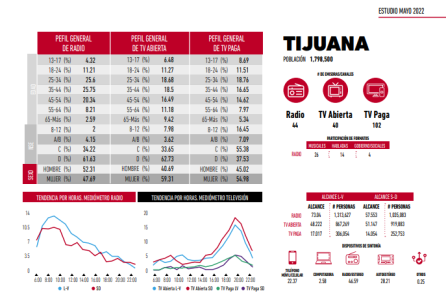
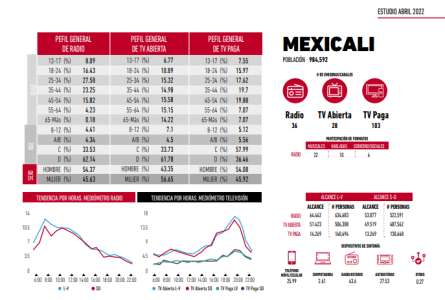
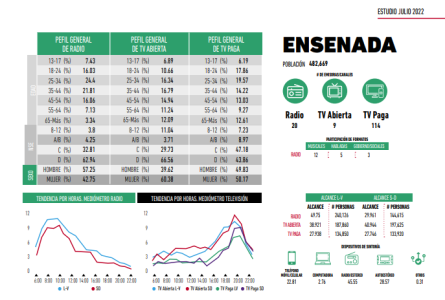
To claify my point, the border regions between Mexico and the USA share a common thread and identity. Having media to tap into that identity and reach listeners (with advertisers that also reach them) from coast to (Gulf) coast sounds worthwhile.No, while Juárez is about 1.5 million or so, El Paso is only about 860,000 and the two are not a huge market.
Reynosa and the several US cities across from that part of NE México are relatively small.
The problem is that Tijuana / Mexicali are so far from the bulk of the population and consumers in Mexico that the economic base has involve dealing with the US dependent maquiladoras (assembly plants that add the value of labor to products then shipped for sale in the US).
Ciudad Juárez is a little closer to Mexican markets, but the other border cities are not particularly large or developed. And all are pretty much controlled by the cartels now and nobody would want to invest there.
Crime, cartels, and other corrupt activity may not make any investment like that worthwhile.
Again, there's always sports betting, or the garden variety hucksters that Mexican border radio is known for. I like your idea of a region-based format like that. Maybe I see more potential for this region driving (and improving) Mexico as a whole. CDMX is a long way from the border.
Not to sound Tim McCarver obvious, but a prosperous Mexico would be a boatload better than the dangerous hot mess that exists now.
Exactly, but I feel that it is already too late, corruption has already crossed the social bases in Mexico and today it is very acute. unfortunatelyNot to sound Tim McCarver obvious, but a prosperous Mexico would be a boatload better than the dangerous hot mess that exists now.
690 is too far from Mexicali to serve that market, no matter what the power or directionality.I think it is time for the XEWW 690 to request a change of pattern, of a directional system and an omnidirectional system, even if it has to reduce power and focus on the Tijuana, San Rosarito and Mexicali area.
91 miles. On the 77 kw day signal, it is quite listenable. Once outside my house in La Quinta, the 690 signal is quite usable and I am in more of their null than Mexicali is.690 is too far from Mexicali to serve that market, no matter what the power or directionality.
Santa Rosa and San Jose are both in the same US market, San Francisco. They are 99 miles apart.
They could, were the "border concept" be viable (very subjective from the offset), do what KOB in Albuquerque did with a synchronized repeater on 690 with something like 1 kw to 2 kw. The same could be done with all the way to Nogales and San Luis Río Colorado (Yuma) if they wanted. 690 is a shared Mexican and Canadian clear channel.
The XEWW null at about 50° is a sympathetic null created by the need to seriously limit the signal at about 130° to protect the primary Mexican station on 690 in Mexico City.
Of course, we are playing Fantasy Radio here... but it is an interesting radio and socioeconomic subject.
It is today. I understand Singapore used to be a rough place too. South Korea used to be a backwater. A lot of Western Europe looked bleak in the 1940s. There's nothing predestined to Mexico being a failed state, like Pakistan.Exactly, but I feel that it is already too late, corruption has already crossed the social bases in Mexico and today it is very acute. unfortunately
Maybe in a car. But is the 690 signal strong enough in Mexicali for indoor listening? See map below from Radio-locator. I know these can be inaccurate. But there are plenty of mountains between Rosarito and Mexicali which reduce conductivity. BTW, the night signal map shows coverage towards Mexicali is almost non-existant.91 miles. On the 77 kw day signal, it is quite listenable.
Attachments
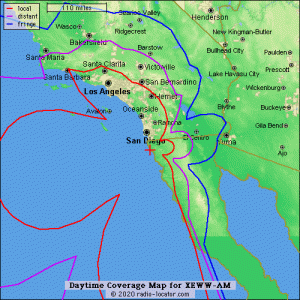
I am speaking theoretically. With a modification of the DA system, they could put a lobe directly East and still be within the border agreement terms and continue to protect Mexico City. But, as I mentioned, the better idea would be a synchronized repeater, such as what XEW's SLP station had in Monterrey for many years.Maybe in a car. But is the 690 signal strong enough in Mexicali for indoor listening? See map below from Radio-locator. I know these can be inaccurate. But there are plenty of mountains between Rosarito and Mexicali which reduce conductivity. BTW, the night signal map shows coverage towards Mexicali is almost non-existant.
Since night use of AM is very limited, rather than redesigning the DA system a repeater makes sense. Remember, the current pattern was designed to cover Los Angeles. 690 is a Mexican channel, so they can likely get considerable relaxation to the East (which had no value in the 50's and 60's).
Synchronized repeaters would probably be the solution, as at night on 690 you can sometimes easily hear CBU Vancouver right underneath XETRA.91 miles. On the 77 kw day signal, it is quite listenable. Once outside my house in La Quinta, the 690 signal is quite usable and I am in more of their null than Mexicali is.
Santa Rosa and San Jose are both in the same US market, San Francisco. They are 99 miles apart.
They could, were the "border concept" be viable (very subjective from the offset), do what KOB in Albuquerque did with a synchronized repeater on 690 with something like 1 kw to 2 kw. The same could be done with all the way to Nogales and San Luis Río Colorado (Yuma) if they wanted. 690 is a shared Mexican and Canadian clear channel.
The XEWW null at about 50° is a sympathetic null created by the need to seriously limit the signal at about 130° to protect the primary Mexican station on 690 in Mexico City.
Of course, we are playing Fantasy Radio here... but it is an interesting radio and socioeconomic subject.
I'm fascinated by the concept of synchronized repeaters on AM. Are any U.S. AM's using one now? If so, do they work well?They could, were the "border concept" be viable (very subjective from the offset), do what KOB in Albuquerque did with a synchronized repeater on 690 with something like 1 kw to 2 kw. The same could be done with all the way to Nogales and San Luis Río Colorado (Yuma) if they wanted. 690 is a shared Mexican and Canadian clear channel.
An earlier post mentioned KKOB Albuquerque has or had one.
CKLW had one in the tunnel between Detroit and Windsor.
If you use a UK based SDR, you might be able to catch some Absolut Radio translators on 1215 kHz. But time may be or may have run out on that.
Speaking of SDR's, I'm tuning into XEWW now. So, does anyone know who is behind what is being played right now and what the future plans actually are?
CKLW had one in the tunnel between Detroit and Windsor.
If you use a UK based SDR, you might be able to catch some Absolut Radio translators on 1215 kHz. But time may be or may have run out on that.
Speaking of SDR's, I'm tuning into XEWW now. So, does anyone know who is behind what is being played right now and what the future plans actually are?
There used to be some on WAPA and WISO in Puerto Rico, but the FCC demanded they be taken down. Blanco Pi had to go on an AM station shopping spree to make up for it, and now has 7 AM stations with FM translators all over the island.I'm fascinated by the concept of synchronized repeaters on AM. Are any U.S. AM's using one now? If so, do they work well?

Published today 1-19-2023
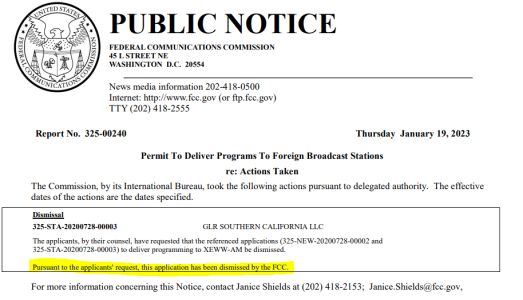
In addition to those and the one for KOB in Albuquerque, there was one in West Palm Beach as well. And "back in the day" WBZ had WBZA to fill for the Boston station in Springfield and WBT in Charlotte had a synchronized facility deep in the WBT night null to the west. But those were licensed stations and counted against the 7 station limits in effect at the time.There used to be some on WAPA and WISO in Puerto Rico, but the FCC demanded they be taken down. Blanco Pi had to go on an AM station shopping spree to make up for it, and now has 7 AM stations with FM translators all over the island.

In addition to those and the one for KOB in Albuquerque, there was one in West Palm Beach as well. And "back in the day" WBZ had WBZA to fill for the Boston station in Springfield and WBT in Charlotte had a synchronized facility deep in the WBT night null to the west. But those were licensed stations and counted against the 7 station limits in effect at the time.
WLLH 1400 in Massachusetts had one but they shut it off and turned in the license
I only hope that the radio has a good future and is not hijacked by Bonilla Valdez as is happening with XEPE-AM 1700 AM
WAPA Ponce PR *had* a syncro in Aguadilla WI3XSO but the FCC pulled the experimental license for it.
- Status
- This thread has been closed due to inactivity. You can create a new thread to discuss this topic.