But it's the President's office, not a briefing room. Their choice.
When he invites the press in, it becomes a mini-briefing room. Other times, they are not allowed in. He doesn't have to allow anyone in. But he does, and he does it because he wants TV coverage. He also answers questions, and he doesn't have to do that either. But he does and they are not filtered or controlled by anyone.
As for the "regular" press conferences and updates, a cross secion of the media should be allowed, and that might require fewer of "the opposition" and more partisans to achieve balance. But the concentration of WaPo, NYT, AP and the Big 3 broadcast TV networks does not any longer represent the sources the majority of Americans use.
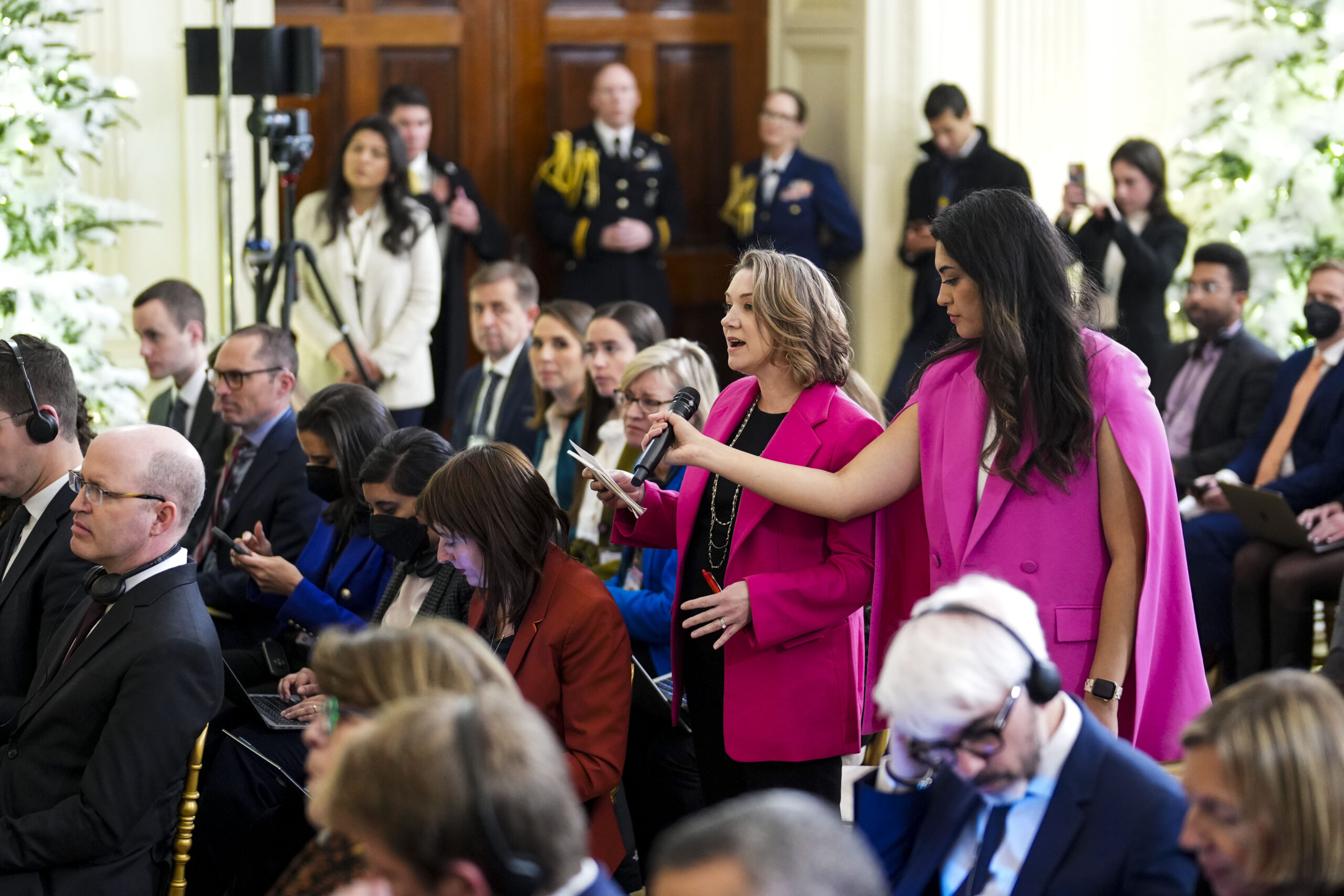
First of all, there are a lot of people in the press room. Once again, I was credentialed white house press, and I didn't work for any of those organizations. I can tell you that there are some local news organizations in that room, not just national media. For over 40 years, Sarah McLendon was in that room. She ran something called McLendon News Service based in Texas. Hearst Newspapers has a reporter in that room. USA Today has a reporter in that room. There are lots of radio reporters, such as ABC News, Salem News, the Christian Science Monitor, and NPR.
The white house press corps is governed by rules set by the white house correspondent's association:

whca.press
If you read the rules, they are not based on ideology. They are based on actual audience figures that must be certified by someone. They are elected by the credentialed members of the media. Very democratic. The association negotiates with the press secretary and communications director. Its all very organized and everyone gets a voice. Coverage isn't based on whether or not you're in the "opposition." But it's a broad range of people from all over the country, and they've all passed FBI background checks and are qualified to be there.
When you say they don't "represent the sources the majority of Americans use," what is your basis for that statement? Would you consider "followers" on X? It might surprise you to know that @CNNBRK is among the top news sites. More followers than Fox News or Breitbart. So when the president criticizes CNN for being "low rated," he's only talking about their prime time talk shows. He's basically using 20th century metrics to judge 21st century media. A lot of the conventional news organizations, such as NBC News, Washington Post, and NYTimes, are in the Top 10 of all internet traffic sites. Up there with Amazon and Google. So if you want to limit coverage to only consensus organizations that most people use, that would eliminate a lot of those right wing influencers who don't have mass numbers.
So who determines who represents the sources the majority of Americans use? It can't be the person they cover. The first amendment very clearly says the government can't "abridge the freedom of the press." So if a reporter says something the government doesn't like, the government can't retaliate against that reporter. This administration wants to control the media. They want to control the narrative. The constitution doesn't give them that right. If they want to control the narrative, perhaps they should do things people say they want, such as keep prices down and protect social security. They aren't doing that, so they're getting criticized. The polls say what the people want, and a lot of the actions being taken by this administration are not popular. The white house thinks they can "fix" the polls by controlling the news. But the American people aren't stupid. They aren't gullible. When he attacks the media, that gives them even more credibility. 60 Minutes is still the top rated TV news show, even though he's suing them. People still watch, and that infuriates him. But the people still watch.
Not only does that mean including Televisa/Univision, Telemundo, and the big alternatives like Fox New and MSNBC, but also the pure web plays I have already mentioned and others. In fact, making room for some of the most influential podcasters or their reporter makes sense now as they reach lots more Americans than the Washington Post does.
Once again, based on what? There are big questions about the metrics used for measuring podcasts. Do you count subscriptions? Do you count downloads? It becomes complicated. The question whca asks is do they cover the news or are they opinion columnists. For example, Joe Rogan isn't a news reporter. He's a personality. If he was to attend a white house press briefing, would he be there to convey the information being presented, or would he be there to be a personality and get video footage that makes him seem important? The rules would allow him to get a temporary pass to get the footage he wants, but he doesn't have to be there every day, as the regular reporters do. This is how David Letterman was able to send people from his show to the press room. There are procedures for anything you can think of.
I am simply saying that the nature of the press has changed, and thinking that AP, CBS, the New York Times and the like represent the news sources of most Americans is just wrong.
You're welcome to your opinion, but unfortunately, it's just an opinion. They may not represent you or your views, but when we talk about consensus news sites, whose job it is to report news, those are among the top sources today. Along with a dozen or so others. What I'm saying is the factors for their inclusion in the media room are based on the documentable size of their audience, and not on their ideology. The current administration is basing a lot of its decisions strictly on ideology, and that's wrong.



 nypost.com