• Get involved.
    We want your input!
    Apply for Membership and join the conversations about everything related to broadcasting.

    After we receive your registration, a moderator will review it. After your registration is approved, you will be permitted to post.
    If you use a disposable or false email address, your registration will be rejected.

    After your membership is approved, please take a minute to tell us a little bit about yourself.
    https://www.radiodiscussions.com/forums/introduce-yourself.1088/

    Thanks in advance and have fun!
    RadioDiscussions Administrators

In a future filled with electric cars, AM radio may be left behind (off-topic)

Except you've removed the original master tape from the equation, eliminating tape hiss and greatly enhancing dynamic range. Yes, you have the limitations of the vinyl and the means of playback, but you had that AND the limitations of tape previously.

Here's a fascinating history: https://www.aes.org/aeshc/pdf/fine_dawn-of-digital.pdf
I think you've missed my point. If you digitize a vinyl recording, you get all the original artifacts - tape hiss and all. Nothing added or subtracted (from the standpoint of the human ear.)

I'm NOT comparing a vinyl record made from a master tape vs. a CD made from the same master tape.

1) Plug a turntable into a computer.
2) Record the vinyl album.
3) Burn a CD of the recording.
4) See if you can tell the difference.
 
Yeah, you don't lay off 18% of your workforce if you're going to stop building cars. That's when you lay off 100%.
The Rivian vehicles are built in Illinois, at a former Chrysler plant.
I’ve seen both the Rivian R1T and R1S around Houston and Austin, and the other day spotted one of the Rivian-built Amazon delivery trucks. So they are slowly making their appearance on the road.

Still keeping my eyes out for a Lucid.
 
I think you've missed my point. If you digitize a vinyl recording, you get all the original artifacts - tape hiss and all. Nothing added or subtracted (from the standpoint of the human ear.)

I'm NOT comparing a vinyl record made from a master tape vs. a CD made from the same master tape.

1) Plug a turntable into a computer.
2) Record the vinyl album.
3) Burn a CD of the recording.
4) See if you can tell the difference.

Hey, this was what I was replying to:

Vintage vinyl records weren't recorded digitally!
 
So, the narrow frequency response, distortion/limiting and noise is preferred? Is that a nostalgic view? Or are you mostly just a fan of the limited content available on AM?

And yet you prefer AM stations? Seriously?
Well, it's a mix of nostalgia (I had the rare pleasure of growing up with AM in the late 90s and early 2000s, before most of the local music stations flipped to talk and religious programming) and, well, the fact that I'll take a program with a narrow frequency response, distortion and noise that doesn't have squirrelies over a crisp, clean digital one that uses low bitrate MP3.

I'm not fond of the limited programming, of course, but between KCBS for news, and KVIN and KYNO for music (and of course my own part 15 project), it's good enough.

FM is good too, of course. I just wish it had oldies (from my perspective, the 80s don't count as oldies, although I suppose technically they are at this point).

And let's face it, playback is a HUGE variable in vinyl. Just tripped over this channel yesterday---a guy with a $12,000+ turntable posting entire albums:

https://www.youtube.com/@hiresvinyl
That's impressive!

I've been wanting one of those laser turntables from Japan, which are better than all than the best conventional turntables because it uses lasers to read the groove instead of a stylus, which is said to produce essentially flawless playback of the record, but those sell for rarefied prices, so unless I get extremely lucky, I'll likely never own one.

c
 
Last edited:
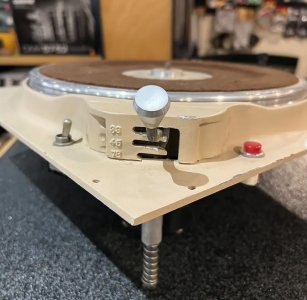
By the end of the 60's and during most of the 70's we used those turntables with the recessed area for 45's. They were in the $400 range. Tonearms were $100 and up. Semi-pro Technics were up to nearly $1000 each.

Often we would keep a spare shell with cartridge in the studio in case one of them got damage in use... keeping in mind that the better cartridges did not particularly like being cued by turning the turntable backwards.

View attachment 4643
View attachment 4644
View attachment 4645

I worked in a few studios (including my first) with those old QRKs. Those suckers were made of cast iron:

Screenshot 2023-04-05 at 8.21.26 AM.jpg
 
Cast aluminum, but cast none the less.
And you could buy replacement felts in a variety of colors... maybe to match the colored pot knob inserts on your Gates Yard board.
 
IIRC....those QRKs had a sort of "speed adjustment' screw next to the number on the speed adjust lever.....
You could "SLIGHTLY adjust speed......but if you overdid it, the torque on the 'table went away....and you could stall it out with your pinky!!!!:(
Had to love those idler-drive platters!!!! The Gates 16" transcription 'tables were a trip in themselves....!!!!;)
How many actually resorted to SANDPAPER trying to smooth out a "flat" on an idler pulley wheel????!!
Ahhh.....the "good ol' daze......!!!"
 
IIRC....those QRKs had a sort of "speed adjustment' screw next to the number on the speed adjust lever.....
You could "SLIGHTLY adjust speed......but if you overdid it, the torque on the 'table went away....and you could stall it out with your pinky!!!!
That was tension adjusting and did not affect speed, but it made slip cuing easier or harder.
 
Rumble master! :cool:
One-inch layer of foam in between the lip of the turnable and the opening in the cabinet where the turntable was housed.

BUT---if your processing was cranked enough---it got through. There are actually a couple of old KHJ airchecks where you can hear it.
 
One-inch layer of foam in between the lip of the turnable and the opening in the cabinet where the turntable was housed.

BUT---if your processing was cranked enough---it got through. There are actually a couple of old KHJ airchecks where you can hear it.
Many times the 'rumble' was caused by leaving the rubber idler wheel engaged with the motor shaft but the motor turned off. Over time that puts dents in the rubber idler wheel that translate into rumble as the motor shaft hits the dents in the idler wheel.
That's why a lot of engineers back in the day, used to put signs/labels on the turntables to "take turntable out of gear when not in use".
The other related cause of rumble, was when the rubber idler would get dried out due to age, causing hard and soft spots, or cracking in the rubber wheel. If one climbed under one of these things while they were running, you could tell by the spring that puts pressure to hold the idler wheel against the motor shaft would stretch and retract rapidly as the motor/idler wheel spun.
 
Many times the 'rumble' was caused by leaving the rubber idler wheel engaged with the motor shaft but the motor turned off. Over time that puts dents in the rubber idler wheel that translate into rumble as the motor shaft hits the dents in the idler wheel.
That's why a lot of engineers back in the day, used to put signs/labels on the turntables to "take turntable out of gear when not in use".
That was also good advice because it forced you to select a speed each time you played a record.

I may have told this story here before (after 20 years, it's all a blur), but at my first station (KIBS in Bishop, California) we signed off every night at 10:00 pm. We (meaning me and a few other teenage DJs, varying from night to night) played Top 40 music, mostly on 45s, and then, just before the sign-off and national anthem on tape cartridge, played a religious minute called "Be Still...and Know."

"Be Still...and Know" was sent to us on 33 1/3 RPM albums...once a month, with the same number of tracks as there were days in a month, so you'd get a new devotional each night.

The show began with this basso profound voice (The Almighty hisownself?) intoning..."Be still... and know."

But after three hours of playing the hits on 45s, I'd often forget to change the turntable speed, so you'd hear a chipmunk say "Be still......" and as I hurriedly shifted the lever from 45 to 33 during the pause a slightly off-key...."....and know."
 
Last edited:
That was also good advice because it forced you to select a speed each time you played a record.
I remember the debates from back in the day; was whether to 'slip-start' the record relying on the felt while allowing the platter to spin under the record, then releasing it, verses using the motor start switch after having 'back-cued' the record something like 1/4 turn for a 33-1/3 or half turn for a 45. Having been the young kid working in production carting spots and music, I'd occasionally get an album or 45 that had been damaged from being played via slip cue, or worse, when someone would groove-burn the start of a cut by cuing the record back and forth too quickly, damaging the first few grooves.
It would be a common sight to watch me muttering on the way out of the Production Control Room: G#d&ammit! Someone ruined this copy too! Sometimes I'd have to run across town to Tower Records to pick up a clean, undamaged copy for carting.
 
It would be a common sight to watch me muttering on the way out of the Production Control Room: G#d&ammit! Someone ruined this copy too! Sometimes I'd have to run across town to Tower Records to pick up a clean, undamaged copy for carting.
I think in the box of 45's I still have, there's a few cue-burned selections in there.
 
I think in the box of 45's I still have, there's a few cue-burned selections in there.
Can't recall the exact era, but believe toward the end of the 70's, it was common to find 45 singles made with recycled. or poorer quality vinyl. If you had one of those it would cue/back-burn the first time you cued the track, no matter how slowly and carefully you rotated in backwards.
I remember when a record promoter was in the building, I mentioned that if you keep sending us sh*tty vinyl singles, it's going to significantly delay getting your singles on the air.
 
Can't recall the exact era, but believe toward the end of the 70's, it was common to find 45 singles made with recycled. or poorer quality vinyl. If you had one of those it would cue/back-burn the first time you cued the track, no matter how slowly and carefully you rotated in backwards.
I remember when a record promoter was in the building, I mentioned that if you keep sending us sh*tty vinyl singles, it's going to significantly delay getting your singles on the air.
I think during the energy crisis in the early 70s LPs had a lot of recycled vinyl in them, and one apparently could see the swirling in some of the records -- some record co's having more of it than others. Or so I have heard.
 
I think during the energy crisis in the early 70s LPs had a lot of recycled vinyl in them, and one apparently could see the swirling in some of the records -- some record co's having more of it than others. Or so I have heard.
MCA was one of the worst offenders in this. A year or two after its release (so...'74 or '75), I asked for a duplicate copy of Elton John's GOODBYE YELLOW BRICK ROAD album (I think we were adding "Harmony" before it was released as the B-side to "Pinball Wizard"). It took five tries to get a good one. The fourth actually had bits of label from whatever vinyl they'd recycled in the grooves of the album.
 
Status
This thread has been closed due to inactivity. You can create a new thread to discuss this topic.


Back
Top Bottom